Fewer than half of the sexual assault kits held in the custody of the Prichard Police Department have ever been processed, the Mobile County Sheriff’s Office disclosed, a revelation that raises the possibility that dozens of criminal cases went nowhere because the evidence that could have advanced them was never tested.
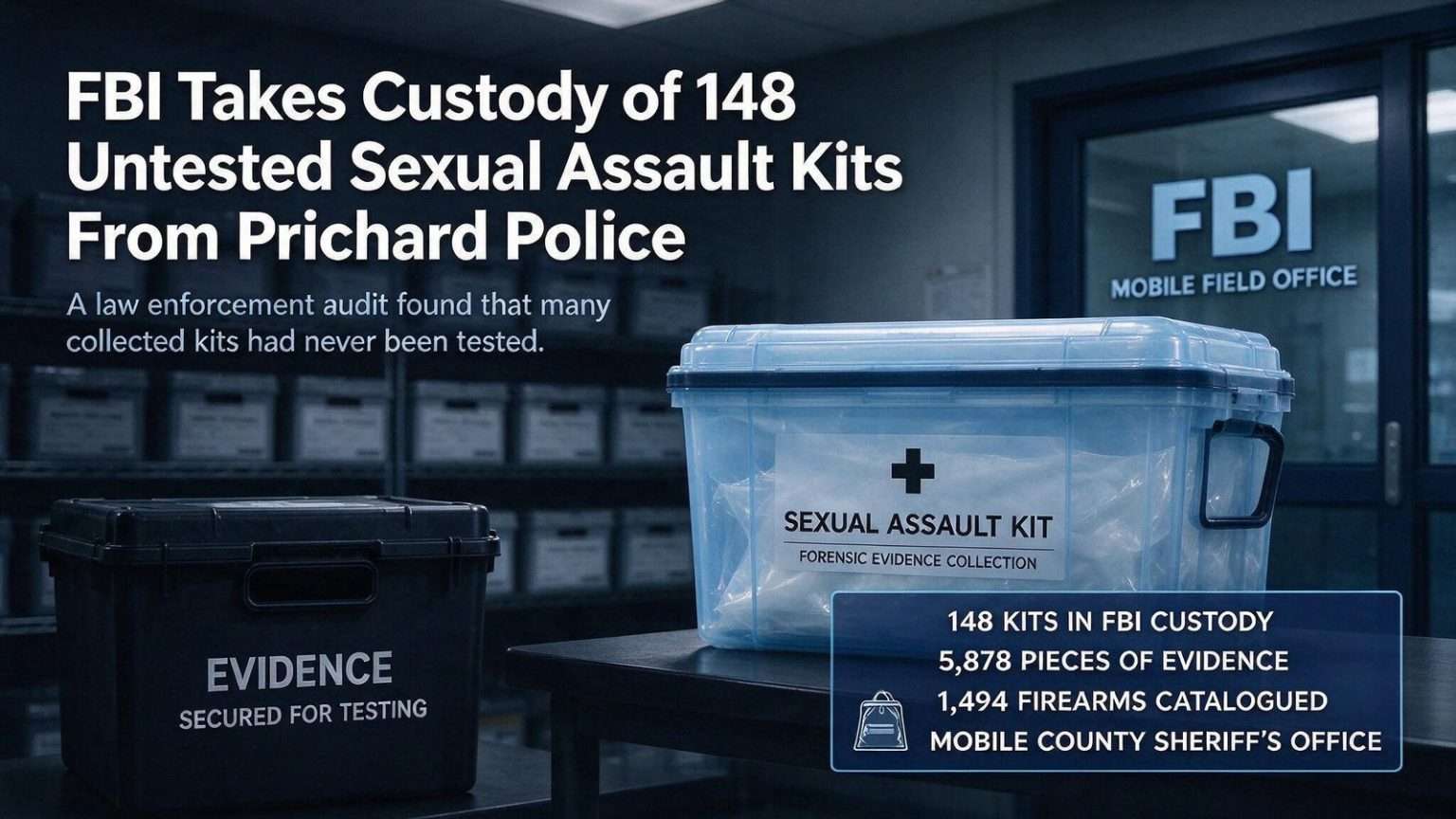
Of 247 collected sexual assault kits, only 99 have been processed and reviewed by the Alabama Department of Forensic Sciences. The remaining 148 are now being expedited. The Federal Bureau of Investigation has taken custody of those kits and is working to process them.
What a Sexual Assault Kit Actually Is
For readers unfamiliar with the terminology, a sexual assault kit, sometimes called a rape kit, is the physical evidence collected from a victim during a forensic medical examination conducted after an assault. The exam is invasive, often lengthy and emotionally difficult, and it is undertaken specifically so that biological evidence can be preserved for investigators.
When those kits are tested, the DNA profiles they yield can be entered into national databases, potentially identifying an unknown assailant or connecting a series of assaults to a single perpetrator. When they sit untested on a shelf, none of that happens. The victim endured the examination, and the evidence produced no investigative value whatsoever.
That is why untested kit backlogs have become a national issue over the past two decades, and why jurisdictions across the country have moved to audit and clear them.
The Sheriff’s Response
Mobile County Sheriff Paul Burch framed the disclosure as a step toward correcting a failure rather than an attempt to minimize it.
“This is about accountability and ensuring every victim’s case receives the attention it deserves,” Burch said. “By identifying every kit, securing the evidence, and partnering with the FBI to complete the testing, we are taking an important step toward seeking justice for victims and strengthening the integrity of these investigations.”
In a statement, the Sheriff’s Office said that as forensic testing is completed and results return, investigators will evaluate each case individually and determine the appropriate investigative and prosecutorial steps based on the evidence and applicable law.
“The Sheriff’s Office is committed to ensuring these cases receive the thorough attention they deserve and that every effort is made to pursue justice for victims,” the statement said.
An Enormous Evidence Inventory
The kits are only a fraction of what has surfaced. According to the Sheriff’s Office, 5,878 pieces of evidence have been gathered so far in the review of the Prichard Police Department. That inventory includes the sexual assault kits and roughly 1,494 firearms.
- 247 sexual assault kits identified in departmental custody
- 99 previously processed by state forensic scientists
- 148 now in FBI custody and being expedited
- 1,494 firearms catalogued during the evidence review
- 5,878 total pieces of evidence accounted for
The Corruption Investigation Behind It
The audit emerged from a corruption investigation into the Prichard Police Department, spearheaded by the FBI’s Mobile Field Office in partnership with local law enforcement agencies.
Two Prichard officers have been arrested so far. Officer Emanuel Naman Dotch was taken into custody in June. Officer Jihad Hasan Irby was arrested in connection with crimes Dotch is accused of committing, which include bribery, evidence tampering and civil rights violations.
The evidence-tampering allegation is significant in this context. When the integrity of a department’s evidence room is called into question, every case that depended on evidence stored there becomes vulnerable to challenge, and every untested item becomes a potential liability.
The Mobile County Sheriff’s Office has assumed control of day-to-day operations at the Prichard Police Department while the investigation proceeds.
What Happens to the Cases
Testing a backlogged kit does not automatically produce a prosecution. Some cases will have passed the statute of limitations. Some victims may be unreachable or may decline to participate in a renewed investigation. In other cases, the identity of the assailant was never in dispute and the kit’s results add little.
But in a meaningful number of cases nationally, backlog testing has identified serial offenders whose crimes escalated while their earlier kits sat in storage. Such reviews have also, in some cases, helped exonerate people who were wrongly accused. That is the outcome investigators will be watching for as results begin returning from the FBI.
The Sheriff’s Office has not said how long the FBI testing will take or how many of the 148 kits involve cases still within a statute of limitations. Victims whose kits were collected years ago may be contacted by investigators as the review proceeds, and anyone with information relevant to the investigation can contact the Mobile County Sheriff’s Office.
For the residents of Prichard, the number that matters most is the simplest one. For years, 148 people submitted to a forensic examination believing it would help. It did not, until now.