Every Baldwin County Student Eats Free Again Next Year — and Parents Don’t Have to Fill Out a Thing
Baldwin County Public Schools will again serve breakfast and lunch at no charge to every enrolled student in 2026-2027 through the USDA's Community Eligibility Provision. No application is required.
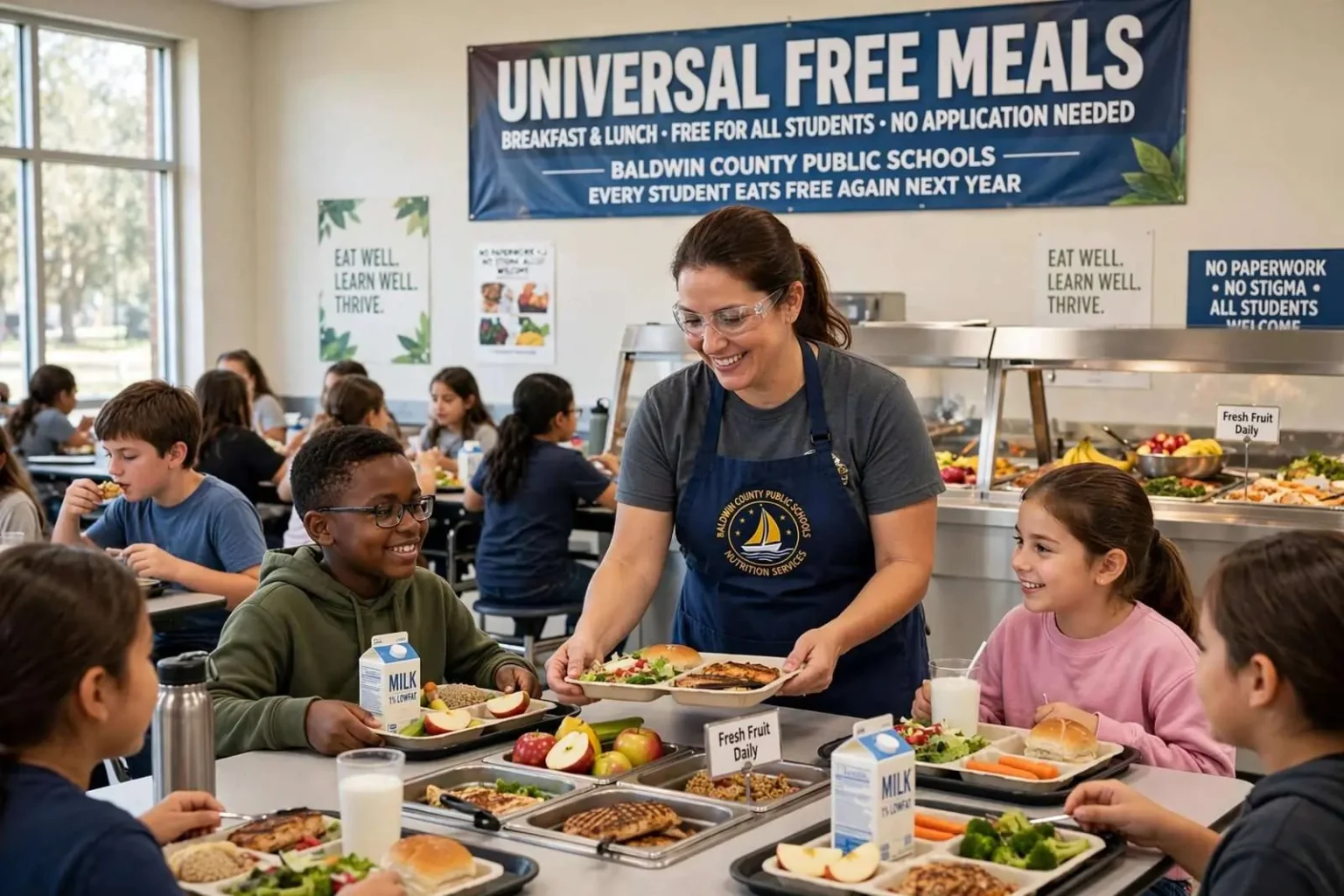
Every Baldwin County student will eat free again next year, the Baldwin County Board of Education has announced, extending a universal free meals program that has made breakfast and lunch available to all students regardless of household income. The decision continues a multi-year effort by the district to address food insecurity and to remove the stigma that can be associated with free and reduced-price meals.
How Universal Free Meals Work
The universal free meals program allows every student in the district to receive a breakfast and a lunch at no cost to the student’s family, regardless of the household’s income. The program is funded through a combination of federal reimbursement under the Community Eligibility Provision, state contributions and local funds that the district uses to fill any gaps.
For families, the program means they do not have to complete the paperwork that typically accompanies free and reduced-price meal applications, and their children do not have to identify themselves as low-income when they go through the lunch line. For the district, the program reduces administrative overhead, speeds up the lunch line and ensures that every student has access to at least two meals during the school day.
Why the District Did This
Baldwin County’s decision to participate in the universal free meals program reflects the district’s commitment to addressing food insecurity among its students, many of whom live in households where access to adequate nutrition is not guaranteed. School meals are an important source of nutrition for many children, and the universal program ensures that no student goes hungry during the school day because of the family’s financial circumstances.
The district has also framed the program as a way to support academic performance. Research has consistently linked nutrition to school attendance, classroom behavior and academic outcomes, and the universal program removes one of the barriers that can prevent students from being ready to learn when they arrive in the classroom each morning.
How Many Students It Affects
Baldwin County Public Schools serves more than 30,000 students across dozens of schools, and the universal free meals program covers all of them. The number of students who would have qualified for free or reduced-price meals under the traditional income-based criteria is a significant share of the district’s enrollment, and the universal program extends meal access to students whose families might not have qualified for assistance under the traditional rules.
For schools in higher-poverty areas of the county, the program has been particularly meaningful. Schools that previously had to manage the logistics of free, reduced-price and full-price meal service have seen their cafeterias operate more efficiently since the universal program began, and the elimination of meal charges has reduced the administrative burden on school staff who previously had to track payments and chase down unpaid meal accounts.
How the Program Is Funded
The Community Eligibility Provision, which is the federal mechanism that allows schools to offer universal free meals, requires that a certain percentage of students at a participating school be identified as eligible for free meals through means other than the household income application. Schools that meet that threshold can offer meals to all students and receive federal reimbursement based on the percentage of students who would otherwise qualify.
For Baldwin County, the combination of the federal reimbursement and the district’s own investment in the program has been sufficient to cover the cost of offering universal free meals. The district has worked to make sure that the program is financially sustainable, and the board’s decision to continue it reflects confidence in the funding model.
What Parents Need to Know
For parents, the most important thing to know is that their children can receive breakfast and lunch at school at no cost, regardless of the family’s income. There is no application to complete, no fee to pay and no stigma associated with participating. The program applies to every school in the district, including the new campuses that have come online as the county’s enrollment has grown.
Parents who want more information about the meals offered, including menus and nutritional information, can find it on the district’s website and through the schools’ regular communication channels. The district also accommodates special dietary needs for students with allergies or medical conditions, and parents should contact their child’s school to make arrangements.
What Comes Next
The board’s decision to extend the program for another year gives the district time to plan for the long-term sustainability of universal free meals. Federal policy around the Community Eligibility Provision can change, and the district will continue to monitor the rules and reimbursement rates to make sure the program remains viable.
For now, the program is one of the more visible examples of how Baldwin County Public Schools has responded to the food insecurity challenges that affect many of its students. The board’s commitment to continuing the program reflects both the immediate impact on students and the longer-term benefits to the district’s academic mission.
What Food Insecurity Looks Like in Baldwin County
Food insecurity is a real and persistent challenge in many parts of Baldwin County, including both the rural communities in the northern part of the county and the working-class neighborhoods closer to the coast. The district’s universal free meals program is designed to address that challenge head-on, ensuring that students who might otherwise go without a reliable midday meal have access to the nutrition they need to learn and grow.
Food insecurity affects students in ways that go beyond hunger. Children who do not have reliable access to nutritious food are more likely to struggle with attention in class, more likely to have behavioral issues and more likely to be absent from school. The universal free meals program addresses those downstream effects by ensuring that the meal gap is closed before it can affect students’ classroom performance.
How Other Districts Compare
Baldwin County’s universal free meals program is one of a growing number of similar programs in school districts across Alabama and the broader Southeast. Several Alabama districts have adopted universal free meals in recent years, often using a mix of federal reimbursement and local funds to make the program work financially. The trend reflects both the availability of federal funding under the Community Eligibility Provision and the willingness of school boards to invest in programs that address food insecurity.
For districts that have not yet adopted universal free meals, Baldwin County’s experience offers a useful model. The district has demonstrated that the program can be sustained over multiple years, that it produces meaningful benefits for students, and that the administrative challenges of running the program are manageable. That kind of demonstration is what tends to encourage other districts to consider similar programs.
What the District’s Food Service Operation Looks Like
Running a universal free meals program requires significant logistical capacity, and Baldwin County Public Schools has invested in the food service infrastructure needed to make the program work. The district’s nutrition services department operates centralized kitchens that prepare meals for distribution to schools across the county, and the staff who run the program have worked to develop menus that meet federal nutrition standards while also appealing to students.
The district also works with local farmers and food producers where possible, sourcing ingredients from within Alabama and the surrounding region. That approach supports the local agricultural economy while also ensuring that the meals served to students are fresh and familiar.
How the Community Can Support the Program
While the universal free meals program is funded primarily through federal and district resources, community support can help the program go further. Local businesses, civic organizations and individuals can contribute through donations to the district’s nutrition services department, and volunteers can help with special events and taste-testing opportunities that give students a voice in what they eat.
The district has also worked with local nonprofits and faith-based organizations to address food insecurity outside of school hours, recognizing that the universal meals program is most effective when it is part of a broader community effort to ensure that children have reliable access to nutrition.
What Teachers Are Saying
Teachers across Baldwin County have reported that the universal free meals program has produced noticeable changes in their classrooms. Students who previously arrived hungry or whose families struggled to afford lunch are now eating regularly without the administrative or social friction that came with the traditional free and reduced-price meal application process. That shift has been particularly meaningful in classrooms where teachers previously spent instructional time managing meal-related logistics.
How the Numbers Compare to Last Year
The district has tracked participation in the meals program closely, and the universal approach has produced higher participation rates than the traditional income-based eligibility system. That higher participation has translated into more meals served per day, more revenue to the district’s food service operation and more students receiving the nutrition they need during the school day. The district has signaled that the continued success of the program is part of why the board voted to extend it for another year.