Shrimp Festival Organizers Warn of Fake Vendor Emails Circulating in Gulf Shores
Fraudulent emails offering vendor spots at the 53rd Annual National Shrimp Festival in Gulf Shores are circulating. Applications closed April 24 and will not reopen until February 2027.
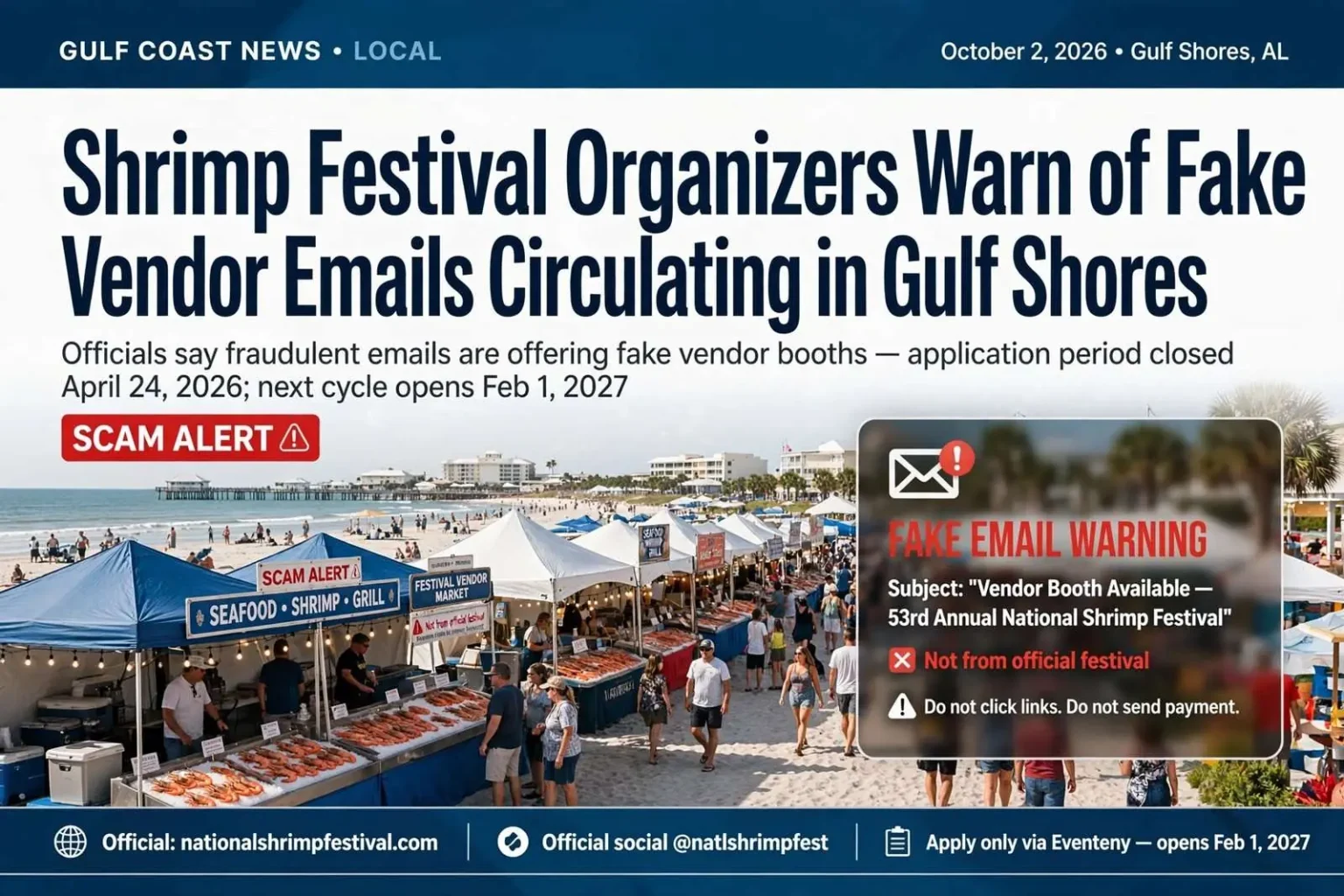
Anyone who receives an email offering a vendor booth at this year’s National Shrimp Festival should delete it. Festival organizers have issued a public warning that fraudulent messages are circulating, purporting to offer vendor opportunities at the 53rd Annual National Shrimp Festival in Gulf Shores. The offers are not real.
The reason the scam is easy to identify, once you know the calendar, is simple: there are no vendor spots to offer. The application period for the 53rd annual festival closed on April 24, 2026. It will not reopen until February 1, 2027. Any email arriving now that claims to have a booth available is, by definition, not coming from the festival.
Why Vendors Are a Target
Event vendor fraud has grown into a recognizable category of scam in recent years, and large regional festivals are prime hunting grounds. The logic is straightforward from a fraudster’s perspective. Vendors are small business owners who genuinely want a spot at a lucrative event. Booth fees are a normal, expected cost, so a request for payment does not immediately raise suspicion. And competition for space at a well-known festival is fierce enough that an unsolicited offer feels like good fortune rather than a red flag.
Scammers borrow the name and imagery of a legitimate festival to give their message credibility. The email may reference the correct festival name, the correct year, even the correct location. What it will do next is ask for a payment, a deposit, or personal and financial information, delivered through a channel the real organizers never use.
The Only Legitimate Channels
Festival officials have been explicit about where authentic information comes from. There are exactly three trusted sources:
The official National Shrimp Festival website.
The festival’s official social media channels.
The festival’s Eventeny page, which handles the actual vendor application process.
Organizers stated plainly that they do not reach out to prospective vendors through unofficial channels and will not send unsolicited email offers. If a message did not originate from one of those three places, it did not originate from the festival.
What to Do If You Receive One
The guidance from organizers is standard but worth restating, because scam emails are engineered to create urgency and short-circuit careful thinking.
Do not click any links in the message. Links may lead to spoofed payment pages or install malicious software.
Do not provide personal or financial information, including banking details, card numbers or business tax identifiers.
Verify independently. Open a browser and navigate to the festival’s official website directly rather than following any link in the email.
Report the message to local authorities so that patterns can be tracked.
Small business owners who have already responded to such an email and shared banking information should contact their financial institution immediately.
About the Festival Itself
The National Shrimp Festival is held every fall in Gulf Shores and stands among the largest festivals anywhere on the Gulf Coast. It draws hundreds of vendors and many thousands of visitors to the public beach area, and for participating businesses it can represent a meaningful share of an entire year’s revenue. That economic weight is precisely what makes the vendor list valuable to impersonate.
For legitimate vendors, the practical takeaway is a date to circle: February 1, 2027. That is when the application window opens for the next cycle, and it will open on the festival’s own platforms, not in anyone’s inbox.
A Broader Caution for Coastal Alabama
Gulf Shores and Orange Beach host a dense calendar of festivals, tournaments and markets across the year, each with its own vendor roster. The pattern that has emerged here is likely to repeat elsewhere. Organizers of any Baldwin County event with a public vendor application process would do well to publish their official channels clearly, and vendors would do well to bookmark them.
Festival officials said protecting participants from fraud remains a priority for the organizing team, and they encouraged anyone with a suspicious message to verify it directly rather than assume it is genuine.
How to Protect a Small Business Year-Round
The shrimp festival scam is one example of a wider pattern in which criminals impersonate beloved local institutions to extract money from small operators. The same playbook shows up around craft fairs, food truck rallies, holiday markets and charity runs across the Gulf Coast. The common thread is urgency: a message that demands payment or information quickly, before the recipient has time to check the facts.
Business owners can lower their risk with a few simple habits. Bookmark the official application pages for the events they care about, so any offer can be checked against a known-good source. Treat any unsolicited message that asks for a deposit as suspect until verified by phone through a number found on the official site. And never reuse the same password or banking credentials across vendor portals, so that a single compromised inbox cannot expose every event the business participates in.
Why the Festival Draws This Attention
The National Shrimp Festival’s size is the root of its appeal to scammers. With hundreds of vendors and tens of thousands of attendees, a single successful fake-booth scam can net a fraudster many payments before anyone notices. The festival’s reputation also lends borrowed trust: a message bearing its name and logo reads as official even when it is anything but.
That is why the organizing team’s public warning matters as much as the event itself. By stating plainly, in advance, that it will never send unsolicited vendor offers, the festival gives every business owner a simple test to apply to any message that lands in their inbox.
The Takeaway for the Community
For residents and visitors, the scam is a reminder that the Gulf Coast’s event calendar is both a point of local pride and, increasingly, a target for those who exploit it. The healthy response is not to distrust the festivals but to rely on their official channels. When in doubt, close the email and open the browser yourself. The real organizers will be exactly where they have always been.
The National Shrimp Festival has been a fixture of Gulf Shores’ fall calendar for more than five decades, and the warning about fake vendor offers is the kind of consumer protection the festival’s organizers now provide each year as the event approaches. Vendors who respect that process and apply through the official channels will continue to find a place at the festival, and scammers looking for an easy mark will continue to find an organized, attentive community of business owners who know better than to wire money on the strength of an unsolicited email.
The Scale of the National Shrimp Festival
The National Shrimp Festival is one of the larger events of its kind on the Gulf Coast and a signature weekend for the city of Gulf Shores. Each fall, the public beach area at Gulf Shores hosts hundreds of vendors, tens of thousands of visitors and a long list of musical acts, food booths and art displays. The festival runs over a long October weekend and is, for many small businesses along the Gulf Coast, the most lucrative single weekend of the year. That kind of economic weight is precisely what attracts scam artists looking to capitalize on vendors who do not yet know their way around the festival’s application process.
For vendors who are new to the festival or considering their first application, the smartest move is to start at the festival’s official website rather than wait for an email or social-media pitch. The 2027 vendor cycle opens February 1, 2027, on the festival’s Eventeny page, which is the platform the organizing committee uses for booth assignments, payment processing and the applicant queue. Vendors who wait for the festival to email them will wait forever; the festival does not solicit vendors directly.
How Fraudsters Mimic Trusted Brands
The mechanics of a vendor scam are simple enough that any business owner who knows what to look for can recognize them. A scammer sends an email that mimics the festival’s branding, references the correct dates and locations, and offers a vendor booth that the recipient did not apply for. The email creates urgency, often by claiming limited availability or a deadline, and asks for a deposit or banking information to lock in the booth.
Because the festival is real, well-known and has a public application process, the scam works in part because it does not seem far-fetched. The recipient has heard of the National Shrimp Festival. The recipient may even have planned to apply. The timing of the email, arriving after the official deadline closed, is the giveaway, and festival organizers have leaned into that signal in their public warning: if the application window is closed, no legitimate offer of a booth can arrive in your inbox.
What to Tell Other Vendors in Your Network
For vendors who receive the fraudulent email, the most useful thing they can do is warn the rest of their professional network. Small-business owners along the Gulf Coast often share information about festivals, tournaments and markets through informal channels, and the same networks that pass along good information about an event’s application timeline can pass along warnings about scams. A quick phone call to a fellow vendor can save another business hundreds or thousands of dollars and the headache of trying to claw back money sent to a fraudulent account.
The festival’s official social media channels are also worth following year-round, not just during application season. Festival organizers post updates about deadlines, waitlists and other operational changes through those channels, and the same accounts that publish legitimate updates will often also publish scam warnings when fraudulent activity surfaces. For vendors who want a single source of truth about the festival’s calendar, those channels are the place to start.