Gulf Shores Mayor Says the New One-Way Bridge Gets People In, but Not Out
Mayor Robert Craft says the new Intracoastal Waterway bridge is working as an inbound route but has left most of the island with a single realistic way off, and he wants the one-way pattern reversed.
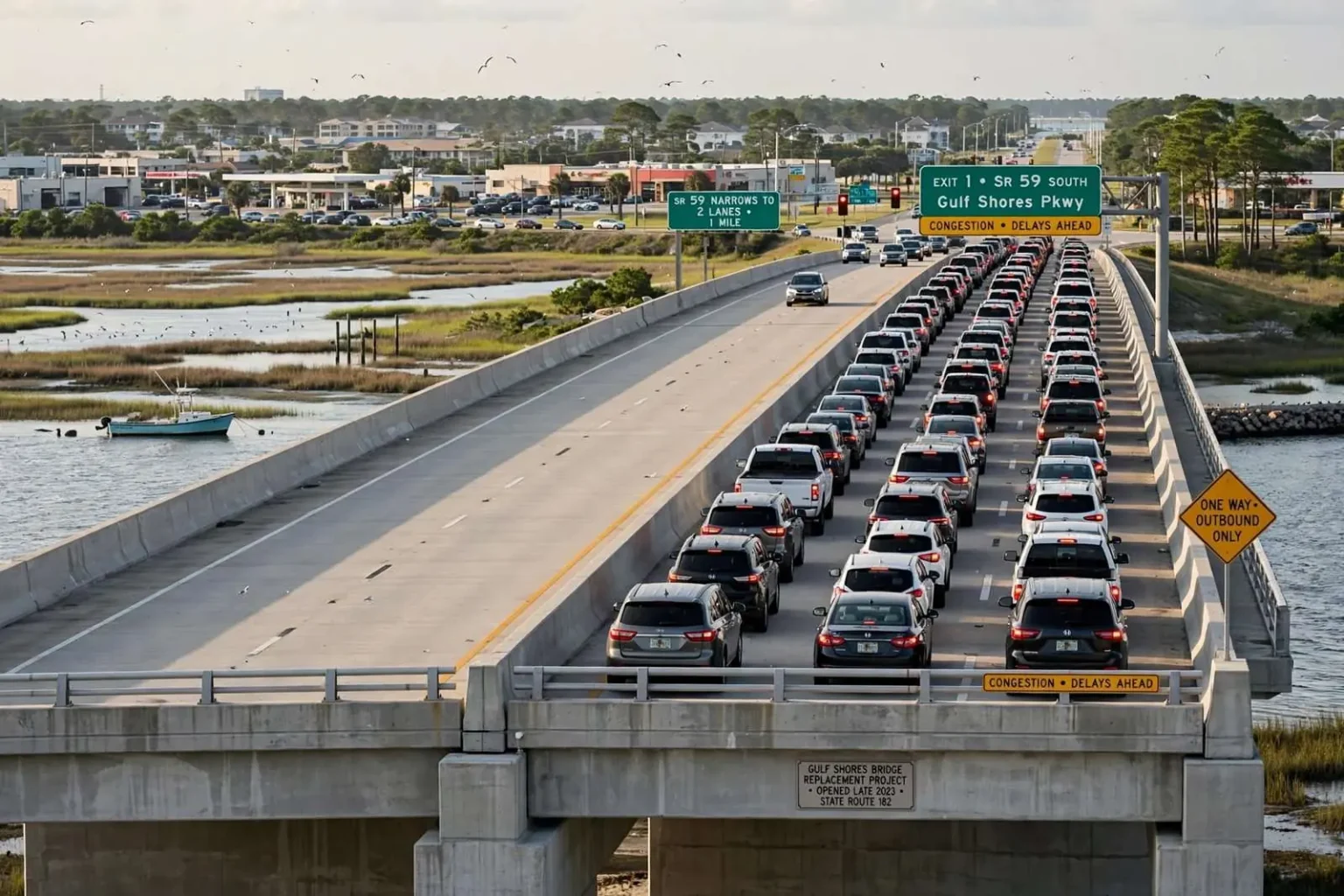
Gulf Shores Mayor Robert Craft used a recent council meeting to make a blunt observation about the city’s new one-way bridge over the Intracoastal Waterway: it moves people onto the barrier island quickly, but it does not move them back off nearly as well, a complaint residents and visitors have voiced since the bridge opened in late 2023.
The bridge, formally the Gulf Shores Bridge Replacement Project along State Route 182, replaced the older two-lane drawbridge that had connected the city’s beach peninsula to the mainland for decades. The new structure is wider and taller, with a fixed span that eliminates the openings that used to back up traffic on summer weekends. But the bridge’s design also consolidates traffic onto fewer approach lanes on the mainland side, and that consolidation is producing the very congestion the new bridge was supposed to relieve.
What the mayor said
Craft said the city has been tracking traffic counts since the bridge opened and that the data confirms what residents have been reporting anecdotally. Inbound traffic flows reasonably well during the morning peak. Outbound traffic, particularly on weekend afternoons and on the days immediately after major events, slows to a crawl and sometimes stops entirely. The mayor said the situation is unlikely to improve without infrastructure changes on the mainland side.
The bottleneck is not the bridge itself, Craft said, but the road network that feeds into the bridge’s western approach. State Route 59, also known as the Gulf Shores Parkway, narrows from four lanes to two in the area just north of the bridge, and the traffic signal at the intersection with the bridge’s approach ramp is not synchronized with the signals farther north. The result is that cars can flow across the bridge in a steady stream and then back up at the first major intersection they encounter.
What ALDOT is doing
The Alabama Department of Transportation has been working with the city on a series of smaller fixes, including signal retiming and the addition of turn lanes at the bottleneck intersection. A larger widening project along Route 59 has been on the state’s long-range plan for several years but has not been funded for construction. The mayor said the city will press for the project to move into the state’s five-year work program.
Beyond the highway work, the city is also looking at secondary access points onto and off the peninsula. The existing road network offers only a few options for crossing the Intracoastal Waterway, and the new bridge carries the vast majority of the traffic. A second crossing has been discussed for years but would require a substantial investment and coordination with the U.S. Army Corps of Engineers, which maintains the waterway.
What visitors should know
For visitors planning trips to Gulf Shores, the practical advice from city officials is to time arrivals and departures outside the peak windows. Inbound traffic is heaviest between 9 a.m. and 1 p.m. on Saturdays during the summer, and outbound traffic is heaviest between 3 p.m. and 7 p.m. on Sundays. Travelers who can shift their schedules by even an hour or two can avoid the worst of the backups.
The city has also added real-time traffic cameras along the main corridors and publishes the feeds on its website. Visitors can check the cameras before deciding which route to take onto the peninsula and which route to use when leaving. The cameras have become one of the more popular features on the city’s tourism website, with usage spiking during major events and holiday weekends.
What residents say
Residents who live on the peninsula have been the most vocal about the bottleneck. Many say the backups have grown worse over the last year, in part because the city’s population and visitation have continued to climb. Several homeowners associations have asked the council to push harder for the highway widening and to consider a temporary fix, such as a contraflow lane configuration, during the worst weekends.
Local businesses have been caught in the middle. Restaurants report that patrons who arrive late for reservations blame the bridge backups, even when the actual cause was a slower kitchen. Hotels report more complaints about outbound travel times than about the rooms themselves. The mayor said the bridge has been a net positive for the city but that the failures on the exit side need to be addressed before the next major summer season.
The economic stakes
Gulf Shores’ economy depends on the free flow of visitors across the bridge. The city’s tourism office estimates that day-trippers and short-stay visitors account for a significant share of the restaurant and retail sales generated during the summer. Anything that discourages repeat visits or that extends travel times on departure can erode the visitor experience in ways that show up in the next season’s bookings.
City officials have said the bridge is a generational investment that will serve the city well for decades, but the access on either end has to keep pace with the bridge’s capacity. That work is now the focus of the next phase of planning, and the council is expected to take up a formal resolution asking ALDOT to accelerate the Route 59 widening project.
What other coastal cities have learned
The Gulf Shores situation mirrors challenges that other coastal communities have faced as their bridge infrastructure has been modernized. Pensacola Beach dealt with similar traffic issues after a new bridge replaced its older span in the early 2000s, and the city worked with Escambia County and the Florida Department of Transportation on a series of traffic-management improvements that eventually eased the worst of the bottlenecks. Orange Beach, just to the east of Gulf Shores, has its own set of access issues tied to the cotton bridge over Wolf Bay.
Each coastal city has had to find its own balance between preserving the small-town character of its beach community and accommodating the volume of visitors that the modern tourism economy demands. Gulf Shores’ mayor has indicated that the city will continue to advocate for the highway improvements and that he expects the traffic situation to improve as those improvements come online.
The bridge’s design and the controversy it drew
The bridge replacement project was the subject of substantial public debate before construction began. The original drawbridge, built in the 1960s, had reached the end of its useful life and required increasingly frequent maintenance. Engineers determined that a fixed-span bridge would eliminate the openings for boat traffic and reduce long-term maintenance costs. The fixed span required raising the roadway to approximately 73 feet above the water, which the city accomplished with a long approach on either side.
During the design phase, the city considered two options for traffic flow: a standard two-way configuration with one lane in each direction, or the one-way couplet that was ultimately built. The one-way design was chosen because it allowed for a shorter bridge structure and provided more flexibility on the approach roads. The trade-off was that traffic leaving the peninsula would have to use a separate bridge span that feeds into a different approach on the mainland side.
That trade-off is the source of the current bottleneck. The exit span, which feeds directly into the Route 59 corridor, has become the choke point. Local traffic engineers have said that a two-way configuration might have produced different congestion patterns, but that the one-way design is not inherently flawed. The issue, they say, is that the supporting road network has not been upgraded to match.
What happens next
The mayor has indicated that he will ask the council to formally request that ALDOT move the Route 59 widening into the next available funding cycle. The widening would add a lane in each direction between the bridge approach and the city’s northern boundary, where the highway already widens to four lanes. That stretch is one of the most heavily traveled segments of highway in coastal Alabama during the summer months.
In the shorter term, the city has asked ALDOT to retime the traffic signals along the bottleneck corridor and to consider a contraflow configuration during the worst weekend afternoons. Both measures are less expensive than the full widening and could provide some relief while the larger project is being designed and funded.
City staff will return to the council with an update on the ALDOT discussions at a future meeting, and the mayor said he expects the bridge conversation to remain a central topic of council meetings through the next budget cycle.
For now, the bridge has done what it was built to do for inbound traffic, and the next task for city and state officials is to make sure the rest of the road network catches up with the structure. The mayor’s blunt framing of the problem at the council meeting was meant to focus that conversation.