Portabella’s Goes Up for Sale as Foley and Gulf Shores Restaurateurs Close Both Locations
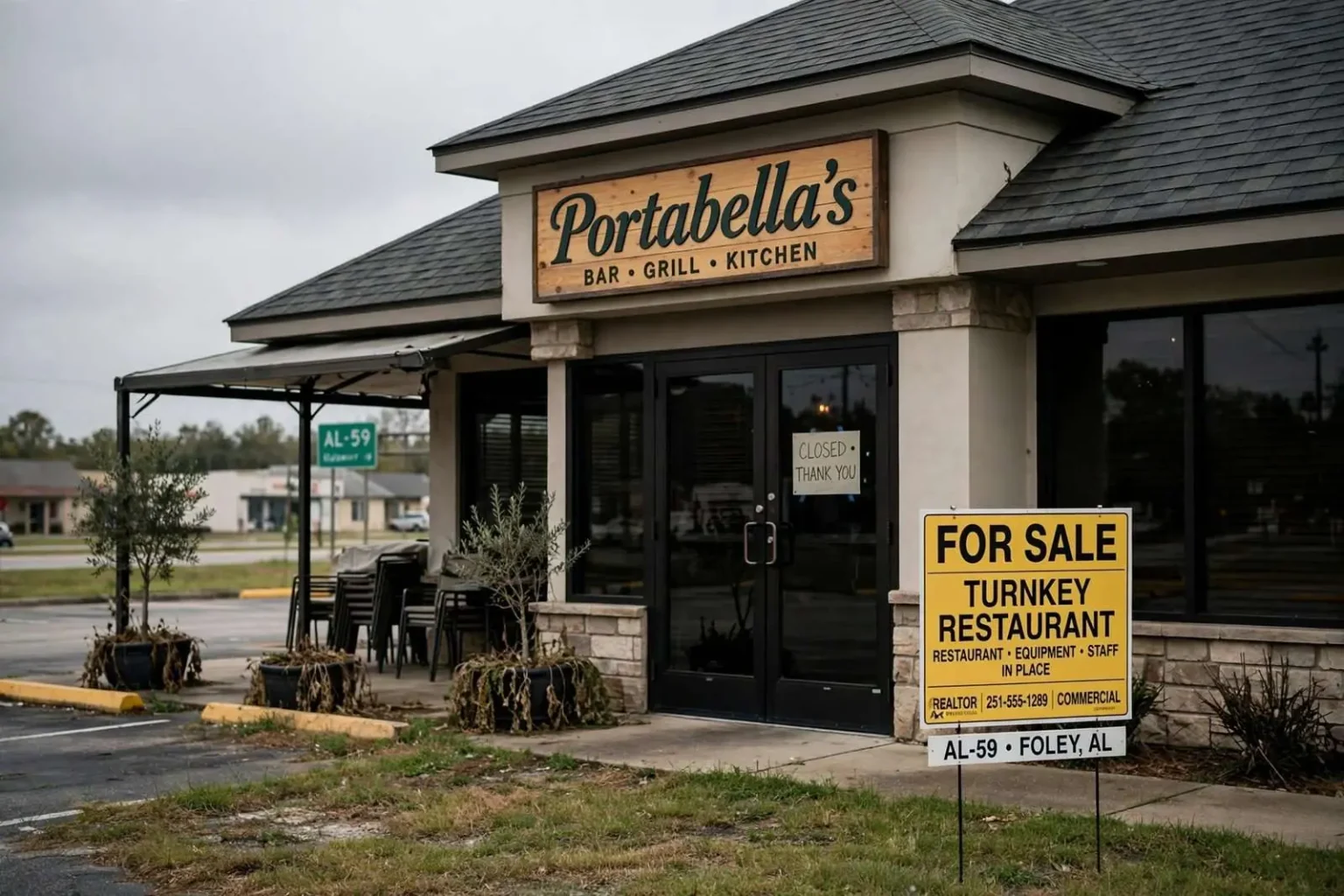
The owners of Portabella's in Foley and Safari and Vine at the Gulf Shores zoo closed both restaurants July 9, citing money, and listed the Foley Italian eatery for sale as a turnkey operation.
Two familiar names on the south Baldwin County dining scene went dark on the same day. Pam and chef Rich Lee, who owned Portabella’s in Foley and opened Safari and Vine at the Alabama Gulf Coast Zoo in Gulf Shores this spring, announced on July 9 that both restaurants have closed.
Portabella’s has been listed for sale.
“We ran out of time and money”
The couple delivered the news in a pair of social media posts, one on each restaurant’s page.
“We are heartbroken to say that we have to close Portabellas and Safari & Vine,” the Lees wrote. “We were hoping that things would turn around soon, but unfortunately, we ran out of time and money.”
Their post offered Portabella’s as a turnkey restaurant, describing it as coming “with an amazing staff who believe in Portabellas” — a signal that the Lees hope a buyer will keep the operation, and the employees, intact.
On the afternoon of the announcement, there was no sign posted at Portabella’s indicating the closure, but the doors were locked and the restaurant was not operating. At the zoo, the main gate to the parking lot was closed.
In their farewell message on the Safari and Vine page, the Lees thanked guests and staff.
“To every guest who dined with us, shared a meal with family and friends, celebrated special occasions or simply stopped in to say hello — thank you,” the statement read. “Your encouragement, kind words and support meant more to us than you know. We are especially grateful to our dedicated team, who poured their hearts into creating memorable experiences every day. We couldn’t have asked for a better group of people. While this chapter has come to an end, we are proud of what we built and the memories we created together.”
A restaurant that was saved once before
Portabella’s had been a fixture on Alabama 59 in Foley for roughly a decade before quietly closing for the first time in March 2023.
The Lees, who had befriended the restaurant as regulars, learned it was shutting down and for sale — and stepped in themselves, taking over the operation and giving the longtime favorite a second life rather than letting it disappear from the Foley dining scene.
That rescue made the second closure harder for regulars to absorb. Alabama 59 is the spine of south Baldwin County’s restaurant corridor, running from Foley through Summerdale toward Gulf Shores, and Portabella’s had built a following of locals who treated it as a special-occasion destination — the kind of independent, chef-driven restaurant that survives in tourist towns only through loyal repeat customers.
The reopening in 2023 also reflected the Lees’ standing in the community. Rich Lee’s kitchen work and the couple’s visibility at the restaurant had made them known figures in Foley, and their decision to buy a business they loved rather than watch it close was a story regulars followed closely.
Safari and Vine’s short run
Safari and Vine was a much newer venture. The couple opened the restaurant at the Alabama Gulf Coast Zoo in Gulf Shores this spring, pairing it with a new zoo campus that has itself been one of the coast’s most closely watched attractions in recent years.
The Alabama Gulf Coast Zoo — known nationally as the “Little Zoo That Could” — spent years raising funds for a move from its old site in the heart of Gulf Shores to a larger, purpose-built campus, a relocation designed to keep the facility out of the floodplain and give the animals modern habitats. A zoo restaurant was part of the vision for the new campus, drawing visitors who wanted a meal without leaving the grounds.
Restaurants built around tourist traffic face a hard calendar. Zoo attendance swells in summer and thins in the off-season, and a restaurant sized for peak season must survive months of lighter business. The Lees’ message that they “ran out of time and money” pointed at exactly that squeeze — a new venture, still finding its audience, competing for diners in a market where visitors have more choices than they can use.
The economics of small-town dining
The closures arrive during a stretch in which independent restaurants across Baldwin County have been operating on thin margins. Food costs, labor shortages and a short tourist season have combined to make year-round operation difficult even for established names, and restaurant owners along the Alabama 59 corridor and the beach highways have spoken openly about the pressure.
Foley’s dining scene has grown quickly in recent years, with new chains and local concepts arriving as the city’s population climbs and its retail base expands. Growth has brought customers, but it has also brought competition, and the independent restaurants that anchored the corridor for decades now share diners with far more options than when Portabella’s first opened its doors.
Gulf Shores presents a different version of the same problem. The beachside market cycles hard between summer crowds and quiet winters, and businesses that depend on one anchor — a zoo, an attraction, a stretch of beachfront — feel every swing in visitation. Safari and Vine’s life span of a single spring-to-summer season reflects how fast those swings can overwhelm a young business.
What the sale listing means
By listing Portabella’s as a turnkey restaurant, the Lees are offering a buyer the rare chance to take over a working operation rather than building one from empty walls. Equipment, fixtures, recipes and — most importantly, by the couple’s account — a trained staff remain in place, and the employees who “believe in Portabellas” are hoping a purchaser keeps them on.
Turnkey sales of independent restaurants in Baldwin County draw interest from several kinds of buyers: local operators expanding, families relocating to open their first place, and investors who see value in a known name along Alabama 59. Whether the next operator keeps the Portabella’s identity or rebrands the space will depend on who buys it and what the location’s history means to them.
For employees, the difference matters. A buyer who preserves the concept preserves jobs, schedules and the kitchen culture the Lees built. A buyer who strips and reopens means reapplying for new positions. In a county where restaurant work is a major source of income for residents on the southern end, those distinctions are felt quickly.
The Lees’ next chapter
The farewell messages did not lay out what comes next for Pam and Rich Lee, and the couple has not announced plans for another venture. Their history suggests they are unlikely to leave the food world; a chef’s skills and a decade of operating experience do not disappear with a closure, and the couple’s goodwill in the community survived the announcement intact.
The reaction to the posts — messages of thanks from diners, offers of help, memories of meals at both restaurants — showed how deeply the two places had worked their way into the south Baldwin County calendar. Regulars described engagement dinners, birthday traditions and after-zoo lunches, the small routines that independent restaurants create and chains rarely replicate.
Whether either name returns in some form, the week’s events left Foley with a valued building listed for sale on its main corridor and Gulf Shores with a zoo campus still looking for a dining partner. Both communities will be watching what moves into the spaces the Lees are leaving behind.
How the story unfolded
The timeline of the closure was abrupt by any measure. Diners who had booked tables learned through social media that the restaurants had shut their doors the same day the announcement appeared, and the physical quiet on Alabama 59 and at the zoo entrance matched the tone of the Lees’ messages — no going-out-of-business banners, no farewell events, just locked doors and statements of gratitude.
That abruptness is common in the restaurant business, where lease terms, payroll cycles and vendor accounts often leave owners little room for a graceful wind-down. Restaurants rarely close on their own schedule; they close when the money runs out, and the difference between an announcement and a quiet lockup is usually a matter of days.
What it says about the Gulf Coast restaurant market
The double closure is a data point in a larger story about south Baldwin County’s post-pandemic dining economy. Visitors have returned in large numbers, but so have the costs of running a kitchen, and the region’s restaurant count has grown faster than its year-round customer base. Operators who once counted on a strong tourist season to carry them through the winter now find the winter longer, the summer more competitive, and the margins thinner at both ends.
Independent restaurants feel that squeeze most. Chains can shift costs to a central office and close individual locations with little local pain; an owner-operator like the Lees carries every bill personally, and the line between staying open and shutting down is drawn by a handful of slow weeks.
For diners in Foley and Gulf Shores, the practical lesson is the one the Lees’ own history tells: local favorites survive only when regulars show up between the holidays and the tourists. Portabella’s was saved once by owners who loved it, and it will take a new owner — and a new base of regulars — for that to happen again.
Until a buyer steps forward, the Alabama 59 building sits empty, the zoo’s restaurant space is dark, and two of the coast’s more beloved dining stories are on pause, pending news from whoever buys what the Lees built.