White Powder Closes Bonner’s Mobile and Foley Offices as Labs Test the Substance
The Mobile and Foley district offices of U.S. Rep. Jo Bonner were closed and checked for contamination after employees opened envelopes containing baggies of white powder.
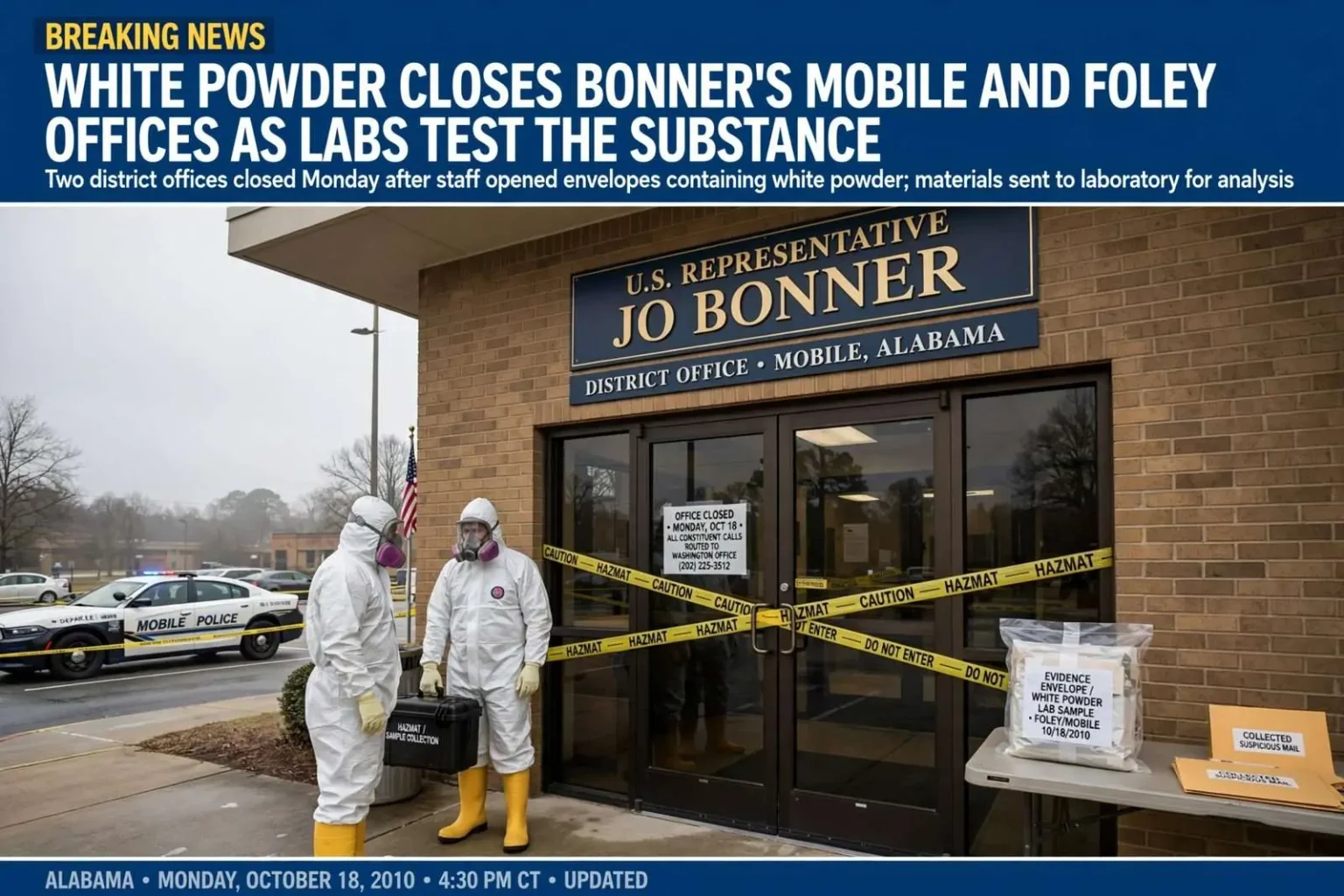
The district offices of U.S. Rep. Jo Bonner in Mobile and Foley were closed Monday and searched for possible contamination after employees opened envelopes containing plastic baggies of white powder. The substances were sent to a laboratory for analysis.
Calls to both offices were routed to Bonner’s Washington office while the buildings were checked, a spokesman said — a small logistical shift that let constituents keep reaching someone, even as the staff in Alabama waited out the testing of the envelopes they had opened.
The simultaneous appearance of powder in two offices nearly an hour apart by highway suggested the envelopes were mailed together, and the closure of both buildings for inspection was the standard response to that possibility: treat every affected space as contaminated until a laboratory says otherwise.
A familiar and unwelcome routine
The protocol that followed was one congressional staffs had learned the hard way. In the fall of 2001, letters containing anthrax spores were mailed to news organizations and to the Washington offices of two U.S. senators, killing five people and infecting seventeen others. The Hart Senate Office Building was closed for months.
The 2001 attacks changed the daily mechanics of every congressional office in the country. Mail screening, glove-and-mask protocols for staff who open envelopes, irradiation of letters bound for Capitol Hill and a national conversation about powder in the mail all date from those weeks, when five deaths from contaminated letters taught the government that an envelope is a delivery system as much as a communication.
In the years that followed, every congressional district office in the country was issued guidance on handling suspicious mail, and every one of them was subject to hoaxes. The guidance runs to a simple sequence: isolate the envelope and the room it was opened in, shut off fans and ventilation where possible, wash, call the authorities, and leave the evaluation of the substance to people in protective equipment.
Most powder incidents turn out to be nothing — flour, sugar, powdered sugar, baking soda, or the residue of an ordinary mailing. But the response cannot be calibrated to the likely outcome. Once an envelope is opened and a powder appears, the office closes, the employees who handled it are evaluated, hazardous materials crews arrive, and the substance goes to a lab. That process runs the same way whether the sender is a terrorist or a crank.
The uniformity is the point. A response that depended on guessing the sender’s intent would fail precisely when it mattered, so the system treats the harmless powder and the dangerous one identically until the lab report arrives. The cost is measured in closed offices and worried staff; the alternative is measured in the 2001 casualties.
For the employees who opened the envelopes, the hours between discovery and lab result are unlike anything else in the job. Public-facing congressional staff are, in the design of the system, the first contact between a congressman’s mail and his district — and in the worst case, the first exposure as well.
Bonner’s district
Bonner, a Republican, represented Alabama’s 1st Congressional District, which takes in Mobile and Baldwin counties and the rural counties north of them. He had held the seat since 2003, succeeding Sonny Callahan, for whom he had worked for many years.
The Mobile and Foley offices are the two points of contact between roughly 650,000 constituents and their congressman — the places where people go about veterans’ benefits, Social Security problems, passports and, in that district, questions about hurricane recovery and the tanker contract. Closing them, even for a day, is not a small thing.
Constituent service is the quiet bulk of a district office’s work. The caseworkers who staff those desks spend their days navigating federal agencies for people who have run out of phone numbers to call — the retiree whose check went missing, the veteran awaiting a claim decision, the family working an adoption across borders. The work is invisible until it stops, and a closed office is a line of returned phone calls.
The two cities, too, divide the district’s geography: Mobile’s office serves the urban core and the counties to its north, while Foley anchors the fast-growing Baldwin County side of the bay, where many constituents find a drive across Mobile Bay inconvenient for routine business. Together they put an office within reasonable reach of most of the district’s population.
The district’s agenda in that period gave the offices’ everyday work its local color. Hurricane recovery questions — insurance, rebuilding assistance, federal grants — still flowed through the casework years after the storms, and the contest to bring aerial refueling tanker work to Mobile had made the Pentagon a regular subject of constituent letters and calls. Neither topic paused for a contaminated envelope.
A tense season in Washington
The incident arrived at a moment of unusual political temperature. The health care debate had run through the fall and winter and had produced town-hall confrontations, angry mail and threats against members in both parties. Congressional security officials reported a marked rise in the volume of hostile correspondence during that period.
The summer and fall of that congressional session had been among the most rancorous in memory. Members of both parties had faced packed and shouting town halls, bricks thrown through office windows in other states, and, in a handful of widely reported cases, direct threats serious enough for arrests. Against that backdrop, every unexplained package landed in a climate already primed for alarm.
Whether the envelopes sent to Bonner’s offices had anything to do with that atmosphere was, on the day the offices closed, unknown. Nothing had been identified, and no one had claimed responsibility.
That gap — between an act and any explanation of it — is characteristic of powder incidents, and it is what keeps them on the news for a day and in the staff’s memory longer. The overwhelming majority are never solved, because the substance itself usually tells no story: no signature, no return address, no residue that points anywhere.
Elsewhere in the delegation, Alabama’s congressional offices had a second disruption to manage the same morning. The entire staff of U.S. Rep. Parker Griffith, who had switched from the Democratic to the Republican Party two weeks earlier, resigned en masse.
Bonner’s Washington staffers pitched in to answer phones for the 5th District until Griffith could make more permanent arrangements — an unusual bit of interoffice charity, and a measure of how completely the party switch had emptied out a sitting congressman’s operation. A constituent calling a congressman’s office does not know or care about the staff’s internal politics; the phones simply must be answered, and on that morning they were answered by the staff of a neighboring delegation member.
Griffith would shortly hire a new chief of staff with deep Mobile connections, drawing on the same networks that were, that Monday, keeping his phones answered. The episode made for a strange week in the Alabama delegation — one congressman’s district offices sealed by hazmat crews in the south of the state, another’s operation rebuilding itself from nothing in the north, and the delegation’s senior members quietly absorbing the overflow of both.
Delegations are small institutions, and Alabama’s seven House members and two senators work the same problems — the port, the Pentagon’s basing decisions, the federal budgets that touch every county — from adjacent offices. The mutual backstop between Bonner’s and Griffith’s operations was an extreme example of a routine habit: district offices cover for each other’s closed days, share casework across county lines and pass constituents to whichever desk can actually help them.
What happened next
Powder scares of this kind almost never produce charges, and almost never produce a public conclusion; the lab result comes back negative, the office reopens, and the story ends without a headline. That is the usual outcome, and it is worth remembering when reading the alarm of the first day.
The statistics of the years since 2001 run heavily toward the anticlimactic. For every genuine attempt to deliver a dangerous substance through the mail, federal investigators have logged hundreds of hoaxes, pranks and misunderstandings — envelopes of flour sent to make a point, powders from packaging material mistaken for something sinister, and the ordinary dust of mail sorted by machine. The system’s designers accepted that imbalance as the price of a response that misses nothing.
The staff members who opened the envelopes in Mobile and Foley did not have that reassurance while they waited. Their Monday ran on the standard script: the isolated room, the evaluations, the questions from hazmat crews, the drive home with the lab result still pending. The buildings would reopen when science said they could, and the casework — the benefits claims, the passport applications, the hurricane questions — would be there when they did.
For constituents, the episode passed in a day and a headline. For the two offices, it was a rehearsal of a protocol everyone in the building had hoped never to run in earnest — and a reminder that the routine machinery of representation, the open door and the answered phone, depends on staff who take the first look at whatever the mail brings.