Fort Morgan Museum Unveils Rarely Seen Relics for the Battle of Mobile Bay’s 150th Anniversary
For the 150th anniversary of the Battle of Mobile Bay, the Fort Morgan Museum assembled a special collection of artifacts, several never before shown to the public, focusing on the human story of the fort.
For the 150th anniversary of the Battle of Mobile Bay, the Fort Morgan Museum assembled a special collection of artifacts, several of them never before shown to the public, and put them on display throughout the anniversary weekend in August 2014.
The anniversary marked a century and a half since Aug. 5, 1864, when a Union fleet under Adm. David G. Farragut fought its way past the forts guarding Mobile Bay in one of the most famous naval engagements of the Civil War. The battle sealed off Mobile — the Confederacy’s last major Gulf port — from blockade running, and it gave the language one of its most quoted orders as Farragut, lashed to his flagship’s rigging, reportedly damned the torpedoes and drove his fleet into the bay. The fort guarding the entrance, begun in 1819 and garrisoned through the Civil War, remains standing at the tip of the peninsula, and its museum is the natural repository for the objects that survive from that morning.
Objects with a story to tell
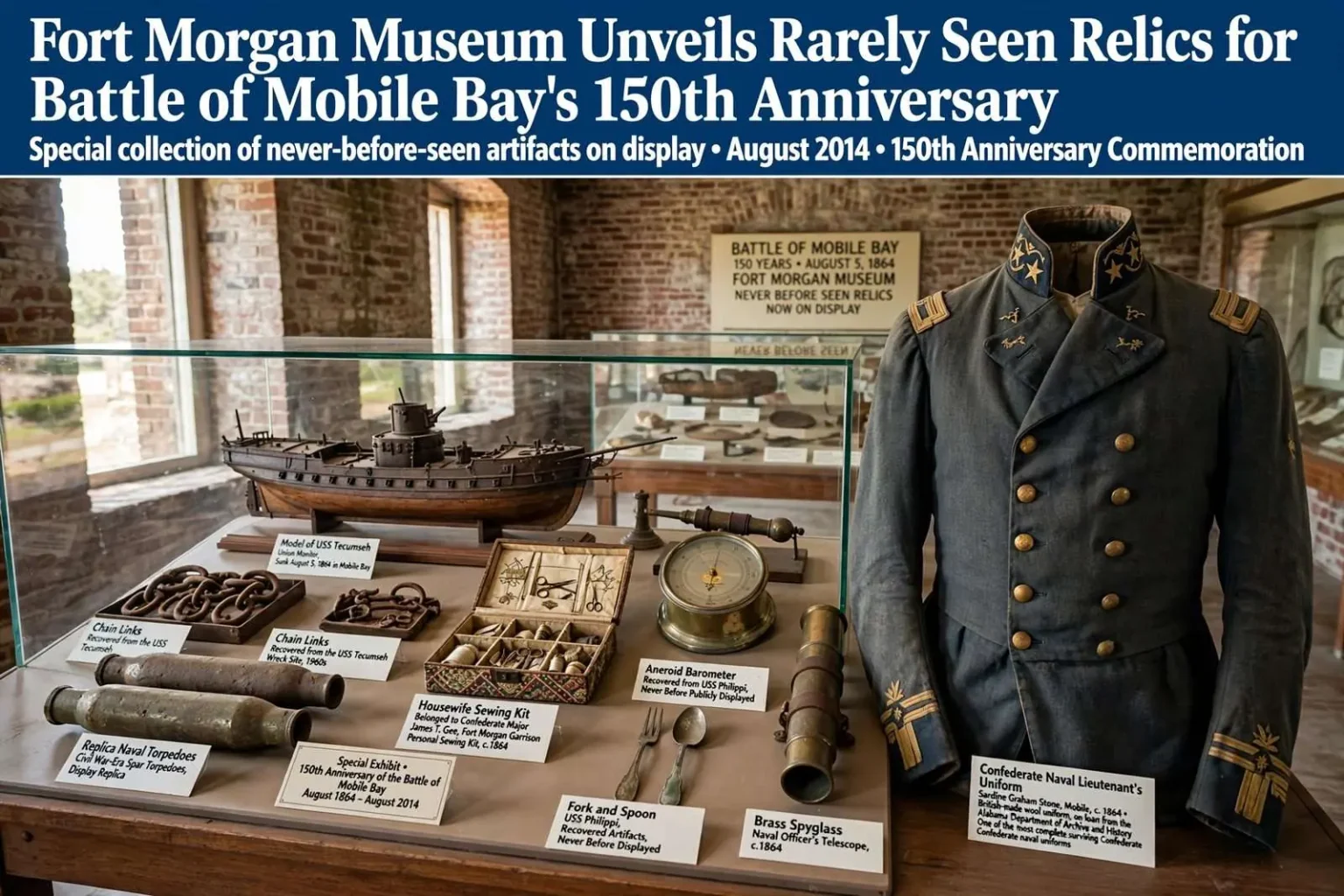
The collection brought together a model of the USS Tecumseh, swords and replica torpedoes, and objects recovered from sunken ships. Among them were links of chain from the Tecumseh, an aneroid barometer from the USS Philippi, and a fork and spoon also from the Philippi. Some of those items, including the pieces from the Philippi, had never been displayed publicly before.
The Tecumseh carries particular weight in the battle’s story. The Union monitor, leading the fleet into the bay, struck a torpedo in the main channel and sank within minutes, taking most of her crew with her — the dramatic loss that prompted Farragut’s famous order and the fleet’s decision to press on. Wreckage and debris from the ship have surfaced over the decades, and the museum’s model, with the links of chain recovered from the wreck, gave visitors a way to connect the ironclad’s story to physical fragments of the vessel itself.
“The most exciting thing to me is, these are new things that have never been seen by the public,” said Fort Morgan Site Director Mike Bailey. “It shows a different side of the fort — the human story.”
One object Bailey pointed to as capturing that personal history was a “housewife” that had belonged to Confederate Major James T. Gee of Fort Morgan. The housewife was a decorated string of pouches in which soldiers kept needles and other sewing equipment needed to maintain their gear while on the march.
Objects like a soldier’s sewing kit carry a museum’s argument in miniature. The big artifacts of the battle — guns, ships, fortifications — describe what happened; the small ones describe who it happened to. A major at Fort Morgan, like every soldier of his era, repaired his own uniforms in the field, and the decorated kit he carried is the kind of object that survives in a family’s keeping precisely because someone treasured it. Placing it in a case beside naval wreckage let the exhibit speak simultaneously about the fleet outside the fort and the garrison inside it.
A uniform from a Mobile officer
Another item drawing attention was a Confederate naval lieutenant’s uniform originally worn by Sardine Graham Stone, an officer from Mobile. The uniform was on loan to the Fort Morgan Museum from the Alabama Department of Archives and History Museum.
“This is probably the most complete Confederate naval lieutenant’s uniform in existence,” said Dr. Bob England, a history professor at Northwest-Shoals Community College. “It demonstrates how slightly this guy was built — it also gives a real good example of somebody who was really proud of the way he looked in combat.”
Confederate naval uniforms are rare survivals. The Confederate navy was small, its officers scattered among a handful of squadrons and shore commands, and the wool uniforms that reached the South through the blockade were worn hard and seldom preserved. A complete uniform with its provenance attached — an officer’s name, a Mobile connection, a documented chain from family to archives — is the kind of object textile conservators see once in a career, and its temporary move to Fort Morgan placed it within sight of the water its wearer defended.
Local historian John Gurner said the uniform stood out for its origins. “It was made in England, like some of the uniforms were for a lot of Confederate troops,” he said. “This one is different because it’s very much a British-made uniform, and it’s got some features that were not common for a Confederate uniform or even a United States naval uniform.”
The British manufacture is itself a piece of the war’s history. The Confederacy’s blockade of its own ports — the Union blockade, that is — meant that military goods flowed through runniers from Europe, and uniforms, buttons and cloth were among the cargoes that slipped through to Southern ports. Mobile Bay’s role as a blockade-running haven before 1864 is part of why the battle for the bay mattered so much to both governments: closing it choked one of the last working arteries between the Confederacy and the outside world.
The personal side of the war
Gurner said one aim of the display was to show a more personal side of what the Civil War was like. “We try to put in some things that are very much interesting, but also some of the stuff you don’t really see a whole lot,” he said. “People see swords and guns and so forth, and some of the small stuff is a little bit more interesting, a little bit more personal.”
That curatorial instinct reflects a broader shift in how battle anniversaries have been presented. A generation of visitors raised on names and numbers comes to a fort expecting armament and tactics; the objects that hold them at a case are the forks, the sewing kits, the barometers — evidence that the men of 1864 lived ordinary domestic lives inside extraordinary circumstances. An aneroid barometer, an instrument for reading atmospheric pressure, belonged aboard ship for the same reason a fork did: the Tecumseh’s and the Philippi’s crews were communities afloat, with kitchens and instruments and daily routines, until the morning those routines ended in battle.
Another goal was to emphasize the role that the Union and Confederate navies played in the war. To reinforce that theme, curators placed a spyglass, or telescope, in the same case as the naval uniform. “It sort of completes the whole naval theme,” Gurner said.
The naval emphasis filled a gap in the popular understanding of the Civil War. The war’s famous campaigns are land campaigns — Gettysburg, Shiloh, Atlanta — but the conflict’s outcome was shaped as decisively at sea and on the rivers, where blockades strangled the Confederate economy and amphibious forces seized the coast a piece at a time. Mobile Bay was one of the last and largest of those naval operations, and the objects in the exhibit — a spyglass, a monitor’s chain, a naval officer’s uniform — belonged to that maritime war rather than to the infantry war most visitors picture.
What stays and what goes
The items borrowed from other institutions were to remain at Fort Morgan only for a short time after the anniversary ended. The rest of the collection, however, would become part of the museum’s permanent displays, according to Bailey.
Loan arrangements of this kind are how a site museum at the end of a peninsula assembles an exhibit its own vault could never support. The Alabama Department of Archives and History, the state’s oldest publicly funded archives and museum, holds collections that rotate through sites across Alabama; bringing a Mobile officer’s uniform to the fort he served is the kind of placement that serves both institutions, giving the archives’ objects an audience that feels their context and giving the fort a draw for an anniversary weekend.
For visitors who made the trip to the tip of the peninsula that weekend, the exhibit offered a rare chance to see objects that had spent years in storage or underwater, and to connect the sweeping story of the Battle of Mobile Bay to the individual soldiers and sailors who lived through it. In highlighting the small and the personal alongside the swords and torpedoes, the museum sought to turn a 150-year-old battle into something close and human.
The anniversary weekend itself drew the crowds the date deserved. Sesquicentennial commemorations at Civil War sites across the South had been building toward their signature dates through 2014, and Fort Morgan — the fortification that actually stood when Farragut’s fleet ran past it — offered what no museum gallery could: the ground itself. Visitors walked the brick corridors, watched the garrison fired upon and the fleet escape into the bay, and then stepped into the museum to see the forks, chains and uniforms that survived it. The fort’s story, told in objects, had come home.