Daphne Utilities General Manager Steps Down to Join Bayfront Algae-Fuel Venture
After nine years leading Daphne Utilities, General Manager Rob McElroy resigned in August 2014 to join Algae Systems, the company turning the city's wastewater into biofuel on Mobile Bay.
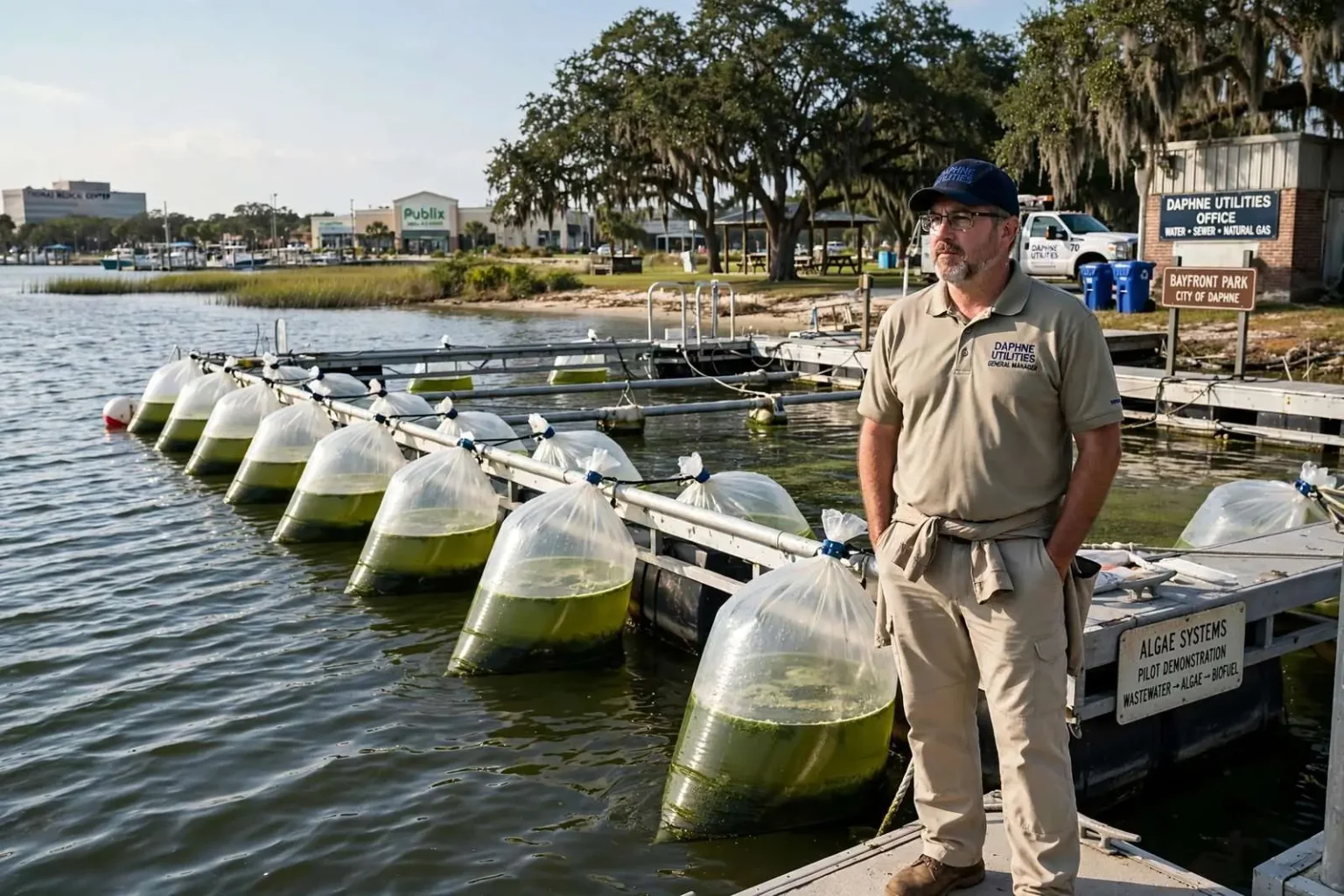
After nine years at the helm of Daphne Utilities, General Manager Rob McElroy announced in August 2014 that he was stepping down to take a position with Algae Systems, the company behind an experimental wastewater-treatment and biofuel project on the city’s bayfront.
The move joined one of Baldwin County’s most stable public institutions to one of its most speculative private ventures — and did so through a single man who had spent his tenure on both sides of the line, first as the utility’s manager and then as the point person for a partnership that turned the city’s sewage into the raw material for an algae-to-fuel experiment.
A resignation and a transition
McElroy submitted his resignation letter to the Daphne Utilities board on a Monday and said he would remain available to work through the end of August. The utility employed about 70 people and served more than 10,000 customers in the city, providing water, sewer and natural gas service.
“I’m just moving on to another path with another company,” McElroy said. “I’ll be going to work for Algae Systems, which is a company that has invested more than $5 million into the local economy already, and I really think I can help them accomplish something really significant in the alternative fuels markets.”
Board Chairman Bob Segalla said a special meeting would be called soon to choose an interim general manager, most likely Assistant Manager Danny Lyndall. Segalla credited McElroy with turning the utility into a well-run operation. “Rob has done an outstanding job for the utility, and we wish him every success because he’s a good manager,” Segalla said.
McElroy, for his part, said he had no complaints about his time at the utility. “It’s been a great company. It’s full of great people and an extremely supportive board,” he said, adding that the opportunity was one that comes along only a few times in a career.
The resignation closed out a tenure that had spanned nearly a decade of growth for Daphne, one of the Eastern Shore cities whose population boomed across the first decade of the century. Running water, sewer capacity and natural gas service for a fast-growing suburb is largely invisible work — noticed only when rates rise or pipes fail — and the board’s assessment of McElroy’s tenure reflected the kind of quiet, operational stability that utility customers rarely think to celebrate but always notice when it is absent.
How the algae project works
McElroy’s new employer had been working with Daphne Utilities on a project that leased a small strip of bayfront property behind Thomas Medical Center and the Publix shopping center. The Daphne City Council gave the utility the green light to lease the property in November 2012. Although the utility operated as a separate entity from the city, its five-member board was appointed by the council.
The Nevada-based company’s process used the city’s wastewater as a nutrient for controlled algae blooms that cleaned the water and, in turn, produced biofuel. A floating dock extending into Mobile Bay in front of the city’s Bayfront Park held effluent-filled plastic bags, with the process driven by wave action and sunlight.
The elegance of the concept was what made it unusual among the many biofuel ventures of the era. Traditional wastewater treatment consumes energy and chemicals to strip nutrients out of effluent; the algae approach turned those same nutrients — the nitrogen and phosphorus that would otherwise be a disposal problem — into feedstock for something valuable. Instead of paying to clean the water, the process in theory got paid twice: once for treating the sewage and again for the oil the harvested algae yielded. The bayfront setting was not decorative. Wave energy did work that pumps would otherwise do, and the Gulf Coast’s abundant sunlight did the rest, which meant the demonstration site’s biggest inputs were essentially free.
The technology had originally been developed by NASA’s Ames Research Center in California and licensed to Algae Systems, which had reportedly secured patents for the process in Australia and India. The NASA lineage gave the venture a pedigree most startups could only borrow: the space agency had spent years studying algae as a compact, closed-loop system for scrubbing carbon dioxide and producing fuel and food aboard long-duration missions, and the commercial offspring of that research sought to scale the same biology to a municipal sewage outfall.
“They’re doing really cutting-edge technology of wastewater treatment using algae and then converting algae into bio crude oil from which any type of fuel can be derived — gasoline, diesel, jet fuel,” McElroy said.
He described the venture as still in its ramp-up phase and said it was backed by private investors, many from outside the country. The demonstration scale of the Daphne site — a floating dock of plastic bags rather than a commercial plant — meant the company’s immediate business was proving yields and costs, not selling fuel. But the commercial logic attracted serious money in a period when domestic biofuel investment was surging and the U.S. Navy was actively courting alternative aviation and marine fuels for its fleet.
A new role and a longer horizon
McElroy said he would become vice president of operations and market development at Algae Systems, a role he believed suited his experience in the utility industry. “There’s a lot of markets within the utility industry that I think I am uniquely qualified to open their eyes to,” he said.
The hire made sense from both directions. For the company, a nine-year utility manager with a clean reputation and relationships across Baldwin County and the wider Gulf Coast utility world was precisely the person to convince municipal operators — a famously cautious customer base — that sewage-fed algae was a technology worth piloting. For McElroy, the move traded the security of a public-sector post for a stake in a venture he had watched from the adjacent desk for two years, with the Daphne pilot as his showcase.
He was especially drawn to the technology’s potential in the developing world, describing the possibility of turning a community’s sewage and lack of clean water and affordable fuel from a liability into an asset. “It could transform a society,” he said.
That framing — treatment as development rather than disposal — was where the company’s pitch extended furthest from its Baldwin County pilot. Communities without centralized treatment plants, and without the tax base to build them, could in theory leapfrog directly to a system that produced clean water and fuel from the same process, without heavy infrastructure. Whether the economics held at that scale was unproven; the Daphne demonstration existed largely to find out.
McElroy said Algae Systems would likely remain in Daphne for at least three more years and evolve into more of a research facility, even as the company’s broader goal was to build commercial sites across the country and beyond.
His departure closed a chapter that began in 2005 and left the utility board preparing to name interim leadership while a company born on the Daphne bayfront looked toward a wider stage.
A small city, a big experiment
For Daphne, the project’s setting said as much as its science. The strip of bayfront leased behind Thomas Medical Center and the Publix shopping center sat along one of the busiest corridors on the Eastern Shore, in full view of commuters on U.S. Highway 98 — an unglamorous patch of shoreline that suddenly hosted technology with NASA roots and investors from three continents. Bayfront Park, the city park in front of the floating dock, meant the demonstration operated beside one of the community’s favorite public spaces, where the sight of effluent-filled plastic bags swaying in the waves became a conversation piece for joggers and picnic crowds.
The location also carried environmental weight. Mobile Bay has long been the focus of conservation efforts around nutrient runoff — the same nitrogen and phosphorus that feed algae blooms in the bay’s open waters are, in the Algae Systems process, deliberately cultivated and converted into fuel. What was a liability in the bay became feedstock in the bags, and local environmental observers noted that a technology which reduced the nutrient load of treated effluent while displacing fossil fuel had an appeal that cut across the usual lines between economic development and conservation.
The arrangement also tested how a small city could host big science. The utility was a separate entity governed by its own five-member, council-appointed board, which allowed the lease and the partnership to proceed as a utility business decision while the city council retained oversight through its appointments. For a city of Daphne’s size, the risk was measured — a strip of underused bayfront leased to a company that had already sunk millions into the local economy — while the potential upside, from high-technology jobs to a foothold in a nascent industry, was the kind that small Gulf Coast cities rarely get a chance to bid for.
The wider algae moment
Algae Systems was not alone in betting on pond scum. The early 2010s saw a wave of investment in algae-based fuels across the United States, as energy companies, venture capital firms and federal agencies chased organisms that could produce oil without competing with food crops for farmland. The field’s enthusiasts pointed to algae’s staggering theoretical productivity; its skeptics noted that more than one high-profile biofuel company had burned through enormous investment without ever reaching commercial scale. Against that backdrop, the Daphne project’s distinguishing feature was its business model: rather than selling fuel into a commodity market against cheap petroleum, it proposed to sell wastewater treatment — a service every city already pays for — and treat the fuel as the bonus.
That was the argument McElroy would now be carrying into boardrooms around the country: that the first customers for algae fuel were not refineries but utilities, and that a technology proven behind a Publix on Mobile Bay could be sold to any municipality tired of paying to throw nutrients away.
As August ended, the two organizations he had spent nine years linking went back to their separate work. The utility board turned to the business of naming an interim manager and keeping water, sewer and gas service uneventful for more than 10,000 customers. Algae Systems settled in for the years of research it planned on the Daphne bayfront. And the general manager who had steered both found his new office just down the road from the old one — managing the transition of an experiment he had helped launch from a floating dock in Mobile Bay toward whatever market, in this country or another, came next.