Cooper Presses Pittman for Four Debates and a ‘Play Nice’ Campaign Pact
Democratic nominee A.J. Cooper asked Republican Trip Pittman for four Baldwin County debates and proposed a written accord limiting spending, banning personal attacks and cleaning up campaign signs.
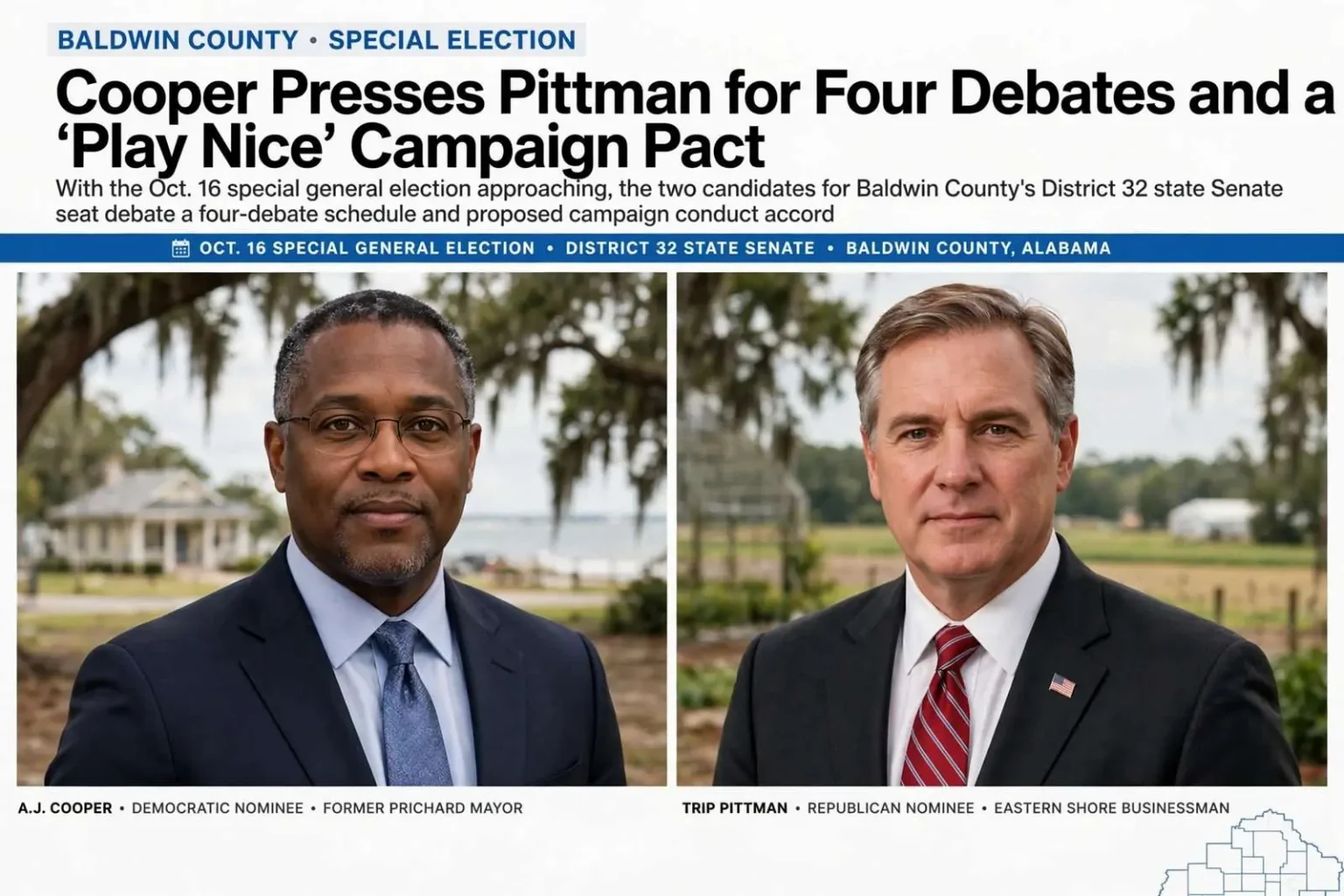
With the Oct. 16 special general election approaching, the two candidates for Baldwin County’s District 32 state Senate seat worked to settle a debate schedule — and the Democratic nominee attached an unusual set of conditions to his invitation. A.J. Cooper, an Eastern Shore attorney and former mayor of Prichard, sought a series of four debates across the county. Trip Pittman, the Eastern Shore businessman who won a bruising Republican runoff earlier in the month, had not committed to that number but said details would be finalized within days.
The special election filled the seat vacated by Bradley Byrne, who left the Senate to become chancellor of Alabama’s two-year college system. District 32 stretches across Baldwin County from the Eastern Shore communities of Daphne and Fairhope to the central county around Robertsdale and the northern reaches near Bay Minette, and its Senate seat has been among the most secure Republican holdings in Montgomery. A special election, though, compresses the campaign calendar and lowers turnout, which gives a Democrat like Cooper a narrow but real argument that retail campaigning — meeting voters face to face — can matter more than party registration totals.
‘Real Talk to Real People’
Cooper argued that a single forum would not do justice to the issues facing a county in the middle of a growth boom. “Trip and I have an obligation to let the people of Baldwin County hear our views on a wide range of subjects but especially on issues like returning a fair share of our tax revenue to Baldwin County, tax appraisals, property and wind insurance, education and openness in government,” Cooper said. “If we can’t present our views in front of our neighbors and friends, how can we be expected to stand up and argue for Baldwin County in front of the State Senate?”
He wanted debates “down on the Shore, in Robertsdale, in Bay Minette and in Daphne so folks can get the information straight from our mouths to their ears.” The geography was deliberate. Baldwin County’s political identity is divided among distinct communities — the Eastern Shore’s growing suburban professional base, the agricultural and industrial interior, and the northern county around the courthouse seat in Bay Minette — and no single venue reaches all of them. Four debates, in Cooper’s framing, would require both candidates to face every part of the district rather than campaigning where their own voters concentrate.
“Slick mailers … just isn’t the same as a live debate where the candidates have to deliver real talk to real people,” Cooper said — a pointed reference to the mail-heavy, increasingly negative Republican runoff that had just concluded. Pittman had emerged from that runoff after weeks of attack advertising funded largely by outside money, and Cooper’s critique positioned him as the candidate offering an alternative to the style of campaign Baldwin County Republicans had just watched. Direct mail had dominated the runoff’s final weeks to the point that many voters’ mailboxes filled with competing claims about the two finalists — a dynamic that plays to whichever candidate has more money and against whichever candidate is trying to win on substance.
The Four-Point Accord
Cooper also proposed a written “play nice” agreement, sending Pittman four terms in an email he closed “with best regards.” The proposed accord read: Signs. Both campaigns would abide by county and municipal sign ordinances and remove all campaign signs within one week after the election. They would pay the Boy Scouts or Girl Scouts 50 cents per sign collected and returned to the Knights of Columbus Hall in Montrose during the second week after the election. Tone. Both would base their campaigns on issues, solutions and proposals, and would “not resort to any depreciatory or pejorative campaign print or media advertisements” or personal attacks. Money. Neither would spend more than $100,000, a cap that would include spending by unrelated campaign committees and political action committees. Forums. Both would take part in as many citizen forums as possible.
The sign provision, with its 50-cent bounty routed through scouting troops, borrowed a practice some Alabama municipalities use to clear roadside litter after elections — turning a cleanup cost into a small fundraiser. The tone clause responded directly to the runoff’s character, and the forums clause matched Cooper’s four-debate proposal in spirit, committing both candidates to as many unscripted public appearances as civic groups could organize.
“I look forward to you and I having the best campaign ever presented to the citizens of Baldwin County,” Cooper wrote. “No matter who wins, we will do ourselves proud by agreeing to the above proposals. I have no pride of authorship, so please feel free to change, add or delete the above suggestions and return them to me for review.” The invitation to edit was a calculated gesture: by inviting Pittman to revise the accord, Cooper made it difficult to decline on procedural grounds and framed any refusal as a rejection of clean-campaign terms he had offered to negotiate.
Why the Spending Cap Mattered
The third condition was the one with teeth. Both Republican runoff campaigns had blown well past $100,000 in a matter of weeks, much of it from Montgomery-based political action committees, and Pittman had made that PAC money a centerpiece of his own argument against his primary opponent. A cap that swept in outside committee spending would have bound not just the candidates but the interests behind them — a commitment no campaign could easily enforce and few would sign. Alabama’s PAC system at the time allowed money to move through chains of committees that obscured the original source, and any candidate who unilaterally refused outside help would simply have watched it flow to his opponent. The proposal put Pittman in an awkward position: he had campaigned against PAC influence in the runoff, but declining the cap would look like embracing it, and accepting it would handicap him against a Democrat with far less money to begin with.
The issues Cooper named for the debates were the ones that dominate Baldwin County politics. Returning a fair share of tax revenue to the county has been a perennial grievance — Baldwin contributes far more in taxes to Montgomery than it receives back in state spending, a disparity local officials have pressed for decades. Property tax appraisals, which have repeatedly risen with the county’s land values, remain a sensitive subject in a state with constitutional limits on property taxation. And property and wind insurance costs, driven by the Gulf Coast’s hurricane exposure, have become one of the defining economic pressures on coastal Alabama homeowners, with premiums rising steadily as insurers reassess their Gulf exposure.
Education and openness in government rounded out the list. Baldwin County’s public schools have grown with the county’s population, making school funding and construction a constant item in local legislative politics, and the district’s voters — among the most civically engaged in the state — have historically responded to candidates who campaign on transparent, accessible government. For a Democrat running in Republican terrain, those quality-of-life issues offered the most promising ground: they cross party lines and affect every homeowner and parent in the district regardless of how they vote.
Cooper’s biography shaped the campaign as well. As a former mayor of Prichard, the troubled Mobile County city just across the bay, he carried experience in municipal government and a story about managing a community through fiscal hardship — credentials he argued prepared him for a Legislature where budget decisions decide what Baldwin County receives back from Montgomery. His Eastern Shore law practice rooted him in the district he hoped to represent, and his party affiliation, in a county where Democrats are scarce in office, made his underdog strategy of personal campaigning and debate challenges the centerpiece of the race.
Pittman, for his part, entered the general election as the clear favorite. The Eastern Shore businessman and nursery operator had won the Republican nomination in a contested, expensive runoff, and in a county that had become one of the most reliably Republican in the state, Cooper faced steep odds, and a series of live, unscripted debates offered one of the few ways for a Democrat to close the gap. Whether Pittman would agree to four debates — or to any of Cooper’s conditions — remained unresolved as the campaigns turned toward the final three weeks.
The negotiation itself, whatever its outcome, established the terms on which the race would be judged. If the candidates met four times across the county, Baldwin County would see more debates than most legislative districts see in a decade; if they did not, Cooper had already framed the refusal as a dodge, and the “play nice” email would stand in the record as the campaign’s defining document. Either way, the debate over the debates had become the story of the race’s opening weeks — fitting, in a district whose voters were being asked to fill a Senate seat unexpectedly vacated in the middle of a term.