Alabama Leads the Nation in Fourth Grade Reading Gains, National Report Card Shows
Alabama's fourth graders posted the largest reading gain of any state on the 2007 National Assessment of Educational Progress, an eight-point jump credited to the Alabama Reading Initiative.
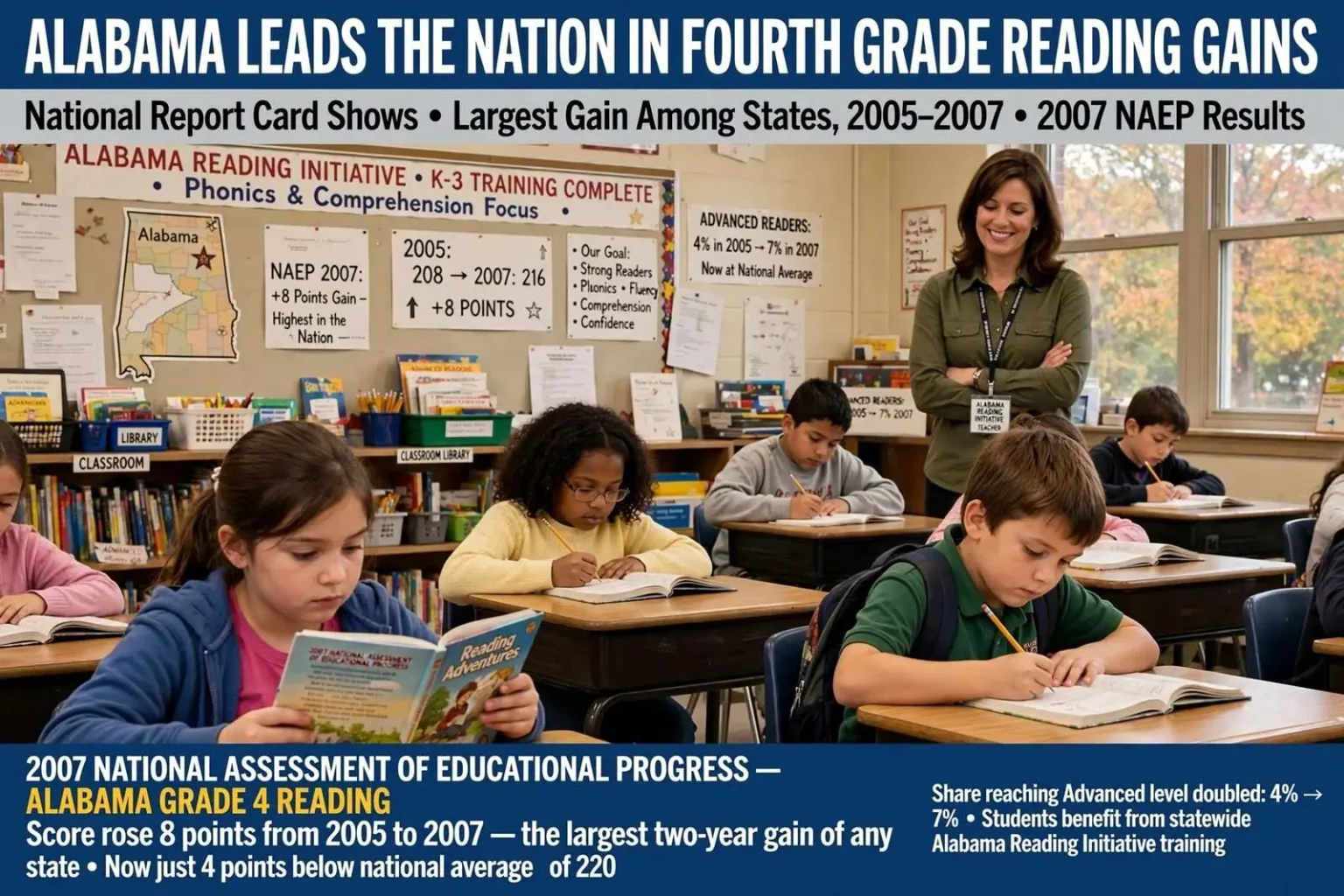
In a state where autumn rankings usually concern football, the best news of the season arrived from an entirely different scoreboard: Alabama’s public schools posted a larger gain in fourth grade reading than any other state in the nation. The finding came from the 2007 National Assessment of Educational Progress, the exam known as the Nation’s Report Card, and it was unambiguous. For a state accustomed to the bottom of national education rankings, a first-place result in anything academic qualified as a genuine event.
“Alabama’s gain in fourth grade reading scores is higher than any other state between 2005 and 2007,” said Mark Schneider, commissioner of the National Center for Education Statistics. “This gain stands out for this year’s assessment, and in the history of NAEP’s state-level reading assessment.”
Eight points in two years
Alabama’s fourth graders scored 208 on the assessment’s 0-to-500 scale in 2005. In 2007 they scored 216 — a gain of eight points, nearly triple the national average improvement, and enough to close most of the distance to the national average of 220. In the language of testing, an eight-point movement at the state level in two years is an unusually large shift; gains of one or two points in a cycle are more typical, which is why federal officials treated Alabama’s result as exceptional rather than routine.
The state also roughly doubled the share of fourth graders reaching the Advanced level, from 4 percent in 2005 to 7 percent in 2007, matching the national figure. Moving the top of the distribution matters as much as lifting the middle: Advanced readers are the students who go on to handle complex texts in middle and high school without remediation, and Alabama’s climb from below the national rate to parity marked a symbolic threshold.
Gov. Bob Riley reached, inevitably, for a sports metaphor. “Alabama is number one in the nation in reading improvements at the fourth grade level. This didn’t happen by accident,” he said. “This is part of our game plan to improve education in Alabama, and this is proof positive that our game plan is working.” He credited teachers directly: “They know how incredible our Alabama Reading Initiative is, and one of the reasons it is so successful is because it provides support for our teachers.”
U.S. Secretary of Education Margaret Spellings issued a statement of her own. “I want to be the first to congratulate the state of Alabama for leading the nation in fourth grade reading gains,” she said. “Combining proven methods of instruction with hard-working students and dedicated teachers has paid off with reading scores rising eight points in just two years. It’s phenomenal.”
The praise from Washington carried particular weight in the No Child Left Behind era, when states were frequently accused of gaming their own tests. NAEP’s value lay in its independence: it is administered uniformly across the country, scored by the same standards everywhere, and cannot be prepared for the way a state exam can, which made Alabama’s rise on it harder to dismiss as testing theater.
The initiative behind the numbers
State officials pointed to a specific cause. For the first time in Alabama’s history, every public school teacher in grades K through 3 had completed training under the Alabama Reading Initiative before the 2007 assessment was administered to fourth graders in February of that year. The milestone meant that the students taking the 2007 exam had spent their entire early schooling in classrooms taught by teachers trained in the same phonics-based, research-grounded methods.
The initiative, launched in the late 1990s, was built on intensive, sustained training in reading instruction rather than on new textbooks or new tests — a bet that the fastest way to improve student reading was to improve the adults teaching it. ARI began as a pilot in a handful of demonstration schools, where reading specialists worked alongside faculties for a full summer of training and followed up with in-school coaching. Its early results in those pilot schools — measurable reading growth across demographic lines — built the case for expansion, and by the mid-2000s the Legislature had begun funding it at statewide scale.
“The impact ARI has had on our school has been unbelievable,” said Sherry Calvert, principal of F.E. Burleson Elementary in Hartselle. “When I asked my faculty what they attribute our positive change in performance to, the answer was, ‘The training ARI provides in reading comprehension.’”
State Superintendent Joe Morton allowed himself one dry line. “We’re number one on the list of fourth grade reading improvement in the nation,” he said, “and it is not because the states are listed alphabetically.” He was also careful about expectations. “This is a marathon, not a sprint,” Morton said. “When we started the Alabama Reading Initiative nearly a decade ago, we knew it would take time to get full funding and implement it statewide. We had to prove ourselves and we are doing so.”
David Byers, vice president of the state Board of Education, said the results validated the state’s spending. “Investments in our Alabama Reading Initiative and Math, Science, and Technology Initiative demonstrate increases in teaching and learning,” he said. The board had argued for years that sustained instructional investment — as opposed to construction, administration or testing — was the spending line that actually moved scores, and the NAEP results gave that argument its strongest evidence to date.
Math gains, and a Baldwin County voice
Mathematics scores rose as well. Alabama’s fourth graders improved from 225 to 229, double the national gain, with the share performing at or above Proficient rising from 21 percent to 26 percent. Eighth graders moved from 262 to 266. The math gains, while less celebrated than the reading result, followed the same pattern — improvement at roughly twice the national pace — and suggested that the state’s instructional strategy was not confined to a single subject.
The 2007 test was also the first administered to students in schools participating in the Alabama Math, Science, and Technology Initiative, or AMSTI, which was then in only about a quarter of the state’s schools. AMSTI took a different approach than ARI: instead of training teachers in methods alone, it shipped classrooms hands-on kits of math and science materials, trained teachers in inquiry-based instruction, and provided on-site math and science specialists who coached faculties through the school year.
“AMSTI training requires students to think, question, and find answers they are able to support and defend,” said Carol Broughton, principal of Fairhope Intermediate School in Baldwin County. “Such critical thinking skills are beneficial for learning and testing.” Baldwin County schools were early AMSTI participants, and Fairhope Intermediate — sitting in one of the fastest-growing corners of the state — became one of the program’s showcase sites on the Eastern Shore.
About 12,000 students from roughly 230 Alabama schools took part in the assessment. NAEP does not report results for individual schools or students; it tests representative samples in grades 4 and 8 every two years, and participation was required of states receiving federal Title I money under the No Child Left Behind Act. The sampling design means the results are a statistical portrait of the state rather than a scoreboard for any district — which is why a school principal’s enthusiasm for ARI, while illustrative, could never appear in the federal numbers themselves.
That structure is also what made Alabama’s gain nationally legible. Because the same sampling standards applied in every state, the comparison Alabama won in 2007 was the closest education policy gets to a fair contest: the same test, the same grades, the same administration window, and no state control over the questions.
The Alabama Reading Initiative was slated to expand into grades 4 through 8 by 2009. State leaders argued that extending the training upward would protect the fourth grade gains from erosion in middle school, where reading demands shift from decoding to comprehension across content areas, and where Alabama’s eighth grade scores remained far below the national average.
In the years that followed, the state’s NAEP reading results proved harder to sustain than to achieve — a reminder, as Morton put it, that this was a marathon. Funding wavered with the economy, leadership changed, and later cycles of the Nation’s Report Card showed the fourth grade surge flattening rather than compounding. But the 2007 result remained the reference point in every subsequent education debate in Montgomery: proof that Alabama’s schools could lead the nation at something, and that the something was sustained investment in how teachers teach.
Reading instruction had been the subject of almost continuous debate in Alabama for a decade before the 2007 results. The state had cycled through reading programs, textbook adoptions and assessment regimes, and the frustrating pattern was consistent: Alabama students could pass state reading tests while still lagging on national measures. ARI’s designers argued the gap was instructional — that too many Alabama teachers had never been trained in the explicit, systematic phonics and comprehension methods the reading research supported — and they built a program to close that gap one faculty at a time.
The model’s economics were part of its appeal. Rather than buying a new curriculum for every school, the state invested in training the existing workforce, then kept specialists in schools to make the training stick. That structure won converts in the Legislature even in lean budget years, because legislators could see the program’s footprint in their own districts: a trained faculty, a reading coach, and test results that moved before the state numbers caught up.
The fourth grade cohort that took the February 2007 assessment had also been the first to spend all of grades K-3 in ARI-trained classrooms, which is why state officials drew a straight line from the training milestone to the score. Test-takers in the sampled schools had, on average, received four consecutive years of instruction from teachers who had completed the same intensive professional development — a dosage no previous Alabama cohort had received.
The result also gave Alabama education officials something they had rarely possessed: a national talking point. State leaders took the finding on the road, and the “number one in reading gains” line appeared in everything from legislative budget hearings to school board meetings across Mobile and Baldwin counties, where local faculties had shared directly in the training that produced it.