University of South Alabama Daphne
A Senate Subcommittee Steered Millions Toward South Alabama Science and Coasts
A $30 million engineering center at South Alabama, a NOAA disaster response center on the Gulf, oyster bed reseeding and hurricane monitoring were among the projects approved in the 2008 spending bill.
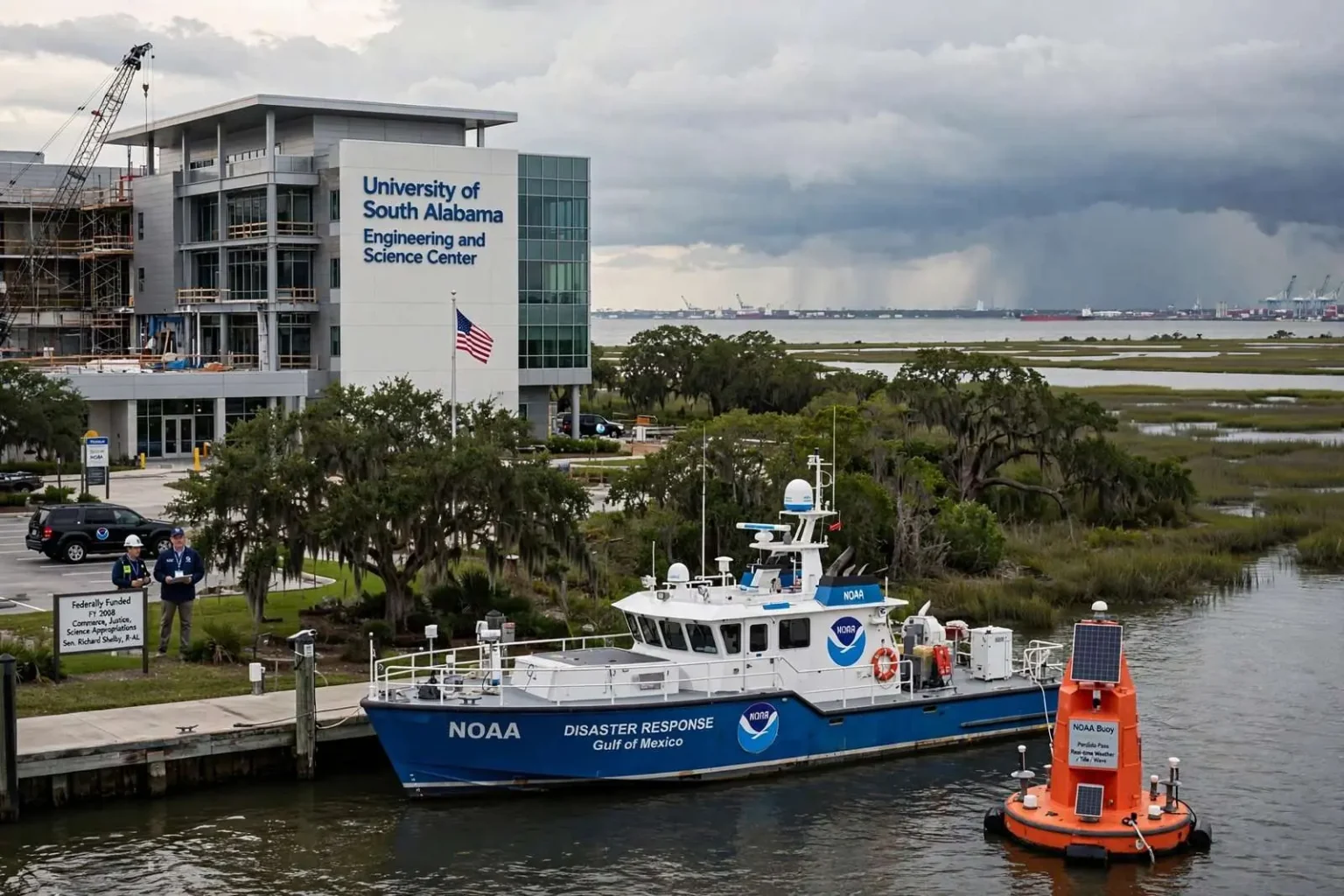
WASHINGTON — A Senate appropriations subcommittee approved a package of federal projects for south Alabama, including $30 million for a new engineering and science center at the University of South Alabama and $6 million for a National Oceanic and Atmospheric Administration disaster response center on the northern Gulf of Mexico. The projects were contained in the fiscal year 2008 Commerce, Justice, Science and Related Agencies appropriations bill, one of the twelve spending measures Congress must pass each year to keep the government funded.
U.S. Sen. Richard Shelby, R-Ala., was the ranking member of the subcommittee that writes the bill — a position that gave Alabama unusual leverage over an account funding NASA, the National Oceanic and Atmospheric Administration, the National Science Foundation, the Economic Development Administration and the Departments of Commerce and Justice. Members of the minority party traditionally steer money toward their states as readily as members of the majority, and the ranking member’s seat on this particular subcommittee meant Alabama’s priorities were embedded in the drafting process rather than added late as an afterthought.
Following the subcommittee’s action, the bill moved to the full Appropriations Committee, then to the Senate floor, where it would eventually be reconciled with a House-passed companion measure. Projects inserted at the subcommittee level are rarely removed later, which is why the drafting stage matters so much to the states of the members who hold those seats.
“This legislation includes a number of important projects in Alabama and across the nation,” Shelby said.
A university built for an industrial boom
The largest single item was the $30 million Engineering and Science Center at the University of South Alabama, intended to provide laboratory and research space both for students and for the regional industries the university serves. The Mobile institution, which opened its doors in the 1960s largely to serve the growing Gulf Coast business community, had long positioned itself as the region’s workforce engine, and the new center would extend that mission into research space that could be shared with employers.
The timing was not accidental. ThyssenKrupp had just announced it would build a steel plant in Mobile County — one of the largest industrial investments in the state’s history, expected to draw suppliers and skilled trades from across the region. The aerospace sector was expanding along the Gulf Coast as well, with existing contractors adding work and new firms scouting sites. Meanwhile, the Mitchell Cancer Institute was drawing research money to the coast, giving the university a biomedical anchor alongside its traditional engineering programs.
Shelby tied the building directly to that shift. “The expanding science and technology based industry in Mobile will only demand more university skilled workers for high paying jobs in the future,” he said. “The new Center will allow USA to prepare students for that workforce.”
A companion item, $250,000 for the Tomorrow’s Engineering and Mathematics Workforce initiative, was aimed at building a pipeline of students prepared to enter engineering programs in the first place — funding K-12 outreach so the university’s engineering enrollment grows from the ground up rather than relying solely on out-of-state recruitment.
For Mobile County, the combination represented a bet that the industrial surge would not be a single-generation phenomenon. Steel plants, aerospace suppliers and research institutes compete for the same small pool of Gulf Coast engineers and technicians, and the state’s universities had historically produced fewer such graduates than the industrial base could absorb.
The Gulf: oysters, storms and disaster response
Several projects addressed a coast still recovering from Hurricane Katrina and increasingly aware of how little it knew about its own waters. Gulf of Mexico Disaster Response Center — $6 million. The center would consolidate NOAA’s regional navigational response teams, damage assessment units and restoration programs under one roof on the northern Gulf, eliminating the patchwork of scattered offices that had slowed the federal response after the 2005 hurricane season.
“We learned during Hurricane Katrina that coordination between agencies and across every level of government is critical,” Shelby said. The disaster response center reflected that lesson directly: rather than sending survey crews, assessment teams and restoration staff from separate offices in separate cities after a storm, a single Gulf-based facility would house them together and let them plan jointly in advance of the next hurricane season.
Center for Ecosystem-based Fisheries Management — $3 million. Then under construction at the Dauphin Island Sea Lab, the center would study the health of Gulf fisheries from the shallows to the outer continental shelf. The Sea Lab, a consortium of state universities located on the barrier island at the mouth of Mobile Bay, had long served as the region’s marine research hub, and the new center marked a shift toward managing fisheries by looking at whole ecosystems — food webs, habitats and water quality together — rather than regulating one species at a time.
Oyster bed reseeding and habitat enhancement — $1.25 million. The University of South Alabama would continue reseeding oyster beds and studying what helps and harms oyster habitat in Alabama’s estuaries. “The oyster industry is a staple of Alabama’s coastal economy,” Shelby said. Oysters had been harvested commercially from Mobile Bay and its tributaries for generations, supporting watermen, processors and restaurants, and the reefs themselves perform ecological work: a healthy oyster reef filters water and provides structure that shelters juvenile fish and crabs.
Coastal inland hurricane monitoring and prediction — $750,000, and coastal weather monitoring for catastrophic events — $300,000. Both were University of South Alabama programs aimed at measuring wind gusts, storm surge and rainfall during a hurricane and improving forecasts of a storm’s intensity and destructive potential — a stubborn gap for emergency managers from Mobile to Baldwin County.
Perdido Pass navigation assistance — $300,000 for a NOAA buoy reporting real-time weather, current, tide and wave conditions off the pass, the narrow inlet connecting Orange Beach’s boating community to the open Gulf. Real-time data at such inlets matters to hundreds of recreational and charter vessels that cross the bar daily, where shifting currents and rough conditions can turn a routine crossing dangerous.
Orange Beach fishing mortality education — $100,000 to teach anglers how to release undersized or unwanted fish without killing them, a response to tightening red snapper regulations. Red snapper stocks in the Gulf had been under strict rebuilding plans for years, and the recreational fishery — central to Orange Beach’s charter fleet — faced shorter seasons and smaller limits. Fish pulled up from depth often suffer barotrauma, so teaching proper release techniques was a way to reduce waste without additional closures.
Maritime Museum — $500,000 for a partnership with NOAA on educational exhibits about the Gulf. The funding would pair a public-facing cultural institution with the federal science agency, putting Gulf research — from hurricane science to fisheries management — in front of the tourists, students and residents who walk the museum’s exhibits.
Public safety money for Baldwin County
The bill also carried grants under the Office of Community Oriented Policing Services, an arm of the Justice Department known as COPS, which nationally received $550 million. Baldwin County’s share went largely to communications, a chronic weakness exposed during hurricane responses, when police, fire, rescue and public works agencies operating on incompatible radio systems had struggled to coordinate evacuations, search and rescue, and recovery operations.
Baldwin County Commission, interoperable communications — $350,000. City of Daphne, wireless technology upgrades — $225,000. City of Foley, communications upgrades — $250,000. City of Gulf Shores, wireless communications upgrades — $200,000.
The pattern reflected the county itself. Baldwin was among the fastest-growing counties in Alabama and the Southeast, its suburban cities growing year after year, stretching police, fire and emergency services from the bay side to the beach while a summer tourist population swelled the numbers needing to be warned and moved.
“Local law enforcement is vital to adequately responding to crime, gang activity and homeland security,” Shelby said. In a county that borders Mobile Bay on one side and Florida on the other, and that includes Interstate 10 and Interstate 65 freight corridors along with miles of Gulf shoreline, those words covered both everyday policing — drug interdiction, traffic safety, growing municipal crime loads — and the homeland security concerns of a coastline regularly in the path of tropical storms.
Interoperable communications — letting radios from different agencies talk to one another — had become a national priority after the 2001 terrorist attacks, when rescuers from separate agencies in the same disaster zone could not communicate. The Baldwin projects applied that lesson locally, so that the sheriff’s office, municipal police departments, volunteer fire departments and EMS could all operate on compatible channels when a hurricane bore down.
Additional money flowed to the University of South Alabama for research into innovative interventions to prevent violence ($500,000) and to the Mobile-based Team Focus mentoring and education program ($800,000), part of a $340 million national account for juvenile justice and delinquency prevention. Team Focus worked with young people, particularly those without a father figure in the home, using mentoring, camps and educational programs, and the federal juvenile justice account funds exactly that kind of community-based prevention work that courts and detention facilities cannot accomplish.
The violence-prevention research supported study of what actually keeps young people out of the justice system — a recurring concern of Mobile County’s city and county leaders alike.
The larger bill
Statewide items included $800,000 for a high-resolution geospatial mapping project, $800,000 for a drought research study, $4 million for a drug and gang prevention and prosecution program run jointly by the Department of Public Safety and the Office of Prosecution Services, and $1 million for the Alabama District Attorneys Association’s regional computer forensics laboratories.
Each addressed a different dimension of a growing state. High-resolution geospatial mapping gives planners, first responders and engineers digital elevation and imagery data precise enough to model flood zones, plan evacuations and site roads — work that was previously done with much coarser maps. The drought research acknowledged Alabama’s vulnerability to prolonged dry periods, which had repeatedly strained municipal water systems and stressed agriculture across the state. The drug and gang program funded a coordinated approach spanning state troopers, local police and district attorneys, reflecting the reality that trafficking networks do not respect county lines. And the computer forensics laboratories gave prosecutors the capacity to extract evidence from the phones, computers and digital media that had become central to virtually every serious criminal case — evidence that without lab capacity often went unexamined.
Nationally, the bill included $209 million for DNA and forensic sciences, $1.4 billion for state and local law enforcement assistance, $282.8 million for the Economic Development Administration, $4.2 billion for NOAA and $17.4 billion for NASA. The totals put Alabama’s individual projects in perspective: against a NASA budget measured in the tens of billions, even sizable state grants are rounding errors in the drafting room — which is precisely why they depend on the subcommittee seats and relationships that members like Shelby cultivate over decades.
The Economic Development Administration line mattered to Alabama as well. EDA grants typically support public infrastructure for distressed or transitioning local economies, and the agency had been an active partner in the Gulf Coast’s post-Katrina rebuilding. NOAA’s $4.2 billion covered weather satellites, hurricane research, fisheries management and coastal restoration — the programs Alabama’s Gulf projects were designed to tap.
“Our bill strikes an important balance,” Shelby said, “between the competing priorities of law enforcement, terrorism, research and strengthening U.S. competitiveness through investment in science.”
For south Alabama, that balance translated into a concrete list: a new engineering and science center on the hill in Mobile, a federal disaster response center for the northern Gulf, research dollars for the Dauphin Island Sea Lab and the University of South Alabama, radio systems for Baldwin County’s fast-growing cities, and prevention money for the region’s young people. None of it was final until Congress completed the appropriations process and the president signed the bill, but by advancing out of the subcommittee — with the state’s senior senator holding one of the two seats that shaped the document — the projects had passed the point where most federal funding proposals die.