Gulf Shores Vape Tax Starts: City Keeps 100% of Collections, Adds $150 Seller Fee
Gulf Shores began collecting its own vape tax Oct. 1, charging 10 cents per milliliter in the city and a $150 annual fee for retailers and wholesalers instead of sharing in the state pool.
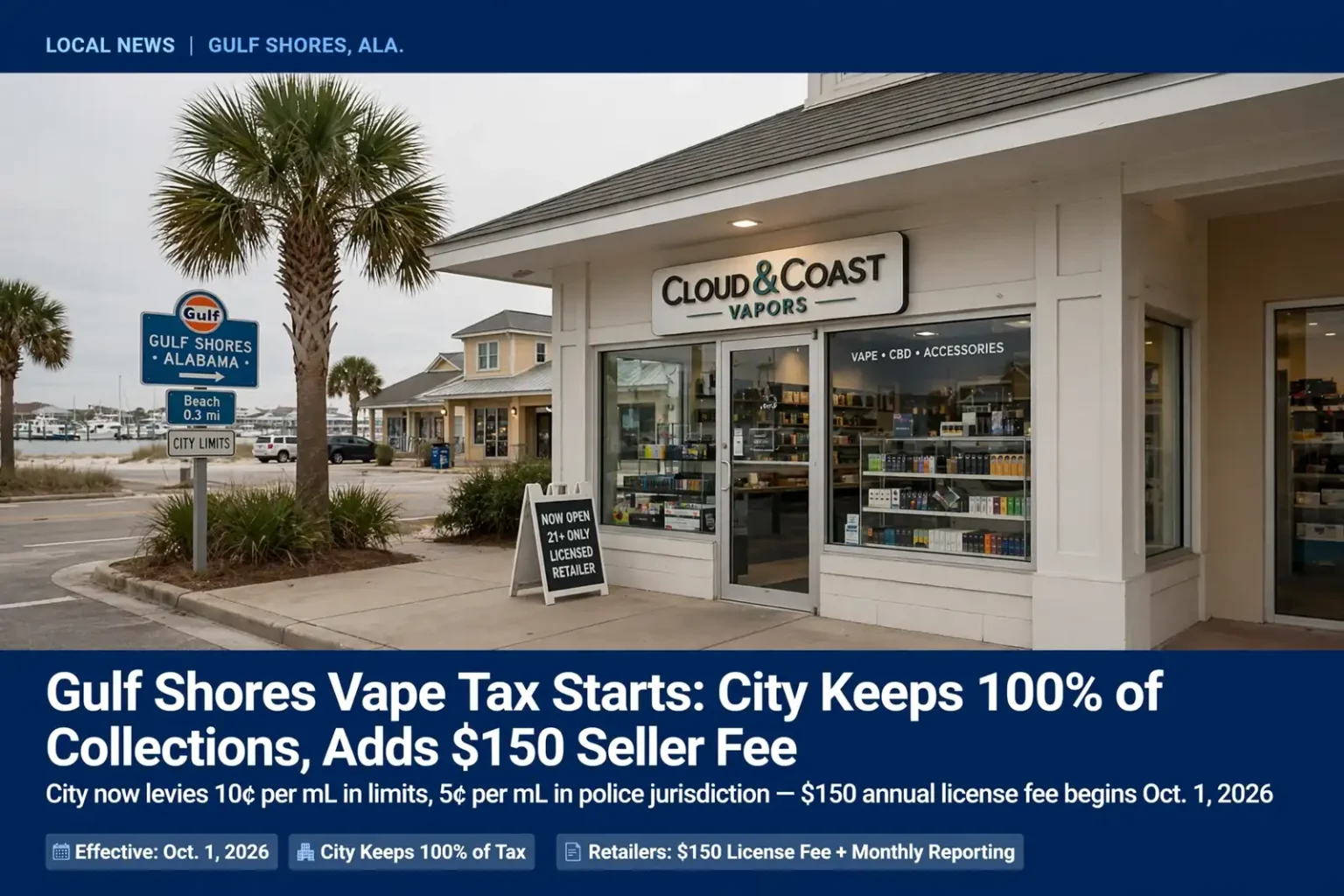
GULF SHORES, Ala. — Retailers and wholesalers that sell vaping products in Gulf Shores are now dealing with a new local Gulf Shores vape tax and a city license fee, after the city chose to collect the tax itself rather than share in a statewide pool. Collections began Oct. 1.
The city is levying 10 cents per milliliter of vapor product sold inside city limits and 5 cents per milliliter in its police jurisdiction. On top of the state’s $150 annual permit fee, Gulf Shores is also charging its own $150 annual fee to each wholesaler or retailer that sells vapor products.
Two ways to collect
When the state created the new tax and permitting fees for vape products, local governments were given two choices for how the money would flow.
Under the first option, the state serves as the main collector, taxing vapor products at 10 cents per milliliter sold. Half of those collections go to the state, with 25% going to county governments and 25% to city governments. The local shares are distributed quarterly based on population.
The second option allows a local government to levy and administer its own tax. In that case, the city keeps 100% of the vape taxes collected within its boundaries.
Gulf Shores chose the second route.
Why Gulf Shores kept the tax local
The math behind the decision comes down to how the statewide pool is divided. The 25% set aside for cities would be split among 465 municipalities based on population. Using 2020 census figures, Gulf Shores would receive about 0.49% of the cities’ share.
The city offered an example: If the 25% collected for cities statewide totaled $500,000, Gulf Shores would get about $2,500 of it.
For a resort city whose stores serve a large seasonal visitor population in addition to permanent residents, that population-based formula would not reflect how much is actually sold within its limits. Collecting locally means sales in Gulf Shores fund Gulf Shores.
“We do feel that we will receive more than we would’ve received had we accepted the state share,” Financial Services Director Anna Franklin said.
What retailers and wholesalers owe
Franklin outlined the city’s requirements for businesses that sell vapor products.
“We will collect an additional $150 fee per wholesaler or retailer who sells vapor products,” Franklin said. “We will also collect $0.10 (per milliliter) within the city limits or $0.05 in the police jurisdiction.”
The city says the extra $150 fee is meant to help pay the cost of administering the tax.
Here is a summary of the Gulf Shores rules:
- Tax inside city limits: 10 cents per milliliter
- Tax in the police jurisdiction: 5 cents per milliliter
- City license fee: $150 per year for each wholesaler or retailer, in addition to the state’s $150 fee
- Who remits: The licensee responsible for the tax may be either the wholesaler or the retailer
- Monthly paperwork: When the wholesaler pays, the retailer must file a sworn statement by the 20th of each month
- Start date: Oct. 1, 2026
Franklin explained how the monthly reporting works when the tax is paid further up the supply chain.
“If the wholesaler remits, then the retailer must submit a sworn statement by the 20th of each month stating this has been paid by the wholesaler,” she said.
No revenue estimate yet
Because the tax only began Oct. 1, the city does not yet know how much money it will bring in. Franklin said the first month will serve as the starting point.
“We will start using October 2026 as a benchmark for trends moving forward,” she said.
October is typically a quieter month at the beach than summer, so year-round collections, particularly during the spring break and summer seasons, will give the city a fuller picture over time.
How it compares with tobacco taxes
Gulf Shores already taxes traditional tobacco products. The city collects 10 cents on each pack of 20 cigarettes and 6.25% of the wholesale selling price on other tobacco products sold in the city.
Those local taxes come on top of the state’s, which include 67.5 cents on a pack of 20 cigarettes along with separate taxes on products ranging from cigars to chewing tobacco and snuff.
A shop owner’s view from both cities
The two neighboring beach cities made different choices. While Gulf Shores opted to collect the vape tax itself, Orange Beach chose to go with the state collection system.
Sanford McLain owns businesses in both cities. In Gulf Shores he operates CBD Pharma, and in Orange Beach his OB Vapors shop is located inside his Undertow Bar and Grill.
McLain said the tax doesn’t bother him.
“I don’t have a problem with the tax,” McLain said. “It’s really not a lot of money when you consider vapes are 20 or 30 milliliters and the tax is 10 cents per milliliter. It’s not going to affect our sales much. I wish they had done it years ago.”
At 10 cents per milliliter, that works out to roughly $2 to $3 in tax on a 20- to 30-milliliter product.
McLain said his wholesaler for both shops pays the tax to the state and passes the cost on to him, and he in turn passes it along to customers.
Part of a broader shift on vaping
The new tax arrived the same day as another state change affecting vape users. Beginning Oct. 1, Alabama’s Clean Indoor Air Act was expanded to include electronic nicotine delivery devices, such as e-cigarettes and vapes, in its definition of smoking. That means vaping is now banned in the same enclosed public places where smoking was already prohibited, including restaurants, retail stores, workplaces and government buildings.
That change came through Senate Bill 9, sponsored by state Sen. Gerald Allen, R-Tuscaloosa, and passed during the 2026 legislative session. Alabama law also prohibits selling nicotine products to anyone under 21.
What it means for shoppers and businesses
For customers, the most noticeable effect is likely to be a small increase in shelf prices as retailers pass the tax along, as McLain described. Shoppers buying in the police jurisdiction outside city limits will see the lower 5-cent rate applied.
Businesses that sell vapor products in Gulf Shores or its police jurisdiction should make sure they hold both the state permit and the city license, confirm with their wholesaler which party is remitting the tax, and file the required sworn statement by the 20th of each month if the wholesaler is paying. Questions about the local requirements can be directed to the City of Gulf Shores Financial Services Department.