The Yiaya Sisterhood: Three Women Who Built the Mobile Greek Festival, and Their Recipes
At 101, Zenia 'Yiaya' Roussos remembers the 1957 bazaar that grew into the Mobile Greek Festival. She and sisters Katina Vallas and Titsa Stratas share their stories and four family recipes as the festival opens Oct. 15.
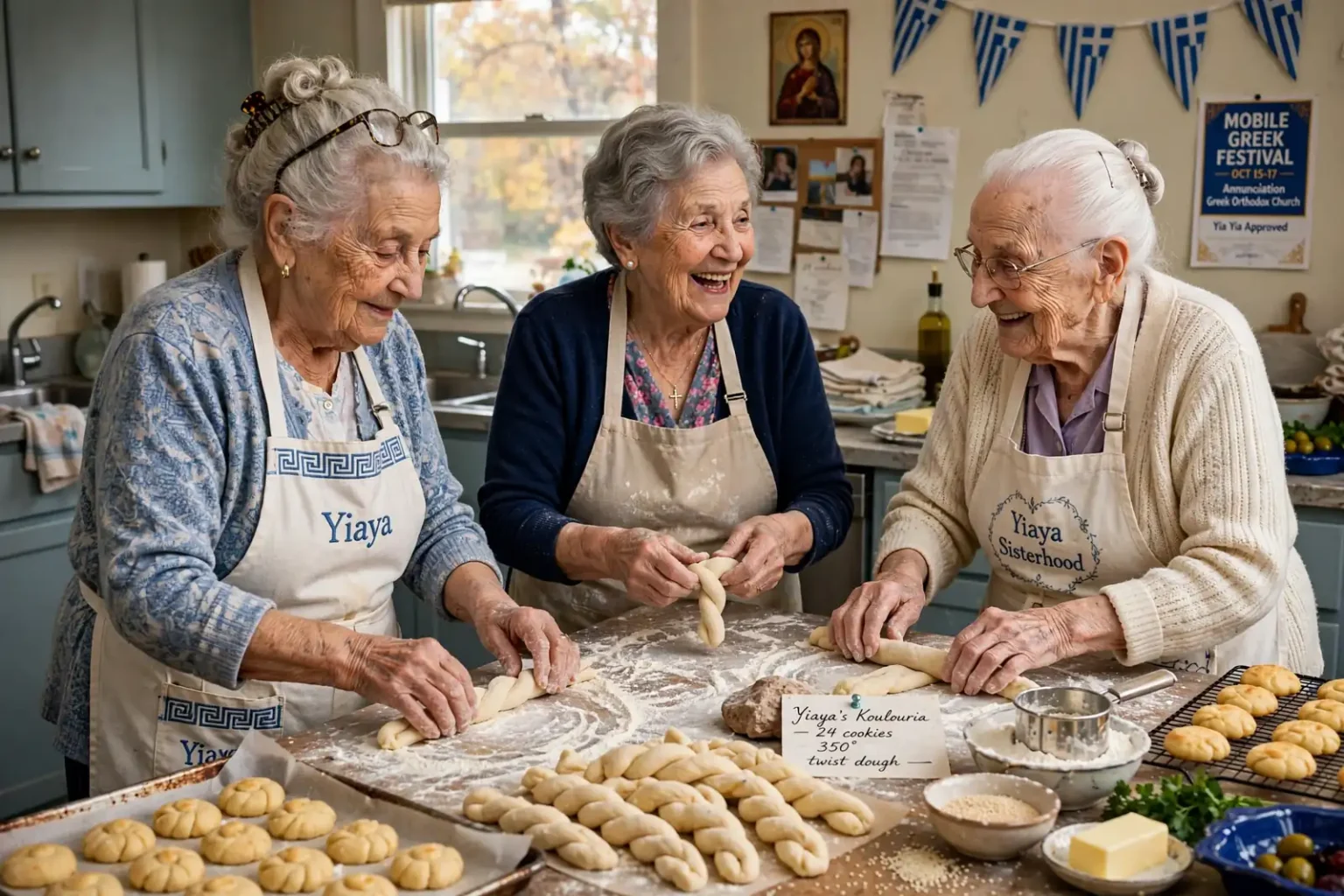
MOBILE, Ala. — Around a flour-dusted kitchen counter, three women divide a batch of cookie dough into equal portions and begin rolling and twisting it into shape, singing in Greek as they work. One is in her 80s, one in her 90s and one is 101. Between them, they have given well over a century of combined service to the Mobile Greek Festival, which opens today at Annunciation Greek Orthodox Church.
The song is one many Greek children learn while baking alongside their mothers and grandmothers. Translated, its lyrics describe the very cookies on the counter: “With my two hands, I shape koulourakia / Koulourakia, koulourakia / The oven will bake them; the house will smell sweet / Koulourakia, koulourakia.” Koulourakia are light, buttery twisted cookies, and they are one of the many treats sold each year at the festival these women helped build.
From a 1957 bazaar to the Hellenic Center
Zenia Roussos, known to family and friends simply as “Yiaya,” the Greek word for grandmother, has been part of the event since the very beginning.
“The Greek festival started from a bazaar in 1957 at the church downtown on Government. The first bazaar was there. Then they bought the property on Ann Street and the Bellingrath house, so we started having the bazaar at the Bellingrath house,” Roussos said. “It was beautiful. Everybody did something. We had lunch and supper and made all the pastries — the baklava, everything. We were there until the hall was built.”
The bazaar was organized by the local chapter of the Philoptochos Society, the national women’s philanthropic organization of the Greek Orthodox Church. Its name means “friend of the poor” in Greek, and its mission includes charitable outreach and preserving Orthodox Christian faith and traditions. The bazaar was held in the old Bellingrath home until the church hall was built around 1974. At that point the parish priest asked Roussos to reorganize the society locally, and she agreed. Today the festival takes place at the church’s Hellenic Center.
The church marks the modern festival’s history from its first Greek Night in 1962, and in the decades since it has grown into one of Mobile’s signature fall events.
Yiaya: faith, family and food
Greek heritage runs through every part of Roussos’ life. Her mother came from Constantinople, today’s Istanbul, and her father from the island of Skiathos. Born in the United States, Roussos settled in the Mobile area with her husband, George.
The couple owned the Roussos Restaurant on the Causeway until Hurricane Frederic destroyed it in 1979. The business moved to several other locations before closing for good in 2009. Long before the church had its own hall, Greek-owned restaurants helped cook for the bazaar. Roussos remembers picking up chicken from a small restaurant on Broad Street and accepting contributions from Constantine’s and, of course, her husband’s restaurant.
“Our faith is part of our living,” she said. “We were very into our church, so after I got married, both my boys were altar boys. One of the priests lived down the street, and my daughter and his daughter were very close, and they all went to church together.”
Her daughter, Georgia Roussos, described the same closeness. “The church and the family were like one. Everything you did revolved around your church, especially in those days, because most women did not work, so they had more time to spend at church, and their children were always in the church,” she said.
The family was also raised on the foods of Greece: spanakopita, pastitsio, stuffed grape leaves, baklava and koulourakia, many of the same dishes that fill the festival’s menu today. Through the festival, Roussos met two sisters who became close friends and fellow pillars of the event.
The sisters: Katina Vallas and Titsa Stratas
Katina Vallas moved to the Mobile area in 1958 and has been involved with the festival for roughly 60 years. Her younger sister, Titsa Stratas, arrived in 1964. Stratas’ husband, Nick, taught music, and the couple pitched in at the bazaar from the start. Nick Stratas later served as festival chairman for many years.
“When we started the bazaar, they asked everybody to make something, so they asked me to make a pan of pastitsio. Everybody contributed,” Vallas said.
She still laughs about one year she helped a group of women make baklava. The dessert is built from paper-thin sheets of phyllo dough, each brushed with butter and layered with a spiced nut filling, then baked and soaked in honey or sugar syrup until the top shatters when cut.
“I was buttering each sheet as they were making it, and somebody put parchment paper down for a layer of phyllo. When I was cutting it, I said, ‘This didn’t cut right.’ But that was so funny,” she said.
How the drive-through was born
As the festival grew, organizers kept looking for ways to serve more people. One of the biggest changes started as an idea Vallas thought was a bit wild.
“One year, my husband said, ‘We’re gonna do a drive-up.’ And I said, ‘Are you crazy?’” Vallas recalled.
“We started the drive-up in the church hall in a little closet, and from there we went outside to the entranceway. We were using so much power that we had to get our own setups,” Stratas added.
The freezers and refrigerators needed to store and prepare drive-up orders drew so much electricity that they affected the church’s heating and cooling. Because the church’s iconography must be kept at a steady temperature, the drive-through was given its own power source to protect the paintings. Today, the sisters’ children and grandchildren work the drive-through, now one of the festival’s most popular features for guests who want a meal without staying for the music, shopping and dancing.
Roots in Greece, lives in America
Vallas and Stratas’ mother came from Symi, a small island in the Dodecanese, and Vallas still spends two weeks there every year. She stays in the family’s stone home in the hills, built in 1879, where each morning she watches ships come into the port. The house did not get a bathroom, shower or washing machine until the 1950s and later. Because Greek dowry tradition passes property through the women of a family, the home has stayed with the women of their family for generations. A plaque marks the front door, and a fence keeps out the goats.
“I was there one day, and some tourists were renting the house next door to me, and they thought we were the Greek embassy,” Vallas said, laughing. “You’re on the water. I enjoy seeing all the people, and they know me by my first name. My grandchildren love it. They go every year and take a friend or so. In fact, my grandchildren just came back, and they were amazed that everybody asked about me, so that means a lot.”
For all their love of Greece, all three women describe themselves first as Americans. “The US is our country. Greece comes second now,” Roussos said. A visit to her husband’s home village in Greece left the couple even more grateful for the life they built here. “I’m first generation. I’m proud to say all three of my children speak Greek. I’m proud that I’m Greek, and it makes me proud when everybody enjoys my Greek background. But I’m an American Greek.”
Her family’s record of military service reflects that pride. Her father served in World War I, her husband was an Air Force radio officer in World War II, her brother served in Korea, one son served in Vietnam and the other in the National Guard.
The sisters’ family history includes both loss and resilience. When Vallas was small, her mother moved the family back to Greece, where Vallas’ twin brother fell ill. “My twin got sick on the island, and there were no pediatricians,” she said. “He died at 9 months, so she wanted to come back to America.” Five years later, Stratas and her own twin were born.
“We spoke Greek to my mother, but to my father, we spoke English,” Stratas said. Their mother taught Greek school, and the family lived in Florida, first in Orlando and later in DeLand, where Greek families were few. “When we moved to DeLand, we had to get permission from the Episcopal Church to allow a Greek priest to have service for us when he came through. When I was getting married, I had to have permission to have a Greek wedding in the Episcopal Church.”
Their father owned a restaurant, and the family regularly hosted visiting Greek families, with the children giving up their beds and sleeping on the floor. Those families returned the favor whenever the sisters’ family traveled. As Vallas put it, “Greeks never meet a stranger.” Roussos, who grew up during the Depression, remembers the same spirit of neighbors helping neighbors, and it is the same spirit the women bring to opening their church and kitchens to Mobile each October.
Passing the torch
Roussos started at the festival working the cash registers and later took charge of pastries, a job she held until age 93 before handing it to Vallas. She no longer works the festival, but she is proud of what it has accomplished.
“We not only made money for the church; we gave money to others,” she said. Over the years, the church has donated to schools, Penelope House and other charities.
The sisters say the reward is in the people. “You get a chance to meet so many people,” Stratas said. “And to serve them Greek food!”
In her home, Roussos keeps a wall of vintage family photographs, a 40th wedding anniversary gift from her family, showing babies, weddings, dances, celebrations and, naturally, meals shared around the table. Looking it over, she offered a simple summary: “My whole life is right here.”
Recipes from Yiaya’s kitchen
The women shared four family recipes. Each is written for a home kitchen.
Yiaya’s Koulouria (makes 24 cookies)
- 3 cups flour
- 1 1/3 teaspoons baking powder
- 1/3 pound butter, softened
- 2 1/2 tablespoons oil
- 2 eggs
- 2/3 cup sugar
- 2 1/2 tablespoons sesame seeds (optional)
Heat the oven to 350 degrees. Sift the flour and baking powder together and set aside. With a mixer, cream the butter, then beat in the oil. Add the eggs, sugar and sesame seeds, if using, and mix well. Work in the dry ingredients a little at a time to form a dough. Divide it into 24 even balls, roll each into a rope and twist into the shape you like. Bake on an ungreased cookie sheet until lightly golden, cool completely and store airtight. Koulouria are traditionally large sesame-covered rings sold as street food; koulourakia are the smaller, butterier cookie version.
Kotopoulo Lemonato, or “Roussos’ Chicken George” (serves 4)
- 4 medium potatoes, peeled and quartered
- 3 medium onions, peeled and quartered
- 4 large carrots, peeled and cut into large pieces
- Other roasting vegetables, optional
- 1 frying chicken, quartered
- 1/4 cup olive oil
- Juice of 2 lemons, plus zest if desired
- 1 tablespoon oregano
- 1 tablespoon garlic powder
- 1/2 tablespoon onion powder
- 2 teaspoons salt
- 1/2 teaspoon black pepper
- Water as needed
Heat the oven to 350 degrees. Set the chicken pieces skin side up in a large, shallow roasting pan and tuck the vegetables around them. Whisk the olive oil, lemon juice, zest and seasonings and pour over everything, then add about half an inch of water to the pan. Bake for about an hour, turning the chicken halfway and basting with pan juices, until the chicken is cooked through and the vegetables are tender and golden.
Yiaya’s Spanakopita (makes 30 pieces)
- 1 pound phyllo dough
- 2 large onions, chopped
- 1 head garlic, minced
- About 2 tablespoons olive oil for sautéing
- 3 sticks (3/4 pound) butter, melted
- 1 1/2 pounds feta, crumbled
- 1 1/2 cups shaved or shredded sharp Parmesan or Romano
- 8 eggs, beaten
- 6 packages (10 ounces each) frozen chopped spinach, thawed and squeezed dry
- Zest and juice of 1 lemon
- Salt, black pepper and garlic powder to taste
Heat the oven to 350 degrees and butter a cookie sheet. Keep the phyllo covered with wax paper topped by a damp towel so it stays pliable. Sauté the onion and garlic in olive oil and a little butter until soft and lightly browned, then cool slightly. Combine the cheeses, eggs, spinach, onion mixture, lemon zest and juice, and season. Stack four to six buttered sheets of phyllo, spoon one-fifth of the filling along the long edge, fold in the sides and roll into a log. Brush the log with butter and lightly score the top into six portions without cutting through. Repeat to make five rolls, then bake about an hour until crisp and deep golden. Extra rolls can be wrapped in foil, frozen and baked straight from the freezer. Roussos’ granddaughter, Alexandra Theris, adapted the recipe for beginners.
Almond Cookies (makes 56 cookies)
- 1 jar (10 ounces) maraschino cherries, halved and drained
- 1/2 pound unsalted butter
- 3/4 cup sugar
- 2 eggs, separated
- 1/2 teaspoon almond extract
- 2 cups flour
- 1/2 cup chopped almonds
- Half of a 12-ounce jar of apricot preserves
Heat the oven to 350 degrees and line a baking sheet with parchment. Cream the butter and sugar, then beat in the egg yolks and almond extract and gradually add the flour. Whisk the egg whites until just frothy. Roll the dough into small balls, dip each in egg white, roll in chopped almonds and press a small dent in the center. Bake until lightly browned and cool completely. Just before serving, fill each with a dab of apricot preserves and top with half a cherry.
If you go
- What: Mobile Greek Festival, themed “Yia Yia Approved” this year in honor of the grandmothers behind the recipes
- When: Thursday, Oct. 15, through Saturday, Oct. 17, 11 a.m. to 9 p.m. daily
- Where: Annunciation Greek Orthodox Church, 50 S. Ann St., Mobile
- Admission: Free
- Payment: Cashless this year; debit and credit cards only
- Food: Indoor dinner line, outdoor food area, Greek bakery and curbside pickup for meals to go
- Also: Live Greek music, folk dancing, a Greek market and church tours