Troy Fraternity Suspension: Pi Kappa Phi Barred Until 2029 After Hazing Finding
Troy University suspended its Pi Kappa Phi chapter until fall 2029 after finding evidence that a new member was hazed. Members living in the chapter house must move out by Oct. 26.
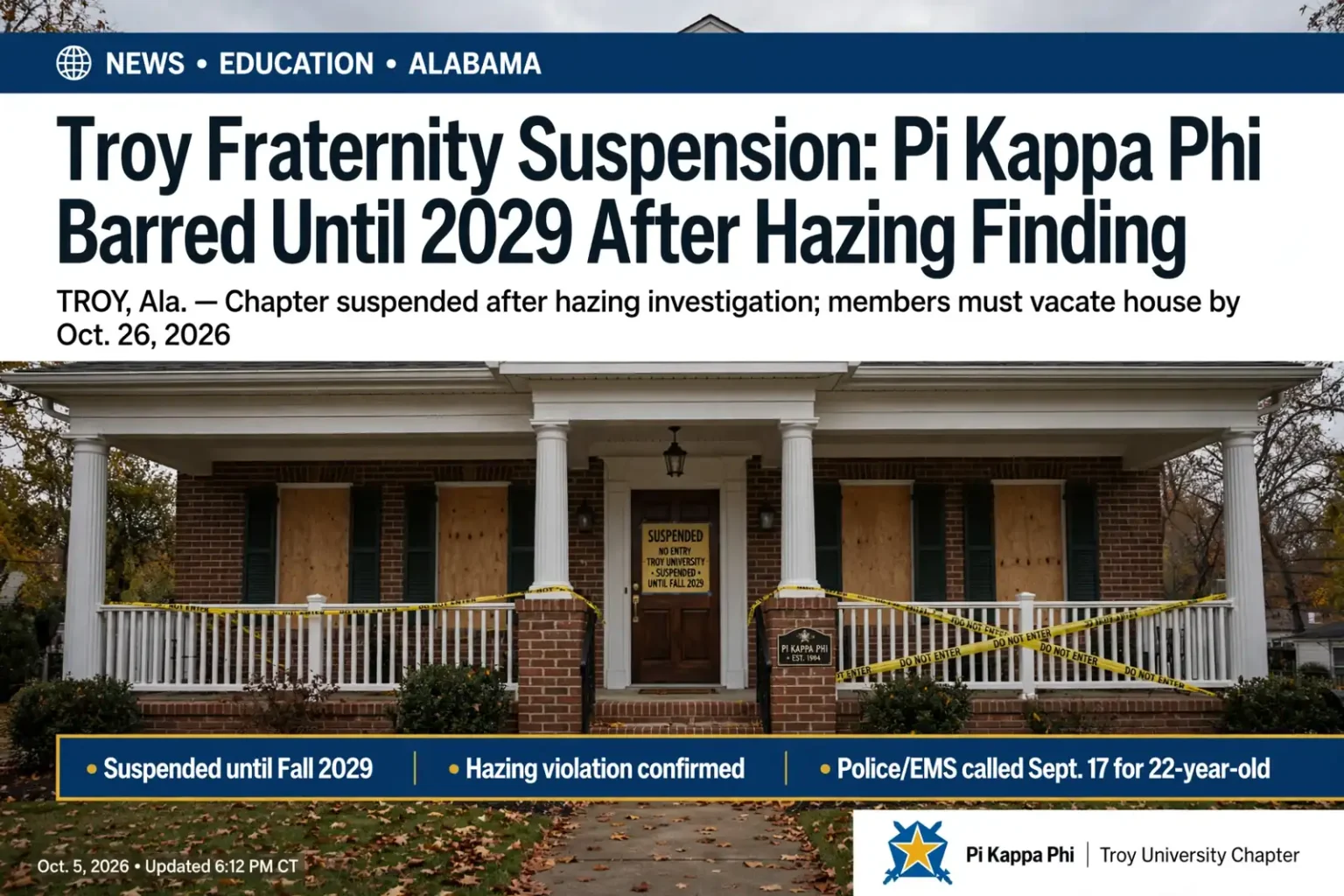
TROY, Ala. — Troy University has suspended its Pi Kappa Phi chapter after a university investigation found evidence that a new member was hazed, putting the fraternity off campus until the fall of 2029. The Troy fraternity suspension also requires members who live in the chapter house to move out by Oct. 26.
The action follows a September incident in which police and emergency medical crews were called for a 22-year-old man who needed medical attention. He was taken to a hospital and released the next day.
What the University Found
Troy University announced that the chapter violated both the university’s hazing policies and those of Pi Kappa Phi’s national organization.
“The chapter was found to have violated University policies and the national organization’s policies on hazing,” Matt Clower, Troy University’s senior director of communication, said in a statement.
The university has not publicly described what the hazing involved. Details of the September incident remain unclear, and school officials have not said how many members were involved, whether any individual students face discipline, or whether the case has been referred for possible criminal charges.
The Sanctions at a Glance
- Chapter: Pi Kappa Phi at Troy University
- Finding: Violations of university and national hazing policies involving a new member
- Penalty: Chapter suspended; not allowed to return until fall 2029
- Housing: Members living in the fraternity house must move out by Oct. 26, 2026
- Related incident: Police and EMS called Sept. 17 for a 22-year-old man needing medical attention; he was hospitalized and released the following day
A suspension that runs until fall 2029 covers roughly four academic years, the length of a typical undergraduate career. Any return would come only after that period ends.
The September Medical Call
According to a police report, officers and emergency medical services were dispatched on Sept. 17 for a 22-year-old male who needed medical attention. He was taken to a hospital and was released the following day.
The report does not lay out what led to the call, and the university has not publicly tied specific events from that night to its findings. The student’s name has not been released, and his condition after his release from the hospital has not been made public.
Not the Chapter’s First Hazing Suspension
This is not the first time Pi Kappa Phi at Troy has been shut down over hazing. In 2013, the university and the fraternity’s national organization suspended the chapter after a hazing victim was tied to a tree, pelted with eggs and forced to find his own way home.
The chapter later returned to campus. The new suspension, coming roughly 13 years after the first, will keep it off campus for about four academic years.
What Happens Next
The most immediate deadline falls on members who live in the chapter house, who have until Oct. 26 to move out. The university has not said what will happen to the house itself during the suspension or whether it will help displaced members find other campus housing.
Troy has also not said whether its findings were shared with law enforcement or whether any police investigation into the September incident remains open. If more information is released about what happened on Sept. 17, or if any charges are filed, this story will be updated.
What State and Federal Law Say About Hazing
Hazing is a crime in Alabama. State law broadly defines it as any willful action taken or situation created, whether on or off campus, that recklessly or intentionally endangers the mental or physical health of a student, as well as forcing or pressuring students into activities such as excessive drinking or physical abuse as a condition of joining or keeping membership in a group.
Under the law, hazing is a Class C misdemeanor. The statute also says that organizations which knowingly permit hazing can be penalized, including the loss of state funds or aid, and that individuals who take part can lose state-funded financial aid.
Whether any criminal charges will follow in the Troy case is unknown. No charges had been announced as of this week.
At the federal level, colleges are under growing pressure to report hazing publicly. The Stop Campus Hazing Act, signed into law in December 2024, requires colleges and universities that take part in federal student aid programs to include hazing incidents in their annual campus security statistics, to provide hazing prevention education and to publish reports listing student organizations that have been found responsible for hazing violations.
Those requirements are meant to give students and parents a clearer picture of which groups have a history of hazing before a new member decides to join. Troy, like other schools that participate in federal aid programs, is subject to those reporting rules.
About Troy University
Troy University is a public university based in Troy, in Pike County in southeast Alabama. It was founded in 1887 as a teacher-training school and has grown into a university system with campuses in Troy, Dothan, Montgomery and Phenix City, as well as online programs and sites serving military students.
Pi Kappa Phi is a national social fraternity founded in 1904 at the College of Charleston in South Carolina. The national organization sets its own standards for chapters, including policies prohibiting hazing, and can suspend or close chapters that violate them.
Where to Get Help or Report Hazing
Students who experience or witness hazing are encouraged to report it to campus police, their university’s dean of students or student conduct office, or the national headquarters of the organization involved. Many universities also offer anonymous online reporting forms.
Anyone who believes someone is in immediate danger, such as from alcohol poisoning, an injury or a medical emergency during an initiation activity, should call 911 right away.