Prichard and Mobile Reinstate Youth Curfews as School Year Begins
Prichard and Mobile reinstated daytime and nighttime curfews for minors this week as the new school year got underway across Mobile County schools.
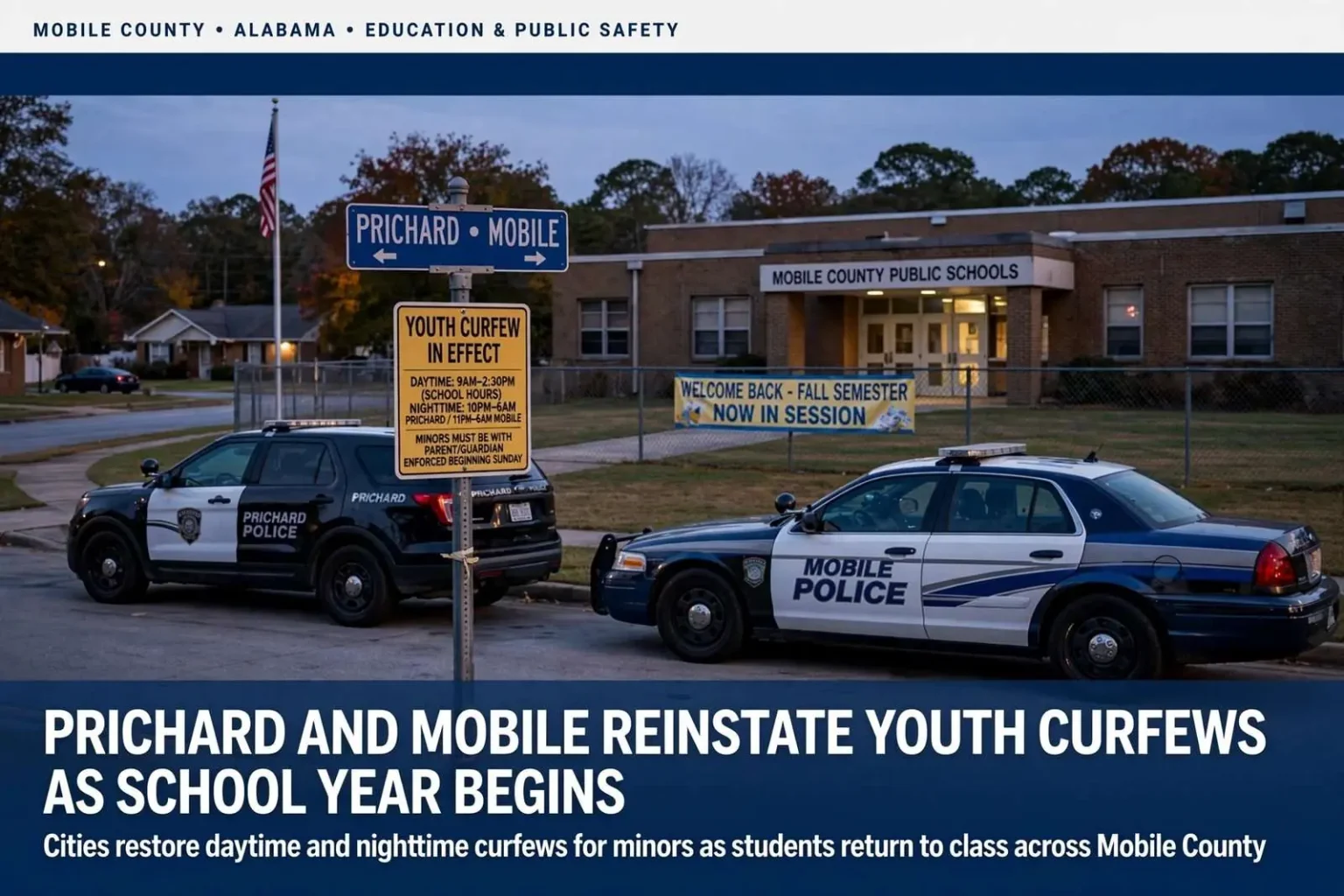
MOBILE COUNTY, Alabama — With students back on campus for the new school year, both Prichard and Mobile have reinstated youth curfews meant to keep teenagers in the classroom during the day and off the streets at night, officials in both cities confirmed this week. The coordinated return of the ordinances reflects a long-standing partnership between the two neighboring municipalities, which sit side by side in the northwestern corner of the county and share many of the same families, schools, and public safety challenges.
Prichard’s rules take effect this weekend
In Prichard, curfew enforcement for minors began at 12:01 a.m. Sunday, requiring anyone 18 or younger without a legal exemption to be accompanied by a parent or guardian during specified hours. The city, which lies just north of Mobile along the U.S. 45 corridor, has used curfew ordinances in past years as part of its juvenile crime prevention strategy, and the start of the school year is the point on the calendar when enforcement typically resumes in full.
According to the city’s intergovernmental affairs office, the ordinance sets separate nighttime and daytime windows, since young people are expected to be in school during the day and supervised at night. The two-part structure is designed to cover the hours when school-age residents are most likely to be unsupervised — the school day itself and the late-night hours after most families have settled in at home. Minors caught outside those hours are taken to the city’s curfew center at the police department and can only be released to a parent or legal guardian.
The curfew center model gives officers an alternative to the county’s juvenile detention system for what are usually low-level status offenses. A teenager picked up on a curfew violation is transported to the police department, where staff document the contact and work to reach a guardian. The requirement that release happen only to a parent or legal guardian is meant to ensure that no child leaves the facility without an adult taking responsibility for getting them home and, in many cases, understanding why the stop occurred.
A proactive approach to crime prevention
Prichard’s police chief described the curfew as a proactive tool for preventing juvenile crime, noting that teenagers found wandering the streets during school hours are statistically more likely to become involved in criminal activity. The reasoning, familiar to departments across Alabama, is that enforcement of a status offense — being out when the law says a minor should be in school or at home — interrupts problems before they escalate into burglaries, assaults, or worse, both as offenses committed by juveniles and as offenses committed against them.
Violations of the ordinance can bring a verbal warning, fines or, in more serious cases, other penalties. The graduated structure gives officers discretion for first contacts, particularly for young people who may simply not realize the school-year rules are back in force, while reserving the stiffer consequences for repeat offenders or situations involving other unlawful conduct.
Under the current schedule, nighttime curfew in most of the city runs from 10 p.m. to 6 a.m. Sunday through Thursday, with a slightly different overnight window in the city’s downtown district and an extended overnight curfew running from just after midnight to 6 a.m. on Fridays and Saturdays. The weekend allowance recognizes that older teenagers may legitimately be out later with families on Friday and Saturday nights, while the separate downtown window reflects the different pattern of activity in the city’s commercial core.
The daytime curfew runs from 9 a.m. to 2:30 p.m. on school days, matching Mobile County Public School hours. That alignment is deliberate: the window covers the full instructional day, so any school-age child seen on a public street or in a business during those hours is, by definition, somewhere other than where the law and the school calendar say they should be. Truant officers and school resource officers coordinate with municipal police to make sure students picked up under the ordinance get back to campus or home rather than simply being turned loose.
Mobile’s curfew runs on a similar schedule
In Mobile, police enforce a comparable set of hours, with a daytime curfew also running from 9 a.m. to 2:30 p.m. and a nighttime curfew from 11 p.m. to 6 a.m., according to the Mobile Police Department’s public information officer. The city’s ordinance applies across Alabama’s fourth-largest city, from the downtown entertainment districts to the neighborhoods north of Prichard’s city limits, and is administered by patrol officers during routine calls rather than by a dedicated curfew unit.
Officers who spot a school-age person out during daytime curfew hours are expected to ask why they are not in school and, when appropriate, help get them there. That emphasis on assistance over punishment shapes how the daytime rule works in practice: a student with a legitimate exemption — a doctor’s appointment, an early dismissal, a work-based learning program — is documented and sent on their way, while a student who is simply skipping class may be transported back to campus so the absence does not harden into a pattern.
During nighttime hours, officers first try to reach a parent or responsible adult before taking a juvenile to the city’s curfew center as a last resort. The preference for releasing minors on the spot, whenever an adult can be located quickly, keeps the curfew center from filling with young people whose only offense was being out late, and it returns children to their families faster than a formal transport and booking process would.
A downward trend in violations
Mobile police said the department logged 21 curfew violations in August of the previous year, with two of those minors ultimately taken to the curfew center. The small share of stops that end in a trip to the center illustrates how the ordinance functions mostly as a checkpoint and a warning system rather than a pipeline into the juvenile justice system. Officials said the overall number of curfew violators has trended downward in recent years, a shift they attribute in part to families and students becoming familiar with the rules over multiple school years of enforcement.
Mobile’s curfew ordinance has been in place since 2011 and was extended in 2012 through the end of 2014, though city officials said it remains unclear what will happen to the ordinance once that extension expires. The uncertainty leaves the measure on a short political leash: each extension has required fresh approval from the City Council, and the current window gives city leaders time to evaluate the ordinance’s record before deciding whether to make it permanent, let it lapse, or replace it with a revised version.
For parents in both cities, the practical message at the start of the school year is straightforward. Teenagers need to be off the streets by the posted nighttime hours on weeknights, in school during the instructional day, and — when they are out during permitted weekend hours — aware that the extended windows end just after midnight. Adults who allow or ignore curfew violations can share in the consequences through fines, and repeated contacts can draw families into the municipal court process.
Both cities frame the curfews as a shared effort between police, schools and families to keep students safe and in class as the academic year gets underway across the county. With Mobile County Public Schools’ calendar driving the daytime windows, and with the two police departments using nearly identical hours, the message to young people crossing the city line between Prichard and Mobile is the same on either side: during the school year, the hours after midnight and the hours of the school day belong at home or in a classroom.
Curfew ordinances of this kind occupy a familiar place in Alabama municipal law. They regulate the movements of minors rather than adults, so they attach consequences to the young person and, through fines and release requirements, to the guardians responsible for them. Legal exemptions typically cover minors who are accompanied by a parent or guardian, traveling to or from work, responding to an emergency, or exercising a protected activity, and officers are expected to ask questions before writing anything up.
The two cities’ approaches also reflect the geography of the communities involved. Prichard’s residential neighborhoods and commercial corridors are compact, which makes nighttime patrols and the downtown-specific window workable for a mid-sized department. Mobile, with a much larger footprint and more varied nightlife, relies on the 11 p.m. start time to leave room for legitimate evening activities while still clearing the streets at a reasonable hour on school nights.
School officials, for their part, have long linked attendance enforcement to the curfews. Daytime truancy sweeps coordinated around the 9 a.m. to 2:30 p.m. window send a visible message in the opening weeks of the school year, when attendance habits are still forming. Police and school staff generally prefer to resolve a daytime stop with a ride back to campus, because a student returned to class is a student counted present for state attendance purposes — and a student who is not standing on a street corner in the middle of a school day.
As the new year gets underway, both departments say the early numbers will be watched to see whether the downward trend in violations continues. For now, the rules are back, the hours are posted, and the burden falls first on young people and their families to know the windows — and on the two police departments to enforce them the way they have since the ordinances first took effect: with a question, a phone call to a parent, and a ride home before anything more serious.