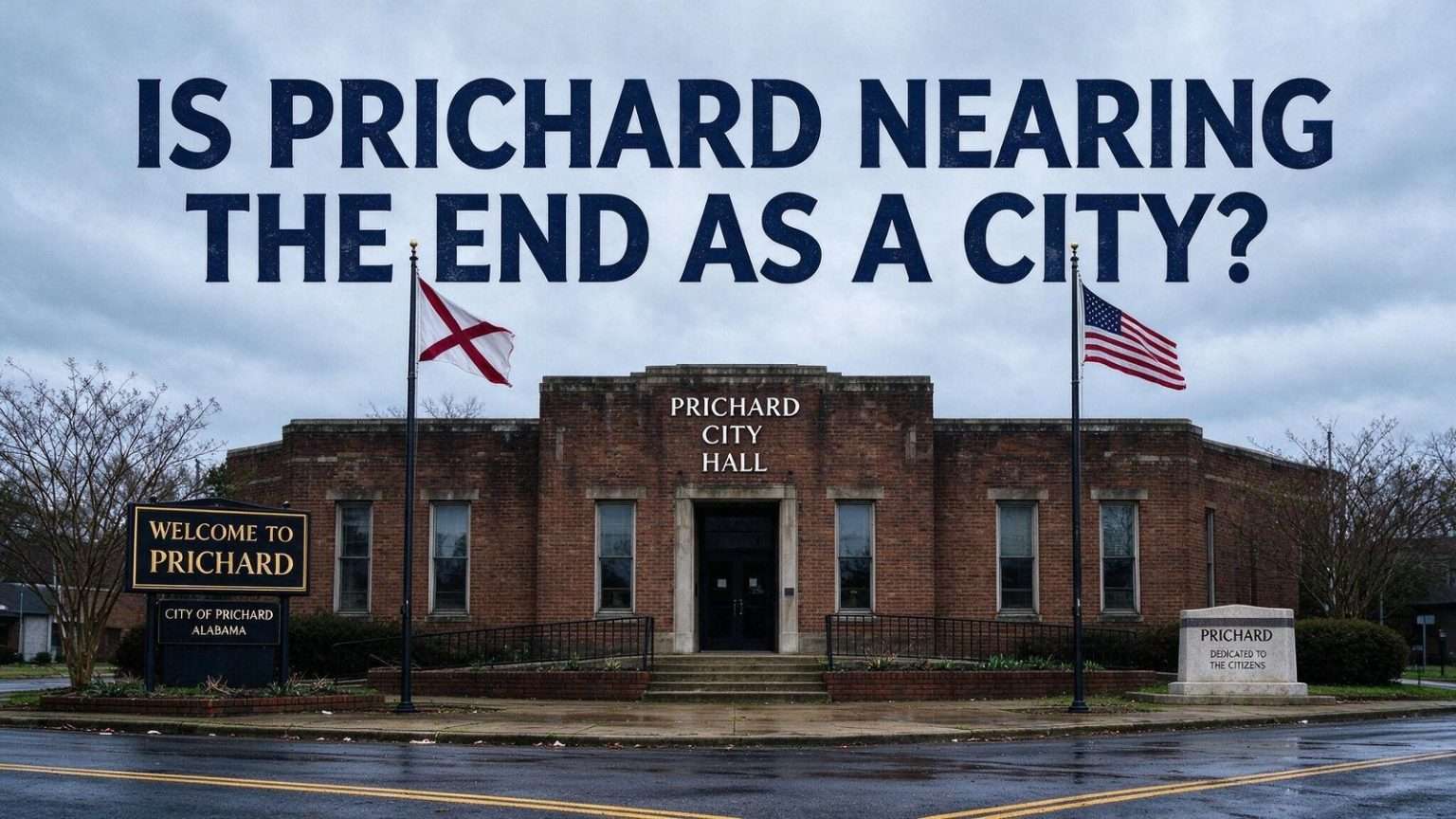
The talk circulating through political and governmental circles in Mobile County in early March 2009 was blunt enough that it was worth stating plainly: some insiders believed Prichard might not survive as a city. The buzz held that financial missteps — made at moments when fiscal nimbleness was needed — had all but choked the life out of a once-proud municipality. The odds, according to those insiders, were better than even that the city would eventually dissolve, with the state stepping in to pick up the pieces.
It was chatter, not an announcement. But it was chatter of a kind that does not usually attach itself to a functioning city, and in Mobile County — where local government is fragmented among the county commission, the city of Mobile and a patchwork of suburbs — a prediction about one city’s survival travels quickly from courthouse hallways into public conversation.
What dissolution would actually mean
The most immediate consequence, and the one people kept returning to, was law enforcement. Prichard, whatever its fiscal condition, had ample need for policing. If the city ceased to exist as a municipal entity, that need would not disappear along with the city seal. It would simply be handed to someone else, under the police jurisdiction rules that extend a city’s enforcement authority beyond its boundaries and assign rural remainder areas to the sheriff. Much of an unincorporated Prichard would fall within the Mobile Police Department’s police jurisdiction, meaning Mobile officers would inherit a substantial share of the calls. The remainder would fall to the Mobile County Sheriff’s Department.
Both agencies were already stretched, and neither had budgeted for the arrival of a former city’s worth of work. The prospect, in other words, was not that Prichard’s problems would be solved by dissolution. It was that they would be redistributed — to two departments that had no obvious capacity to absorb them. The same arithmetic applied to other city functions: water service, code enforcement, street maintenance and the courthouse annexes where Prichard residents conduct everyday business would all need new operators or new arrangements almost overnight.
A city with a long shadow
Prichard sits immediately northwest of Mobile, and for much of the 20th century it was one of Alabama’s larger cities, a working-class community whose population climbed steadily through the postwar decades. Incorporated in the 1920s and named for an early settler family, Prichard grew as a bedroom and industrial companion to the port city next door, attracting families who worked in Mobile’s shipyards, factories and rail yards but wanted homes of their own just beyond the city line.
Its decline since then has been among the starkest in the state: residents left, the tax base thinned, and the obligations the city had taken on in more prosperous years remained on the books. The city’s troubles were not secret by 2009. Prichard had already been through a Chapter 9 municipal bankruptcy in the preceding decade, and its employee pension fund — underfunded for years — had become the subject of litigation and headlines that made the city a statewide cautionary tale about municipal finance.
By 2009 those obligations had become the central fact of Prichard’s public life. A city whose revenues had fallen far below what its commitments required was, in the assessment of the people watching most closely, running out of room to maneuver. The national recession bearing down on the country that winter only sharpened the squeeze, cutting sales tax collections and state shared revenues just as the city needed every dollar to meet fixed obligations.
Why dissolution is not simple
The unanswered questions were as significant as the prediction itself. Nobody quoted in these conversations was prepared to put a date on anything, and no formal proceeding was under way. Dissolving a municipality in Alabama is not a routine administrative act, and the state had shown no eagerness to volunteer for what would follow. Cities in Alabama, once incorporated, occupy a legal status that the state does not lightly unwind, and the machinery for dissolving a city of Prichard’s size — tens of thousands of residents, a water system, employees, debts and assets — had rarely, if ever, been exercised on that scale.
Bankruptcy, by contrast, was a path Prichard had already traveled. Chapter 9 of the federal bankruptcy code exists precisely for municipalities whose obligations exceed their capacity to pay, and a city that reenters protection can restructure debts under a judge’s supervision while continuing to operate. Dissolution offers no such framework — it simply ends the entity, leaving the state and surrounding governments to sort out the residue. That difference explains why the insiders’ talk of dissolution, while dramatic, stopped short of describing any legal mechanism by which it would happen.
For neighboring governments, the prospect carried its own anxieties. Mobile County officials calculated what it would cost to absorb roads and services; the city of Mobile weighed the policing burden a jurisdiction change would add; and suburban mayors watched to see whether the state would set any precedent for how a failing city’s affairs are wound down. No one wanted to be the jurisdiction that inherited the problem, and no one could say with certainty who would.
The conversation itself was the signal
What the talk did reveal was that the possibility had crossed from the unthinkable into the merely difficult. When people in county government begin working through the practical mechanics of a city’s disappearance — who answers the calls, who picks up the pieces, which budget absorbs the cost — the conversation has already moved some distance from where it began. In government, contingency planning is often the most honest barometer of what officials actually expect, however carefully they qualify it in public.
The episode also said something about the era. The recession that began in late 2008 hit municipal budgets across Alabama, forcing cuts in cities large and small, and it sharpened long-running questions about which communities could sustain the services their residents expected. Prichard’s case was the most extreme in Mobile County, but the arithmetic it faced — shrinking revenue, fixed obligations, an aging infrastructure and a population smaller than its service map — was familiar to officials in a dozen other small cities around the state.
For residents of Prichard, the discussion carried an obvious sting. The question being asked around Mobile County was not how to restore the city’s finances. It was what would happen to the place if no one could. Homeowners wondered what dissolution would mean for property values, insurance and the water service they paid for; retirees with pensions at stake watched the news from City Hall with particular attention; and families whose roots in the city ran back generations bristled at the suggestion that their city’s story might end in a ledger line. Whatever the odds really were, the fact that respectable people in county government were discussing the end of Prichard at all told residents that their city’s crisis had entered a new and darker phase.
The pension problem at the center
Any discussion of Prichard’s finances in that period eventually arrived at the pension fund, because it was the obligation that could not be negotiated away. The fund had been allowed to fall so far behind its promises that the courts became the arena where the question was settled, and the rulings that emerged bound the city to benefits it had no clear way to pay. Unlike discretionary spending, which a council can trim year to year, a pension debt follows a city into every budget until it is funded, restructured or discharged — and none of those options was available to Prichard in a form that ended the crisis.
The pension dispute also carried a human dimension that complicated the politics of any fix. The people owed the money were retirees — former police officers, firefighters, clerks and public works employees — many of whom had spent entire careers with the city on the understanding that a modest pension would follow. Proposals to reduce or suspend benefits set the city’s survival against the security of its oldest and most vulnerable creditors, a choice no elected official wanted to own and no court embraced lightly.
That is the backdrop against which the dissolution chatter of early March 2009 should be read. The insiders doing the talking were not, for the most part, hostile critics of the city; they were officials close enough to the ledgers to see the trajectory, and their grim arithmetic was an expression of concern rather than contempt. Talk of the state stepping in was less a plan than a prediction: that at some point Prichard’s obligations would exceed not just its revenues but its legal capacity to keep operating, and that someone above the city would have to decide what happens next.