Mobile Man Wounded in Late-Night Shooting Near Interstate Motel
A man was shot in the abdomen outside a Mobile motel near Interstate 65 after two strangers allegedly asked him to break a $100 bill, police say.
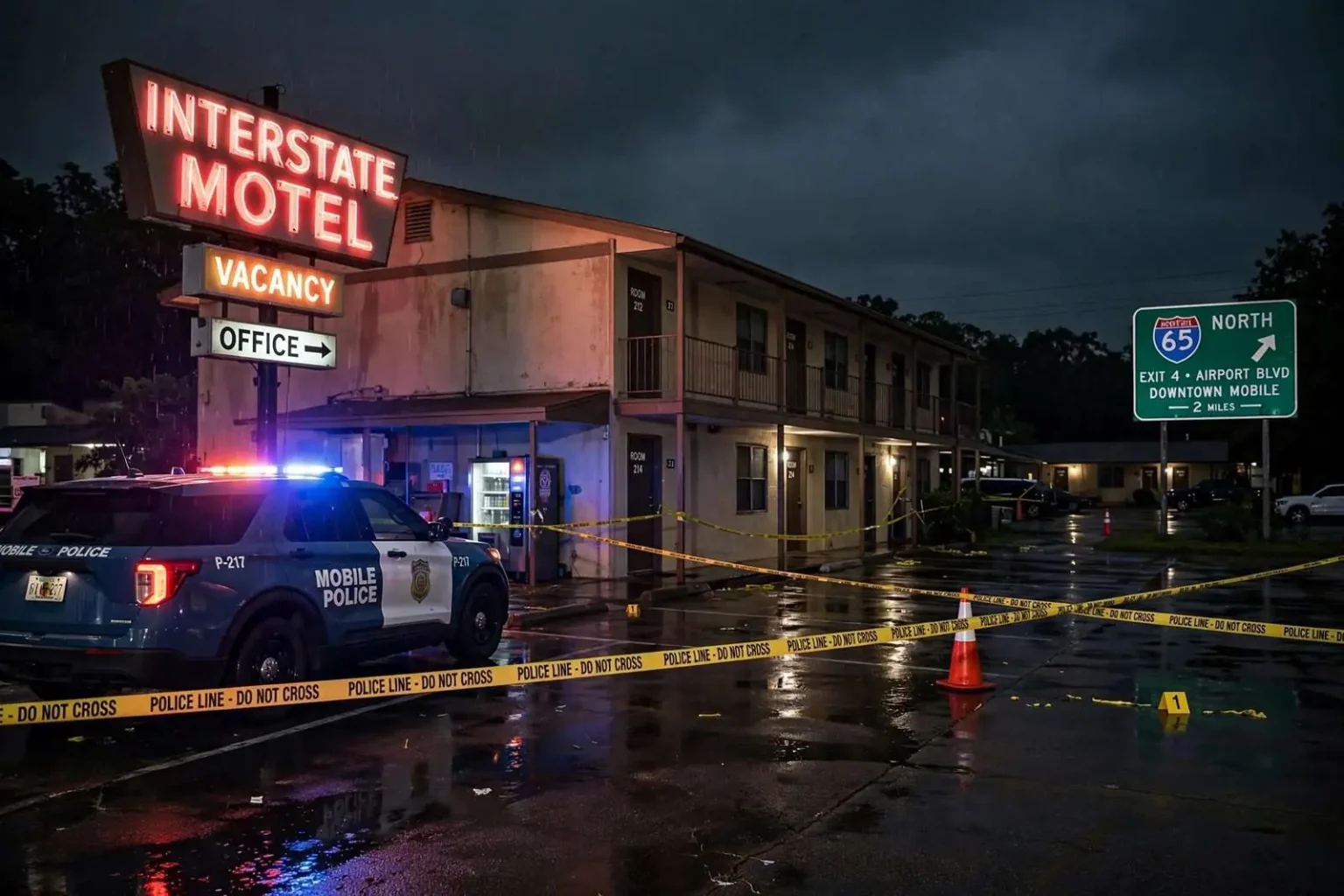
MOBILE, Alabama — A man was recovering after being shot in the abdomen outside a motel along the Interstate 65 corridor in Mobile, in what investigators describe as a robbery attempt gone wrong. The late-night gunfire left one man hospitalized, two suspects at large, and police searching for answers about an encounter that began with an ordinary-sounding request for change.
A late-night encounter turns violent
Mobile police say officers were called to the motel property late on a Sunday night after reports that someone had been shot. The motel sits along the busy Interstate 65 corridor, one of the main north-south arteries cutting through the city, where a string of lodging properties serves travelers passing through the Gulf Coast region.
Responding officers found the victim suffering from a gunshot wound to the abdomen. Paramedics rushed him to a nearby hospital for emergency treatment. His condition following the shooting was not immediately made public, and authorities did not release his name.
According to the account the victim gave investigators, two men he did not know approached him outside the motel and asked whether he could break a $100 bill. When he told them he did not have change, the men allegedly produced a weapon and opened fire before running from the scene.
Detectives spent the hours after the shooting canvassing the motel property, looking for witnesses who may have heard the confrontation or seen the suspects flee. Investigators have not publicly described the two men beyond the details the victim was able to provide in the immediate aftermath of the attack.
Police describe a staged setup
A spokesperson for the Mobile Police Department told reporters the encounter had the hallmarks of a planned robbery rather than a random dispute. The request for change, in the department’s view, appeared to be a pretext used to gauge whether the victim was carrying cash worth stealing.
The tactic is one officers across the Gulf Coast have warned about in various forms: a seemingly harmless question from strangers that is really a probe. A traveler who pulls out a wallet to look for bills has, in effect, answered the question for the people asking it, revealing whether cash is there for the taking.
Investigators continued working to identify the two men involved, though no arrests had been announced in the immediate aftermath. Police urged anyone with information about the shooting or the suspects to come forward, noting that tips from the public often prove decisive in cases involving unidentified attackers at commercial properties like motels, where security camera coverage can be uneven.
The case remained open as detectives reviewed whatever surveillance footage was available from the motel and neighboring businesses along the corridor. Until an arrest is made, police said, the department is treating the incident as a targeted robbery that escalated to gunfire when the victim’s answer disappointed the men who approached him.
A recurring concern along the interstate corridor
Motels clustered near interstate exits have long drawn attention from Mobile-area law enforcement because of their transient clientele and late-night foot traffic, conditions that can make it easier for opportunistic criminals to target travelers. Guests arriving at night, often unfamiliar with the area and carrying cash or valuables for a trip, present the kind of opportunity that predators look for.
The Interstate 65 corridor through Mobile connects the city’s northern neighborhoods to the downtown district and continues south toward the Eastern Shore, passing rows of lodging properties, restaurants and service stations that depend on highway traffic. The same visibility that makes these businesses convenient for travelers can make their parking lots inviting settings for street-level crime after dark.
Incidents like this one add to a broader pattern of nighttime robberies and assaults reported in and around the city’s motel districts over the years, prompting periodic calls for added patrols and better lighting in parking areas. Neighborhood groups and business owners along the corridor have at times pressed for coordinated efforts between police and motel operators to address the problem.
Law enforcement agencies nationwide have responded to similar conditions with a mix of strategies: increased patrols of hotel and motel properties during overnight hours, requirements that properties maintain exterior lighting and maintain guest registers, and cooperation with operators to keep known troublemakers off the premises. The Mobile Police Department has emphasized visibility in commercial corridors as part of its broader approach to reducing after-dark crime.
What travelers should know
Safety specialists have long advised travelers to stay alert in motel parking areas, particularly at night. Simple precautions can reduce risk: park in well-lit spots close to the room, keep valuables out of sight, remain aware of anyone loitering nearby, and avoid displaying cash in public.
Police also note that requests from strangers that seem designed to start a conversation about money — breaking a large bill, asking for cab fare, or soliciting with a hard-luck story — can sometimes be a way of sizing someone up. The recommended response is to keep moving, avoid opening a wallet, and head for a populated, well-lit area or inside the motel office if something feels wrong.
If a confrontation does occur, officers say, the safest course is to comply with demands rather than resist, then call 911 as soon as possible and provide as detailed a description as memory allows. Quick, accurate descriptions of suspects and any vehicle involved remain the most valuable information a victim or witness can give investigators.
The shooting also serves as a reminder to area residents about the importance of reporting suspicious activity early. In commercial corridors with constant turnover, patterns of trouble — the same people lingering in a parking lot night after night, or repeated confrontations at the same address — often become clear only after multiple people report what they saw.
The road ahead for the investigation
As the investigation continues, detectives will be working to establish whether the two suspects have struck before. Robbery crews that work motel corridors frequently hit multiple properties in a short span, and linking cases through similar tactics — in this instance, the request to break a large bill — can help investigators build a picture of a pattern that individual victims never see.
Investigators will also be working to determine whether the motel’s own cameras captured the encounter. Under the city’s lodging regulations, motels are expected to maintain functioning security systems, and footage from a single camera trained on a parking area can be enough to identify a suspect vehicle and direction of travel after a crime.
The Mobile Police Department encourages anyone with information about the shooting to contact its investigations section or Mobile Area Crime Stoppers, which allows tipsters to submit information anonymously and may offer rewards for tips that lead to arrests. Calls to Crime Stoppers are not traced, and tipsters never have to testify about what they reported.
For the neighborhood of motels, restaurants and service stations that lines the corridor, the incident is a fresh argument for the upgrades that business owners have periodically requested: brighter parking lots, cameras that cover more of the property, and a visible security presence in the late-night hours when trouble is most likely.
For now, a Mobile man is recovering from a gunshot wound he received for the crime of not having change for a $100 bill, and police are hunting for the two men who pulled a trigger over the answer. Investigators say the case demonstrates how quickly an ordinary interaction with strangers can turn into violence — and why the small decisions travelers make in parking lots at night matter more than they might think.
How the community can help
Robbery cases built on brief, violent encounters between strangers often live or die on the quality of the tips that come in during the first days after the crime. Police say the most useful details include the suspects’ physical descriptions, clothing, direction of travel on foot or by vehicle, and anything distinctive a witness noticed — a particular voice, gait or piece of jewelry.
Even fragments of information can matter. A guest who heard the argument but never looked outside may still be able to fix the time of the shooting, which helps investigators match the incident to camera footage from surrounding businesses along the corridor. A driver who passed the motel around the same hour and saw two men moving quickly through the parking lot may have caught a partial plate or a car model.
Police departments along the Gulf Coast repeatedly stress that anonymous tips are welcome precisely because witnesses who fear involvement can still pass along what they know. The decision to report does not obligate anyone to become a witness in court, and the information that breaks a case is frequently as small as the color of a shirt or the sound of a vehicle accelerating away.
As detectives piece together the timeline, the victim remains the only person who heard the suspects speak, making his account central to the case. Investigators have not said when — or whether — he will be able to speak with them again, but the description he provided in the hours after the shooting now forms the starting point for the search.