Mobile Murder Case Still Stalled as Defendant Enters Fourth Year of Treatment
A Mobile murder case remains stalled after a judge ruled the defendant will continue psychiatric treatment rather than stand trial for the 2010 killing.
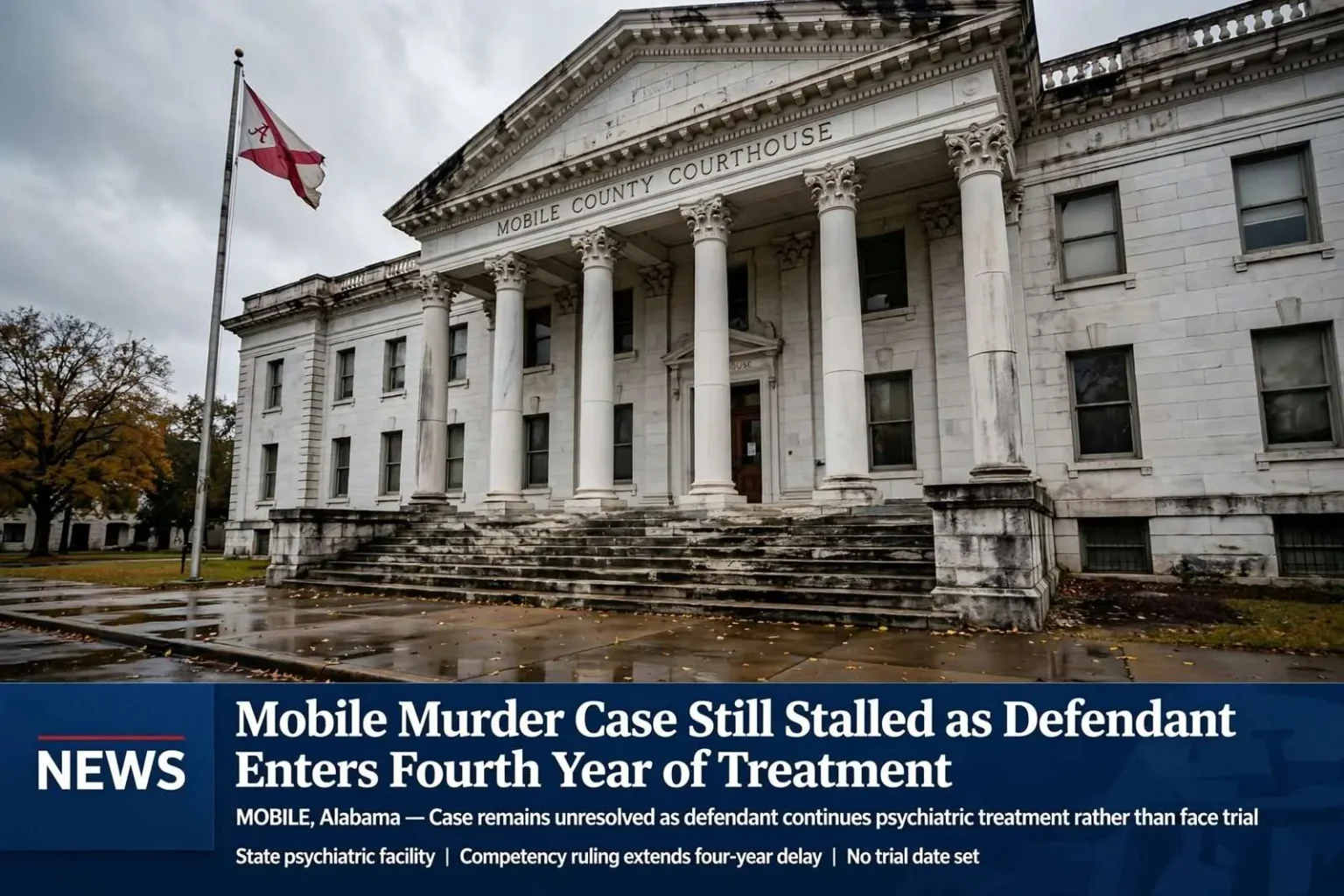
MOBILE, Alabama — A Mobile County murder case that has sat dormant for years remains unresolved after a circuit judge ruled this month that the man accused of killing his mother’s boyfriend will continue psychiatric treatment rather than face a courtroom.
The defendant has been held at a state psychiatric facility since late 2011, roughly a year after he was accused of fatally shooting a 47-year-old man inside a shared home in west Mobile. Investigators say the victim was shot in the home’s front room in the summer of 2010, and the weapon used in the killing was recovered at the scene.
The defendant, now 30, was ruled incompetent to stand trial in the fall of 2011. Under Alabama law, that ruling does not end a case — it suspends it. A defendant cannot be tried unless he understands the proceedings against him and can assist in his own defense, and when doctors find that capacity lacking, the law commits the person to treatment aimed at restoring it, with the criminal charges waiting on the outcome.
That suspension has now stretched into a fourth year. The man accused in the 2010 killing has spent the intervening time at a state psychiatric facility rather than a jail, his case numerically open but practically frozen — no trial date, no plea, no resolution for a family that has waited since the summer of 2010 for the justice system to move.
Doctors say symptoms persist. At a recent court hearing, a forensic examiner from the state psychiatric facility presented updated findings on the defendant’s mental state, concluding that he continues to show symptoms of serious mental illness and cognitive limitations that would prevent him from meaningfully assisting in his own defense.
According to the examiner’s report, the defendant has been diagnosed with a psychotic disorder, antisocial personality disorder, bipolar disorder, chronic substance abuse issues and borderline intellectual functioning. The report noted that he continues to deny having a mental illness and resists his ongoing treatment, at one point telling his treatment team in frustration that he does not believe anything is wrong with him.
That resistance matters clinically. Competency restoration depends heavily on the patient’s engagement — medication regimes require cooperation, and the psychoeducational work that teaches a defendant what a trial is and what the roles of judge, jury and defense attorney are requires a patient willing to learn. A patient who denies his illness and refuses treatment presents the hardest restoration case there is, and examiners who evaluated this defendant found little evidence of progress toward the legal standard the court requires.
The legal machinery of competency
Alabama’s competency framework follows the U.S. Supreme Court’s long-standing standard: a defendant must have a rational and factual understanding of the proceedings and sufficient ability to consult with his lawyer. The evaluation is conducted by forensic professionals at a state facility, their findings reported to the court, and the judge then decides — as Mobile’s circuit judge did again this month — whether the defendant should be recommitted for more treatment or brought to trial.
The system also carries a clock. A decade ago, the Supreme Court’s Holladay v. Alabama decision and subsequent legislation imposed limits on how long a defendant found incompetent can be held before the state must either civilly commit him or release him — a recognition that indefinite commitment without trial risks punishing illness before guilt. For cases like this one, the statute of limitations and commitment deadlines create a legal pressure that builds quietly in the background while the medical question — restorable or not — remains open.
The defendant’s attorney argued in court that his client should instead be found not guilty by reason of insanity and transferred to a civil treatment facility, which would allow him to continue receiving care without the case repeatedly returning to the criminal court’s docket.
That request would have ended the criminal prosecution entirely. An insanity acquittal in Alabama sends the defendant to the custody of the state mental health authority rather than the Department of Corrections, with release controlled by a court-ordered review process rather than by sentence completion. For the defense, the advantage was finality: his client would remain in treatment — which he needs whether or not he is ever convicted — without the recurring competency hearings that have marked this case since 2011.
The judge did not rule on that request, choosing instead to take the matter under submission and order the defendant recommitted to the state facility for continued treatment.
A case with no clear ending
The ruling means the case returns to the same holding pattern that has defined it for years: a defendant in treatment who examiners say is not improving, a prosecution that cannot proceed without a competent defendant, and a judge weighing options the law only partially equips him to resolve.
The underlying facts have never been in serious dispute in the public record. The 47-year-old victim was shot inside the west Mobile home he shared with the defendant and the defendant’s mother; the gun was found at the scene; the defendant, then in his mid-twenties, was charged with murder. What the courts have been deciding ever since is not whether the events happened but whether the man accused of them can be tried for them — a question of capacity that two years of treatment has, by the examiners’ account, failed to answer affirmatively.
The diagnoses complicate every path forward. Psychotic disorders and bipolar illness are treatable, and restoration is possible in many such cases. But antisocial personality disorder is not a condition medication reaches, and borderline intellectual functioning limits how much a patient can absorb of the legal education competency requires. Layered over chronic substance abuse and the patient’s own denial, the clinical picture examiners described is one in which restoration is not merely delayed but genuinely in doubt — the kind of case where treatment continues not because doctors expect a change but because the law provides no other lawful custody for a person facing capital-level charges.
The families on both sides of the case live with the uncertainty. The victim’s relatives have watched a four-year-old killing produce no trial and no verdict, the court’s docket filled instead with hearings about psychiatric reports. The defendant’s mother — the victim’s longtime partner — is connected to both men, her family simultaneously the source of the accusation and the context of it. Cases in this posture ask those families to hold grief and patience at the same time, often for years, while the question of competence is litigated one report at a time.
The judge’s decision to take the insanity-acquittal request under submission leaves open the very resolution the defense seeks. If the court ultimately grants the transfer, the criminal case would end without a verdict — an acquittal by reason of insanity that places the defendant in civil custody for treatment subject to periodic review. If the court declines, the case returns to the competency track, where the next forensic report will again decide whether another year of treatment begins or a trial date finally appears on the calendar.
Either outcome carries trade-offs the court laid bare by its deliberateness. An insanity acquittal without a trial denies the state its prosecution and the victim’s family its day in court, but it guarantees continued custody and treatment. Continued recommitment preserves the possibility of a trial while leaving the defendant in a facility whose examiners say his symptoms persist — the same report, in all likelihood, arriving again next year.
For now, the order stands where the case has stood since late 2011: treatment continues, the charges wait, and the question of whether this killing will ever be tried remains, as it has been for four years, unanswered.
The case illustrates a tension Alabama courts have confronted repeatedly in the past decade: the intersection of rising forensic evaluations, limited psychiatric beds and a criminal docket that cannot absorb indefinitely non-restorable defendants. State facilities that conduct competency evaluations and restoration serve every county in Alabama, and their capacity constrains how quickly defendants move through the process even when restoration is possible. When a patient is not restorable, the legal system’s only instruments — recommitment, civil commitment, or release — are all imperfect, and judges must choose among them with incomplete medical answers.
Mobile County’s experience mirrors what prosecutors and defense attorneys across the state describe. Competency questions arise in a small fraction of cases but consume a disproportionate share of courtroom time, because each determination requires expert evaluation, a hearing, and periodic re-evaluation as treatment proceeds. A single non-restorable defendant can generate years of hearings without ever reaching a trial — as this case’s fourth year demonstrates.
The defense’s insanity strategy also reflects a practical reading of the clinical evidence. Proving legal insanity at trial requires showing the defendant did not understand the nature or wrongness of his act because of mental disease — a high bar usually contested before a jury. But when the same defendant is already documented as seriously mentally ill, non-restorable, and in state custody, an insanity acquittal by agreement or judicial finding accomplishes custody and treatment without litigating the underlying events. The judge’s decision to reserve ruling on that request suggests the court recognizes the fit — and recognizes, equally, the weight of resolving a murder case without a trial.
The next forensic report will likely frame whatever comes. If examiners find the same symptoms and the same denial, the pressure toward an insanity resolution will grow; if his condition changes, the prosecution’s path to a trial reopens. Four years into the case, the only certainty is the one the court affirmed this month: the state’s treatment of the man accused of the 2010 killing continues, and the verdict — in any form — waits.