Fairhope Sports Promoter Released After Arrest on Louisiana Fraud Warrant
Sports promoter and media consultant Steve Harrelson was freed from the Baldwin County Jail after being held on an out-of-state fraud warrant, with restitution reportedly made and Louisiana authorities expected to settle the case.
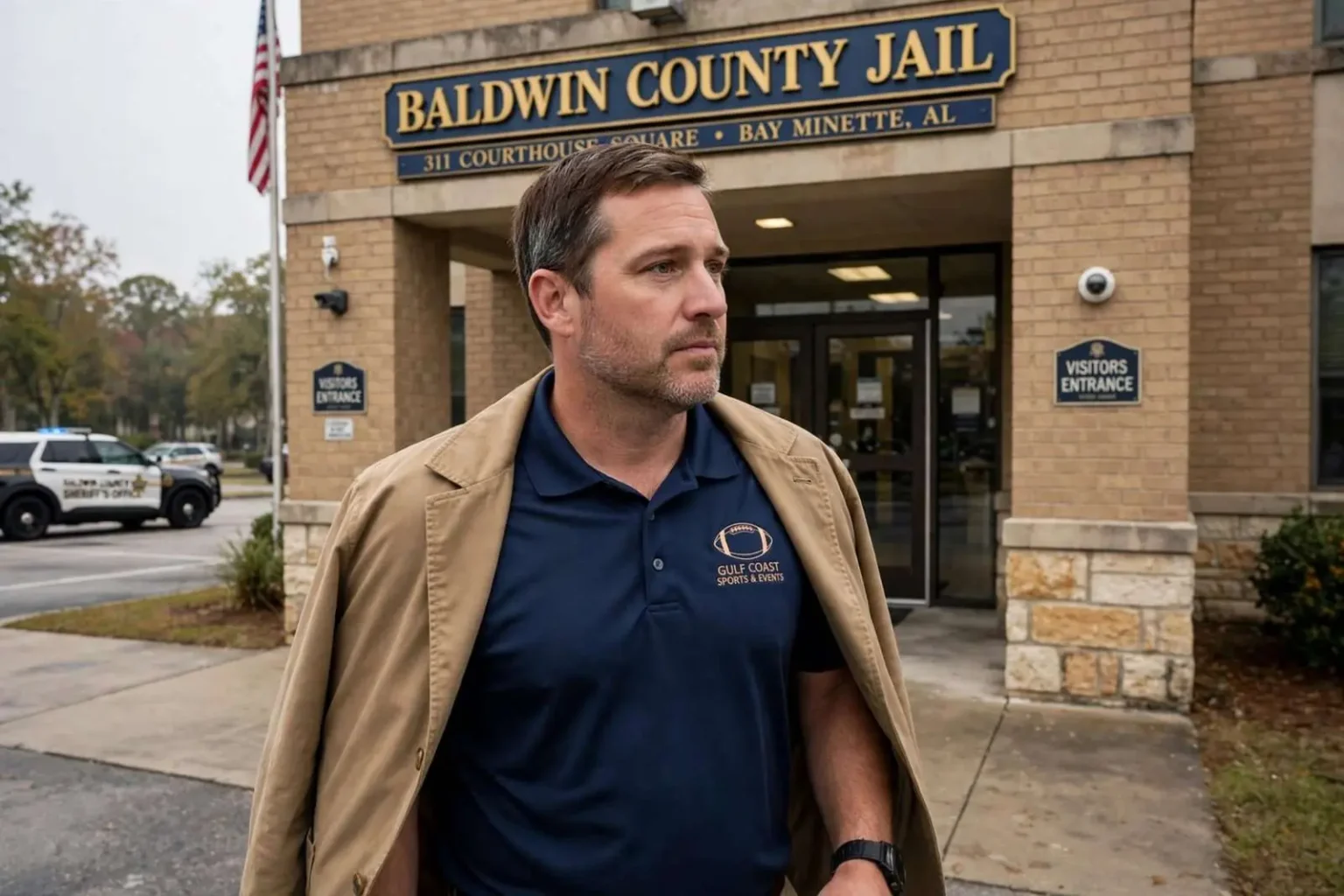
Local sports promoter and media consultant Steve Harrelson was expected to be freed after his brief jailing in Baldwin County, according to sources familiar with the matter.
Harrelson was booked into the Baldwin County Jail in the middle of Wednesday afternoon as a fugitive from justice on an out-of-state warrant that alleged fraud in Orleans Parish, Louisiana. Restitution had reportedly been made, however, and Louisiana authorities were expected to settle the case against the Fairhope man. Baldwin County authorities released him the following morning, pending a hearing in Louisiana the next week when the matter would likely be resolved.
The arrest brought renewed public attention to Harrelson, 43, of Fairhope, a familiar figure in Gulf Coast sports and event promotion. Details of the underlying Louisiana allegation were limited, but the swift move toward a resolution, with restitution said to be in hand, suggested the episode would be resolved short of an extended legal fight.
The mechanics of the case follow the standard pattern for out-of-state warrants. When a person is wanted on charges in another state, local officers can hold them as a fugitive from justice while the requesting jurisdiction decides whether to seek formal extradition or allow the matter to be handled through a return appearance. In practice, cases in which restitution has been made and both sides are prepared to resolve the matter tend to move quickly — which is exactly how this one unfolded, from a Wednesday afternoon booking to a release the next morning without a protracted detention fight in Alabama courts.
A familiar name in coastal sports
Two years earlier, Harrelson had figured in a local controversy over the Gulf Coast Classic, the annual football matchup between Alabama State University and Southern University. At that time, Mobile city officials sought to boost the city’s appropriation for the event dramatically, from $40,000 to $450,000, a proposal that drew scrutiny given the size of the increase and the public dollars involved.
That earlier debate had placed Harrelson at the intersection of sports promotion and municipal spending, a position that made his name recognizable well beyond the promotional circuit. The Gulf Coast Classic had been pitched as a draw for visitors and a showcase for the region, and the sharp jump in requested funding became a flashpoint over how aggressively local government should invest in marquee events. Supporters argued that a well-promoted classic could fill hotel rooms and restaurants, while critics questioned whether the projected return justified so large a public outlay in a tight budget year.
The dispute touched on questions that recur whenever Gulf Coast cities court signature events: how much public money a municipality should commit to attract visitors, who benefits when those visitors arrive, and whether the promised economic impact stands up to scrutiny. Mobile’s deliberations over the classic came at a moment when cities across the region were bidding for festivals, bowl games and tournaments as anchors for their hospitality economies, making the size of the proposed increase — an eleven-fold jump in a single year — the focus of the debate.
College football classics matching historically Black universities carry particular weight in that market. Matchups like Alabama State and Southern draw alumni crowds that travel in numbers, fill hotels over a full weekend and support events around the game itself. That economic promise is what promoters sell to host cities, and it is why the gap between a $40,000 line item and a $450,000 one became a genuine civic argument rather than a routine budget entry.
The Baldwin County connection
The booking itself was routine business for the Baldwin County Jail, the county’s main detention facility, which processes a steady flow of arrests ranging from local charges to out-of-state holds. Fairhope, Harrelson’s hometown, sits across Mobile Bay from Mobile proper, and its residents regularly appear in the county’s court system — meaning a fugitive hold executed in Baldwin County can move a person into the orbit of two states’ legal machinery in a single day.
For someone whose career depends on being seen and connected, an afternoon in the county jail is more than an inconvenience. Promoters work on reputation and relationships, and news of an arrest travels quickly through the small world of Gulf Coast event promotion, where the same sponsors, universities and municipal officials cross paths at event after event. The speed of the resolution — roughly one day from booking to release — limited that exposure, but the record of the arrest itself became part of the public timeline attached to Harrelson’s name.
The episode also illustrated how the fugitive process works for people with ties to two Gulf states. Orleans Parish, which includes New Orleans, is a short drive west of Baldwin County, and commercial and personal travel between the two is constant. Fraud allegations arising in one jurisdiction frequently surface as arrests in the other, when a routine check or a flag on a warrant turns up someone already living across the state line. In such cases, the local jail functions as a way station — a place to hold the person until the requesting parish decides how to proceed.
Toward a resolution
With his release from the Baldwin County Jail and a Louisiana hearing on the calendar, Harrelson’s immediate legal exposure appeared to be narrowing. The reported restitution and the expectation that Orleans Parish authorities would settle the matter pointed toward a conclusion in the days ahead rather than a protracted proceeding.
Restitution plays a distinctive role in cases like this one. When an alleged victim has been made whole before the criminal case is resolved, prosecutors and courts often treat that as a mitigating factor that can support dismissal, a reduced charge or some other negotiated end. That is what sources described as the likely path here: a hearing, a formal resolution, and the closing of a case that never reached the point of a contested fight in either state’s courts.
The compressed timeline is worth noting for what it did not include. There was no bond hearing stretching over days, no dispute over extradition, no attempt to contest the warrant’s validity in an Alabama courtroom. Each of those steps is available to a person held on an out-of-state warrant, and each can add weeks to a detention. Sources familiar with the matter attributed the speed to the practical posture of the case — an allegation that had reportedly already been addressed financially, a defendant willing to appear in Louisiana, and authorities on both sides of the state line with no interest in a prolonged process. When those elements align, the fugitive system works exactly as designed, moving a case to the jurisdiction where it belongs rather than warehousing the person who faces it.
For a promoter whose work depended on relationships with sponsors, universities and city officials across the coast, the arrest was an unwelcome interruption. Yet the quick turnaround, one night in jail followed by a morning release, kept the episode brief. In the promotional business, where contracts and partnerships are built on personal credibility, the difference between a week-long detention and an overnight hold can determine whether a professional setback becomes a career problem.
What comes next
As the case moved back to Louisiana for its next step, the focus shifted to the scheduled hearing and whether, as sources anticipated, the parties would formally close the books on the fraud allegation. A resolution on that timeline would leave the matter as a brief and largely technical episode — an out-of-state warrant honored across the state line, restitution acknowledged, and a hearing to record the settlement.
The matter underscored how figures active in the public-facing world of sports and civic events can find private legal troubles thrust into view, and how quickly such episodes can unfold, from an afternoon booking to a next-morning release, when restitution and cooperation smooth the path toward settlement.
It also served as a reminder of the economy Harrelson works within. Sports and event promotion occupies a real niche on the Gulf Coast: cities from Mobile to the Baldwin County beach towns regularly invest public money in events they believe will draw visitors, and promoters serve as the brokers who connect those municipalities with the games, festivals and tournaments that can deliver them. When a promoter’s name surfaces in legal news, the ripple runs through that entire marketplace — sponsors reassess, city officials revisit their assumptions, and the next proposal for a marquee event gets a harder look.
For now, the Gulf Coast Classic episode two years ago remains the reference point most local observers attach to Harrelson’s name, and the Louisiana case appears set to resolve quietly beside it. Whether the hearing proceeds as expected and the fraud allegation is formally settled will be recorded in New Orleans; the release from the Baldwin County Jail has already been recorded here. Between the two, the episode stands as a small but complete illustration of how out-of-state legal matters play out when the parties are prepared to resolve them — quickly, quietly, and without the extended fight that once looked possible.