Fairhope Regroups After Lone $5.4 Million Bid Sinks Soccer Complex Plans
Fairhope leaders rejected the only bid for its long-planned soccer complex after it came in far above budget, and are now retooling the project.
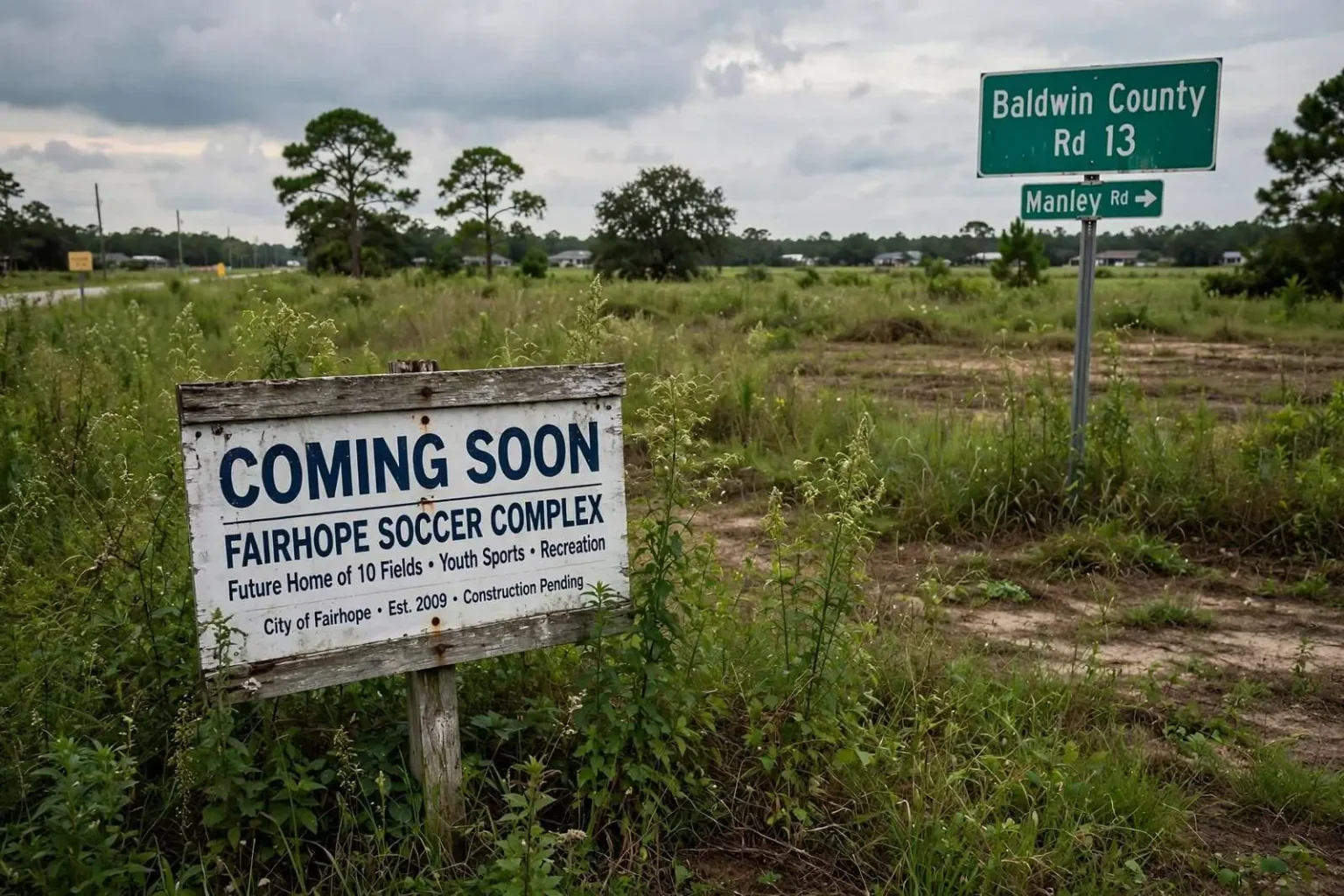
FAIRHOPE, Alabama — On a nearly 40-acre stretch of former farmland at the corner of Manley Road and Baldwin County 13, weeds have grown up around a “Coming Soon” sign advertising the city’s planned soccer complex, a quiet marker of just how many delays have piled up since Fairhope bought the property in late 2009 for $875,000. What was pitched more than a decade ago as a cornerstone recreational project for one of Baldwin County’s fastest-growing cities now sits in limbo once again, after a construction bidding round came back so expensive that city leaders have sent the plans back to the drawing board.
The long gap between purchase and construction is not unusual for municipal park projects, which routinely move through land acquisition, design, environmental review and funding stages before a single shovel hits the dirt. But the Fairhope soccer complex has collected more than its share of complications, and the latest one is the hardest to solve: money. A project that leaders once hoped to deliver for a modest construction budget is now estimated near $7 million to build in full, and the city’s first serious attempt to price the work came back roughly two and a half times what was set aside.
A budget blown wide open
City leaders had lined up roughly $2 million for construction this year, hoping to have fields ready in time for fall recreational leagues. Fairhope’s youth soccer programs, like recreational leagues across Baldwin County, have grown alongside the city’s population, and the lack of dedicated complex space has long been cited as a strain on scheduling and field availability for young players. Having real game fields ready by autumn was the whole point of the timeline.
Instead, when bids finally came back in late July for the 10-field complex, only one contractor submitted a proposal, a Summerdale-based firm, and its price of about $5.49 million covered only grading, drainage, parking and the fields themselves, without sidewalks, fencing, irrigation or lighting included. In other words, the number did not represent a finished, playable facility — it represented the earthwork and turf, with the amenities that make a complex usable in the evenings and safe for families still to be funded on top.
A single-bid response is a familiar frustration for Gulf Coast municipalities. Contractor capacity along the Alabama coast has been stretched by years of commercial and residential growth, and large sitework packages routinely draw thin fields of bidders, which drives prices up. The City Council rejected the bid, and officials are now working to rework the project into something more affordable, with the goal of bringing it back to market in a form the city can actually pay for.
The rejected bid also underscored a basic budgeting reality. The roughly $2 million the council had identified was always a fraction of what a 10-field complex with full infrastructure would cost at current construction prices, and once the true market price arrived in black and white, the gap between ambition and funding could no longer be ignored. The council’s decision to reject rather than award was, in effect, an admission that the project as scoped does not fit the budget as written.
Leaders search for a workable number
The council president said he and the mayor are working closely with the city’s engineering firm to trim costs while preserving as many amenities as possible, while the mayor has asked the council to settle on a hard budget figure so the project can move forward. That dynamic — engineers shaving the scope, elected officials arguing over the ceiling — is now the central debate at City Hall, and it will determine what residents eventually see on the Manley Road property.
Both officials say a decision on how to proceed is expected by September, when the city will need to formally commit funding for the fiscal year. Municipal budgets in Alabama run on an October 1 fiscal calendar, so the fall budget season is the moment when capital projects either get their appropriations or slip for another year. For a project that has already waited more than a decade since the land purchase, missing another funding window would be a bitter outcome, which is why leadership is pressing for a firm number rather than another round of conceptual planning.
Setting a ceiling will force uncomfortable choices. Every dollar spent on grading and drainage on a sloped site is a dollar not available for lighting, which determines whether fields can host weeknight games, or irrigation, which determines whether turf survives Baldwin County’s hot summers. The engineering firm’s task is to find the cheapest configuration that still delivers playable fields, while the council’s task is to decide how much of the wish list the city can responsibly finance now versus phase in later.
A project already redesigned once
This is not the complex’s first setback. Engineers first had to account for a sloped site, and neighboring residents later raised concerns about routing the main entrance through a residential stretch of Manley Road. Steep topography is one of the biggest cost drivers in park construction, because it multiplies earthwork volumes, and a site carved out of old farmland rarely offers the flat, well-drained footprint that a field complex ideally needs.
The plans were revised so that most access would instead come from Baldwin County 13, with drainage handled through an underground green infrastructure system rather than traditional retention ponds. Routing traffic onto a county highway rather than a neighborhood street answered the residents’ objections, but it created its own obligations, because heavy recreational traffic on a county road required a formal arrangement between the city and Baldwin County.
To make that access work, the city negotiated with the county to take over maintenance of that stretch of road, and current plans call for a 700-space parking lot with several access points. A parking field of that size reflects the scale of the original ambition: a facility designed not just for weekly practices but for tournament weekends, when hundreds of families arrive at once and parking capacity becomes the difference between a functioning complex and a gridlocked one.
Scaling back to get something built
The original vision called for two professional-quality fields with bleachers, a press box, a concession stand and enough amenities to host state high school championships or college tournaments, on top of a playground, picnic pavilions and a walking path open to the public. In other words, Fairhope was not planning a practice-field farm; it was planning a destination facility that could draw traveling teams and their spending to restaurants, hotels and shops across the eastern shore, while also serving as everyday parkland for nearby neighborhoods.
With the full project now estimated near $7 million, city leaders say the immediate priority will be building usable fields for local youth leagues first, with amenities like bleachers and press facilities added later as grant funding allows. That phasing strategy is a common path for cities in Fairhope’s position: get the core infrastructure in the ground, open the gates, and pursue recreation grants and revenue over time to layer in the features that make a complex tournament-ready. It trades speed for polish, but it converts a stalled project into an active one.
Phasing also changes what the complex is in the short term. A complex without a press box or championship-grade amenities cannot bid to host high school title events or college showcases, and without lighting it is largely a daytime facility. Supporters of the scaled-down approach argue that hundreds of young players practicing and playing on real fields is worth more than an empty showcase, and that the tournament amenities can follow when the money does.
No appetite for the current price tag
At least one council member has said publicly that a $5 million price tag is too high for the city to absorb and that he would not support spending at that level, though he said officials are looking at ways to cut costs, including possibly using city crews for some of the work. Putting municipal public works employees on tasks such as clearing, fencing or finish work can shave meaningful dollars from a contractor bid, though it also stretches the timeline and requires the city to manage more of the project in-house.
The cost debate comes at a time when cities across Baldwin County are juggling rapid growth against the price of the infrastructure that growth demands. Construction costs for sitework, concrete and utility work have risen sharply in recent years across the Gulf Coast, and municipalities that budgeted projects years ago are finding their dollars buy noticeably less when bids finally arrive. Fairhope’s experience is a local instance of a regional problem, which is one reason officials are skeptical that simply re-bidding the same plans would produce a better number.
Despite the setback, city leaders have stressed that scrapping the project entirely is not on the table, framing the complex as a needed investment in Fairhope’s youth sports programs even if it takes longer than originally hoped to get shovels in the ground. For the families who have watched weeds grow around the Coming Soon sign for years, the promise now rests on whether the mayor, the council and their engineers can land on a number by September that buys real fields — and this time, holds.