Fairhope’s Magnolia Beach Gets Makeover With 3,000 Tons of New Sand
Fairhope trucked in roughly 3,000 tons of sand to repair severe erosion at Magnolia Beach on Mobile Bay, restoring a popular bayfront stretch.
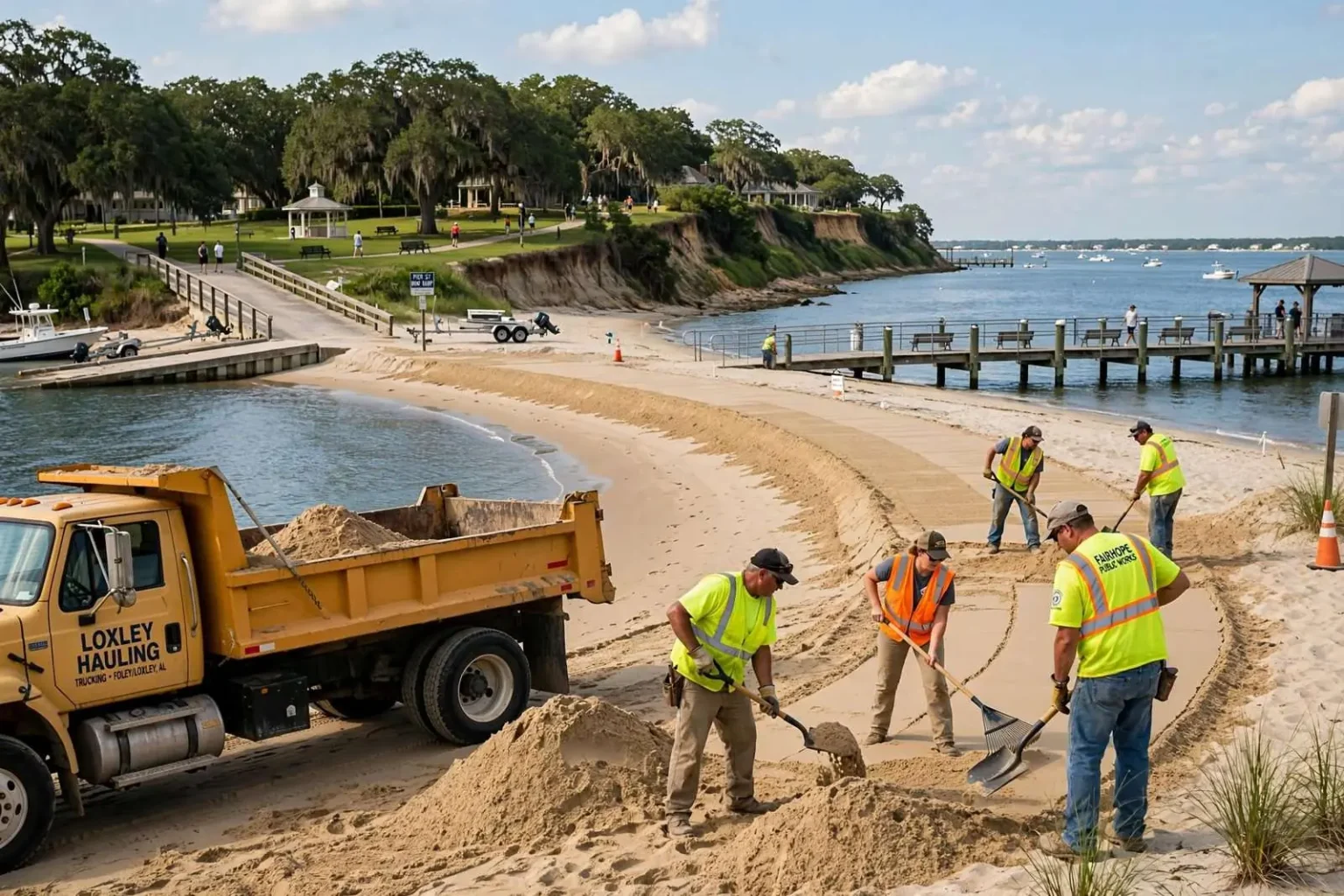
Fairhope has a refreshed bayfront beach after crews spent more than a week hauling in roughly 3,000 tons of sand to repair a badly eroded stretch of shoreline on Mobile Bay.
The work restored one of the city’s most-visited public spaces, a natural beach that had worn down over years of storms, boat wakes and ordinary wave action until officials determined it could no longer safely serve the crowds it draws. The project put Fairhope among the Gulf Coast communities that periodically rebuild their beaches — a maintenance chore made necessary by the simple physics of a bay that never stops moving.
The city council approved contracts in late June to supply and haul sand to Magnolia Beach, the popular stretch between the Pier Street boat ramp and the Pecan Avenue pier along the city’s Eastern Shore Trail. One Foley-based company was contracted to supply up to 5,850 tons of sand for roughly $35,100, while a Loxley-based trucking company was paid nearly $34,800 to haul it to the site.
Why the Beach Had to Be Rebuilt
City officials say the project became necessary after erosion along the beach reached a point where it was no longer safe for public use. Fairhope’s mayor said the deteriorating conditions left the city with little choice but to act, given how heavily used the beach area is by residents and visitors walking the scenic Eastern Shore Trail along Mobile Bay.
Magnolia Beach sits in the middle of Fairhope’s celebrated waterfront, below the bluff-top parks and municipal pier that define the city’s identity. The Eastern Shore Trail, which threads along the bay from the Daphne side through Fairhope toward Point Clear, funnels walkers, runners and cyclists directly past the beach, and the stretch of shoreline between the boat ramp and the pier has long served as the trail’s unofficial rest stop — a place to take off shoes, launch a kayak or watch the sun set across the water toward Mobile.
Years of erosion had narrowed that beach and undermined its edge, and city leaders concluded that waiting longer would mean losing more of it. Sand beaches along Mobile Bay’s eastern shore are inherently transient: the bay’s wind-driven waves, particularly out of the south and southeast, steadily pull sand along the shoreline and offshore, and no single replenishment stops the process — it only resets the clock.
As of early July, the city’s public works director said the project was roughly 90 percent finished, with delays at the sand supplier’s pit pushing final completion into the following week. Officials ended up needing less sand than initially planned, meaning the city expected to save around $28,000 compared to the original contracted amount, since haulers and suppliers are paid only for material actually used.
That pay-per-load structure is standard for municipal sand contracts and it worked in Fairhope’s favor this time. Rather than committing to a fixed total, the city bought what the beach actually needed — and the answer turned out to be roughly half the contracted maximum, cutting the project’s combined supply-and-haul cost by more than a quarter.
How the Work Got Done
Each truckload delivered to the site carried about 20 cubic yards, or roughly 27 tons, of sand. A steady procession of dump trucks from the Loxley hauling firm shuttled between the supplier’s pit in Foley and the bayfront, spreading piles along the eroded stretch for crews to work.
Public works crews handled the labor-intensive task of spreading and shaping the new sand by hand to help keep costs down, with the bulk of that work completed over a weekend following the initial round of deliveries that began in late June. By limiting the project to city crews with hand tools and light equipment, Fairhope avoided the expense of hiring a heavy-construction contractor — a trade of labor for dollars that made a modest budget go much further.
Officials said a handful of additional truckloads were still needed to finish the stretch nearest the boat ramp, with plans to bring in a dozen or more additional loads to extend the restoration work to the south side of the Pecan Avenue pier.
The phased approach let the city prioritize the most damaged section first while keeping the rest of the beach open to the public. Finishing the area by the Pier Street boat ramp matters for another reason: the ramp is one of the bayfront’s busiest access points, with trailers coming and going for anglers and pleasure boats launching into Mobile Bay, and a stable beach edge there protects both the launch itself and the foot traffic around it.
A Recurring Cost of a Waterfront City
City leaders expect to need similar sand replenishment work every two to three years to keep pace with natural erosion, and have discussed longer-term solutions such as nearshore oyster reefs or other structures designed to reduce wave action along the shoreline.
The idea of oyster reef breakwaters has gained ground along the northern Gulf Coast in recent years. Rather than hard structures like bulkheads — which can worsen erosion on neighboring properties — living shorelines use reefs, and sometimes planted marsh, to knock down wave energy before it reaches the beach while giving oyster larvae a surface to colonize. Restoration projects across Mobile Bay have tested the approach, and communities that install them trade a larger upfront cost for slower erosion, cleaner water and habitat for the bay’s struggling oyster population.
For Fairhope, whose bayfront is the centerpiece of its tourism economy and its residents’ daily life, the arithmetic of beach maintenance is straightforward. A recurring sand project priced in the tens of thousands of dollars protects the parks, pier and trail corridor that draw visitors from across the region and drive the downtown economy along Fairhope Avenue.
The mayor’s point about usage is borne out on any fair-weather evening: the stretch between the Pier Street boat ramp and the Pecan Avenue pier may be the busiest piece of shoreline on the Eastern Shore, where fishermen cast from the sand, families wade at the waterline and the sunset crowd gathers along the bluff above. Letting it erode to unusability was never a realistic option for a city that bills itself around its bay.
What Comes Next
With the bulk of the sand in place and shaped, crews were set to close out the remaining loads — the final sections by the ramp and the extension south of the pier — once the supplier’s pit caught up with deliveries. Residents can expect the fresh beach to settle and compact over the following weeks, blending with the older sand at the edges as normal weather works on it.
City officials will keep the longer-term question open in the meantime: whether Fairhope continues to buy sand every few years, or invests in wave-damping structures that could stretch those intervals. Either way, the council’s late-June contracts bought the city something it had been steadily losing — a beach wide enough, and safe enough, for the crowds that consider it the heart of the town’s waterfront.
The project also illustrated how Baldwin County’s municipalities manage their shared coastline in an era of rapid growth. Fairhope, Daphne, Spanish Fort and the beach communities to the south all face the same calculus — heavy public use of limited waterfront against the relentless natural forces of Mobile Bay — and each has taken a different mix of hard armoring, living shorelines and periodic renourishment. Fairhope’s bluff-and-beach geography makes its choices especially visible: the city’s parks sit atop one of the highest bluffs on the bay’s eastern shore, and the beaches below them are the only soft landing between the green spaces and the water itself.
Sand for projects like this one typically comes from inland borrow pits such as the supplier’s operation in Foley, where deposit material is screened and graded before being trucked to the coast. Beach-quality sand for a bayfront doesn’t require the fine, white quartz of the Gulf-front beaches at Gulf Shores, but it does need to hold up under foot traffic and resist washing out in the first heavy blow — a specification that shapes both the price and the choice of supplier.
The hauling contract, meanwhile, shows the logistics behind even modest municipal projects. Moving 5,850 tons at roughly 27 tons per load means more than 200 truck trips under the maximum scenario — a convoy of dump trucks rolling from Foley through Loxley and down U.S. 98 to the Fairhope bayfront, coordinated over more than a week around summer traffic on the Eastern Shore’s main roads.
City staff said the hand-spreading effort by public works crews, completed largely over a single weekend, was the piece of the project residents noticed most — a small army of city workers moving sand by shovel and rake to reshape a beach their own families use. The work also saved taxpayers the mobilization costs that a private contractor would have charged simply to bring equipment to the site.
For now, Fairhope’s bayfront is whole again. The erosion that made the project necessary will resume — it always does on a working bay — and the city has planned for it, with replenishment built into future budgets and longer-term shoreline options still on the table for the leaders who will decide how this stretch of the Eastern Shore looks a generation from now.