Fairhope Awards Nearly $260,000 for Emergency Repairs to Storm-Ravaged Gully
The Fairhope City Council awarded nearly $260,000 in emergency contracts Monday to repair a storm-damaged gully near the city's sewer plant, with the federal government covering most of the cost.
Repairs to one of the areas hit hardest by the spring’s devastating flooding will begin soon in Fairhope, after the City Council awarded nearly $260,000 in emergency contracts. The council approved the contracts on the night of Monday, June 9, 2014, with the federal government expected to cover the majority of the cost. The damage traced back to an April storm that dumped upwards of 20 inches of rain on south Baldwin County — a deluge that fell in roughly 24 hours, turning gullies into torrents and overwhelming drainage systems built for storms many times smaller.
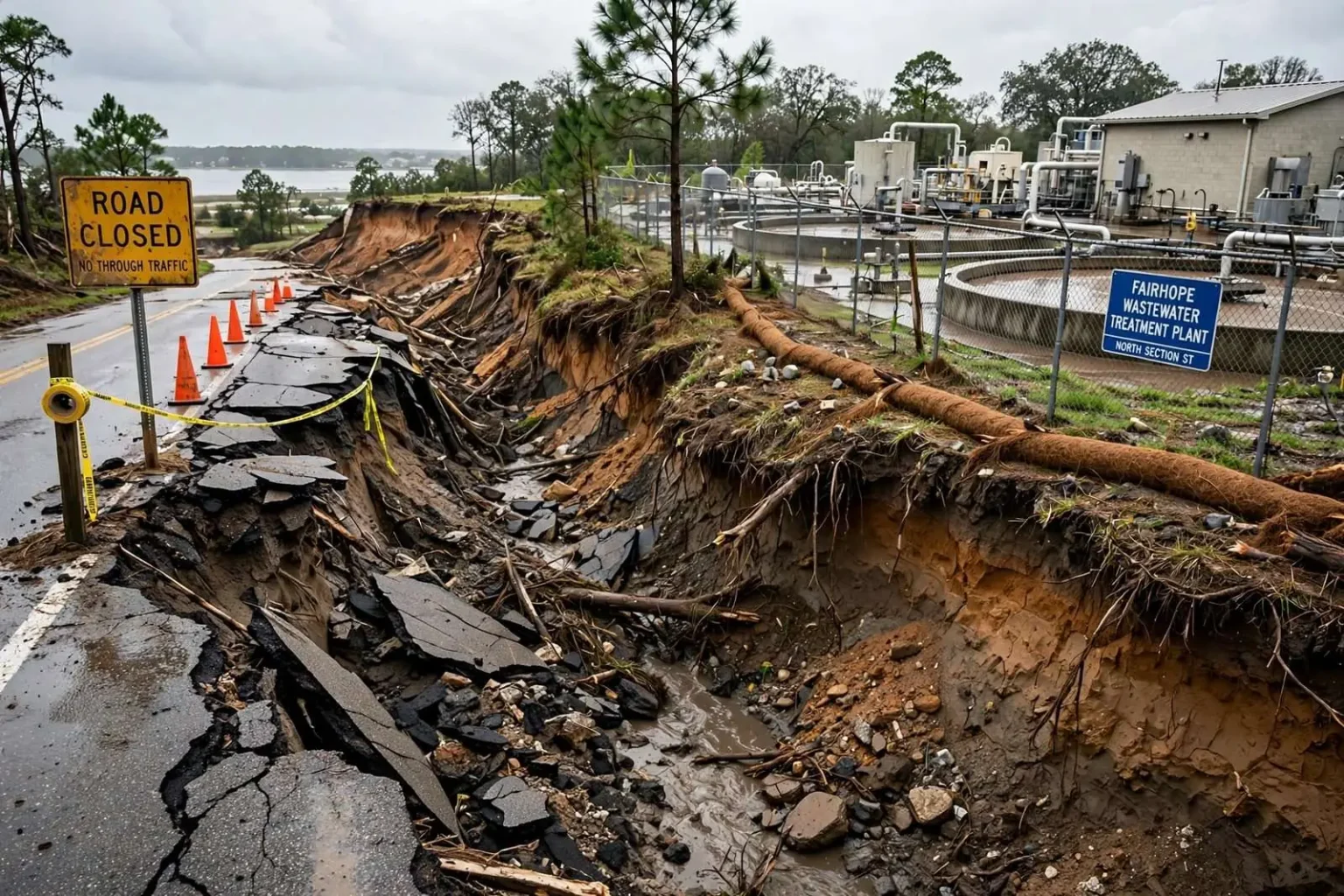
The deluge washed out a portion of a gully that runs alongside Fairhope’s sewer treatment plant on North Section Street, damaging a section of roadway and eroding nearby bluffs. Fairhope’s geography makes storms like this one especially punishing: the city sits on a bluff above Mobile Bay, and the deep gullies that cut through the plateau drain rapidly toward the water, carrying away soil, undermining pavement and threatening anything built along their edges. When the April storm hit, those natural drainageways became the weak points in the city’s infrastructure.
Engineering and construction contracts
With state and federal emergency declarations in place, the council moved to line up the work. It hired the Daphne firm Hutchinson, Moore & Rauch for $37,000 to engineer a repair plan and put the project out to bid. The emergency declarations unlocked the funding channels — federal disaster assistance routed through state agencies — but the city still had to document the damage, scope the repairs and run the procurement, all under compressed timelines.
According to Scott Hutchinson of the firm, five companies received bid packets, and the lowest and only bidder was Spanish Fort-based Ammons & Blackmon Construction, which was awarded the contract. A single bidder is not unusual for specialized emergency work: few contractors keep the equipment and crews on hand to rebuild washed-out gully slopes and roadbeds on a deadline, and the ones that do are quickly booked across a disaster region once the work starts.
The project was divided into two parts, each with federal support. The U.S. Department of Agriculture’s Natural Resources Conservation Service agreed to cover 75 percent of the $192,696.80 cost to rehabilitate the gully erosion near the sewer plant, with the city responsible for the remainder. The NRCS operates an Emergency Watershed Protection program that helps local governments stabilize stream banks, gullies and other watershed damage that threatens lives and property — a less-heralded sibling to FEMA’s disaster programs, but often the first responder for exactly this kind of erosion work.
The Federal Emergency Management Agency agreed to cover 75 percent of the $66,520.20 needed to repair the gully area near the damaged stretch of North Section Street, just north of the Fairhope Colony Cemetery, with the state and city splitting the remaining quarter. The split reflects the standard disaster-assistance formula in Alabama: FEMA carries three-quarters of eligible public-assistance costs, and the state and the local government divide what is left. For a city of Fairhope’s size, that federal participation is frequently the difference between repairing damaged infrastructure quickly and putting it off for budget cycles.
A second front near U.S. 98
The storm damage extended beyond the sewer plant. FEMA representatives told city officials the agency also wanted to move quickly on replacing a gravity sewer line that washed out under U.S. 98 along Fly Creek, near the Publix shopping center. The line had been patched with a temporary fix in the aftermath of the storm — a stopgap that held sewage moving but left the city exposed the next time heavy rain filled the creek.
Toward that end, the council on Monday night hired the firm Preble-Rish, at a cost of $44,760, to engineer plans to replace the old sewer line and to design a new lift station on the east side of U.S. 98. Gravity sewer lines depend on continuous, gradual downhill grades; when a washout breaks the grade or exposes the pipe, the standard long-term answer is often a lift station that pumps sewage over the obstacle, which is why the design work bundled the two projects together. The estimated cost of the new lift station was $325,640, pointing to significant additional spending ahead as the city worked through the full scope of the storm’s damage.
That figure — nearly five times the emergency contracts approved in a single night — illustrates a pattern familiar to every community recovering from a major flood. The first wave of contracts covers the visible, urgent damage; the engineering studies that follow reveal deeper problems, and the permanent fixes arrive on a schedule set by funding approvals, easements and construction seasons rather than by urgency. Utility infrastructure under state highways adds another layer, since work along U.S. 98 must be coordinated with the Alabama Department of Transportation.
Recovering from a punishing storm
The April storm ranked among the most destructive weather events to strike the region in recent memory, and Fairhope was among the communities that bore the brunt of it. The same system that flooded the Fish River watershed and swamped neighborhoods across south Baldwin County hit Fairhope’s bluffs and gullies with particular force, because the city’s steep terrain concentrates runoff into a handful of channels. The combination of intense rainfall and the area’s characteristic bluffs and gullies made erosion a central concern, threatening roads, utilities and the treatment plant that handles the city’s wastewater.
Losing even a portion of that plant’s protection was a serious matter for a growing city. Fairhope’s population had been climbing steadily as the Eastern Shore boomed, and the sewer system’s capacity to handle that growth depends on keeping its trunk lines, lift stations and plant out of harm’s way. Every dollar of the repair work, in that sense, was also a down payment on the city’s future development capacity.
The heavy reliance on federal reimbursement reflected both the scale of the damage and the value of the emergency declarations, which unlocked USDA and FEMA support to shoulder most of the repair costs. For Fairhope taxpayers, that federal participation meant the city’s share of the immediate repairs would be a fraction of the total. With the engineering and construction contracts in hand, officials expected work to move forward on stabilizing the gully near the sewer plant and repairing the roadway along North Section Street. The parallel effort to replace the failed sewer line under U.S. 98 signaled that the city’s storm recovery would continue for months, as temporary fixes gave way to permanent infrastructure.
How emergency disaster contracting works
The sequence Fairhope followed — council award, engineering contract, bid process, federal reimbursement — is the standard choreography after a federally declared disaster in Alabama. Cities cannot simply begin reconstruction with whoever is available; to keep federal funding, the work has to be documented, competitively bid or procured under emergency exceptions, and performed to federal standards. That paperwork discipline frustrates residents who want damage fixed immediately, but it protects the community from footing the entire bill for repairs that fail federal review.
The emergency declarations matter for another reason: they establish that the damage was caused by the storm event itself, not by deferred maintenance. That distinction determines eligibility. A gully that had been eroding for years and finally gave way might be denied federal reimbursement, while a gully destroyed by a documented 20-inch rainfall in April clearly qualified. The city’s engineers, along with state and federal reviewers, spent the weeks after the storm walking sites and photographing damage precisely so that each repair could be tied to the event.
Local officials also had to keep two funding streams straight. The Natural Resources Conservation Service handles watershed-oriented repairs — stabilizing gullies and stream banks that threaten public facilities — while FEMA’s public assistance program covers the repair or replacement of damaged public infrastructure like roads and sewer lines. The two programs pay at the same 75 percent share but reimburse through different agencies, applications and timelines, which is why the council’s package split the work into separately funded parts even though the damaged sites sit near one another on the same stretch of North Section Street.
What it means for Fairhope residents
For the neighborhoods around the treatment plant and North Section Street, the repairs address problems residents have watched worsen since the storm: a damaged road surface, unstable bluff edges and a gully that continues to move sediment downstream whenever it rains. Stabilization work on gullies typically involves reshaping the channel, installing erosion-control structures and replanting the slopes, with the goal of letting ordinary rainfall drain away without eating further into the banks. Until the work is complete, the sites remain vulnerable to the next heavy storm.
The sewer line under U.S. 98 is the piece with the widest public impact. The corridor near the Publix shopping center is one of the busiest commercial stretches on the Eastern Shore, and a permanent failure of the gravity line there would put wastewater service for a large part of the city at risk. The temporary patch has carried the load since April, but a lift station and rebuilt line would give the system redundancy it currently lacks — one reason FEMA’s representatives pressed the city to move quickly on the engineering.
The council’s June 9 action was, in practical terms, the turning point between response and recovery. The emergency phase — sandbags, road closures, temporary patches — was ending, and the rebuilding phase, with its federal funding shares and engineered designs, was beginning. Nearly $260,000 in contracts was only the first installment; the $325,640 lift station and the permanent sewer line replacement will follow in later council agendas as designs are completed and additional reimbursements are secured. Residents can expect the work sites along North Section Street and U.S. 98 to remain active for months, with the city’s storm recovery measured not in one meeting’s approvals but in the steady sequence of repairs that turn a flood’s damage back into working infrastructure.