Baldwin County’s Sages Named the One Problem They Would Fix First: The Traffic
Asked to name the single problem in Baldwin County that could be corrected with relative ease, business people and civic figures answered with near unanimity: the roads, the bridges and the growth filling them.
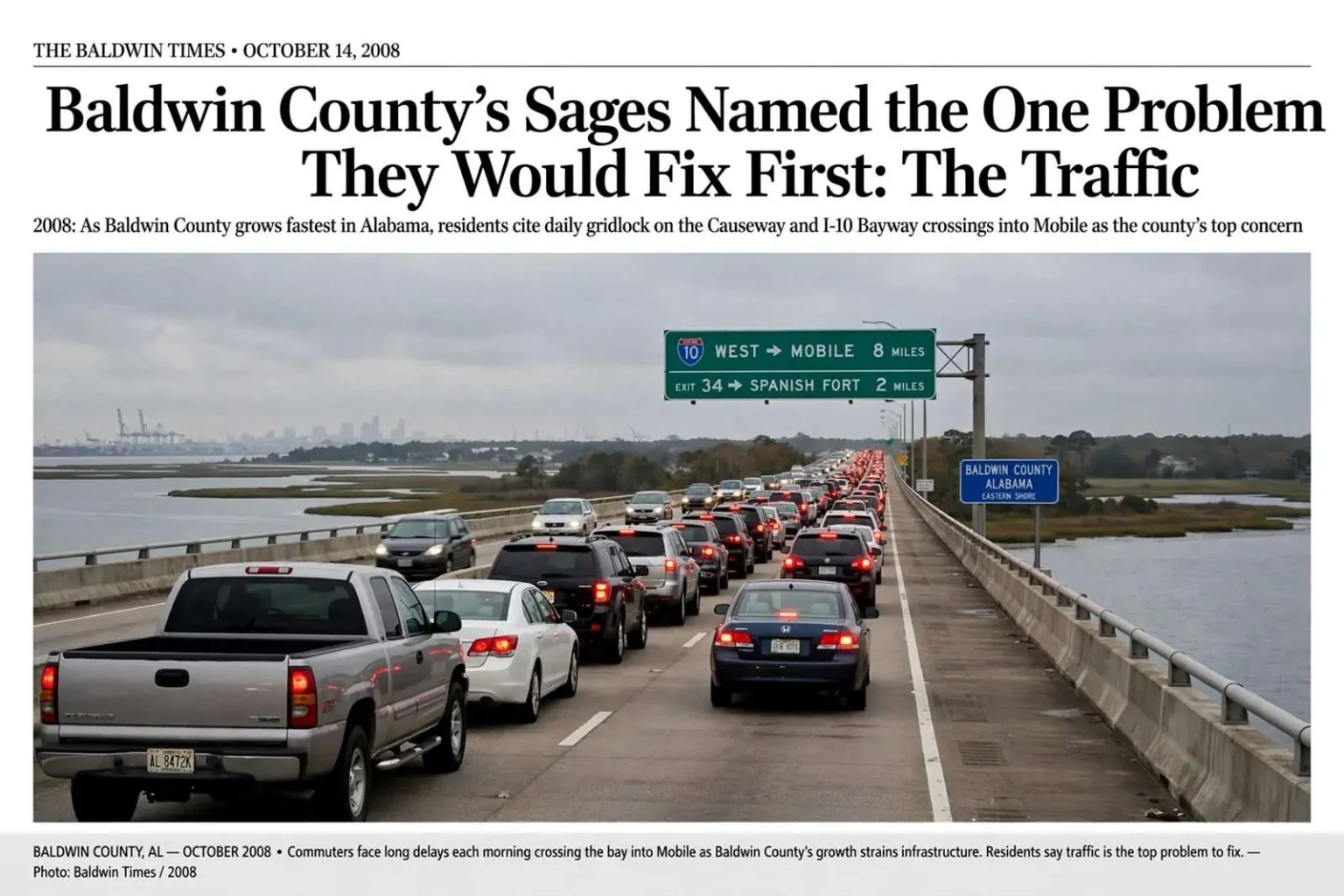
Baldwin County in 2008 was the fastest-growing county in Alabama, and its residents had begun to notice that everyone else had noticed. Asked to name the big county’s biggest problem — the one that could be corrected with relative ease — a group of Baldwin business people, lawyers, developers and civic figures returned answers that circled back, again and again, to the same subject. The traffic. And behind the traffic, the growth that produced it.
The canvass captured a county at the inflection point of its modern history. Baldwin’s population had been climbing for a generation — retirees from the Midwest, families drawn by the schools, and the magnetic pull of the Gulf beaches — and by 2008 the strain was visible every weekday morning on the crossings into Mobile. What follows is what the county’s own civic class said when asked to name the one thing they would fix first.
The Commute Across the Bay
“In my opinion, the biggest problem facing Baldwin County is the population explosion which has created tremendous commuter congestion on the Causeway and the I-10 bay way,” said Kim Robertson of Spanish Fort. “People that live in Baldwin County and work in Mobile risk their lives each and every day simply getting to and from work.”
His proposed remedies — rerouting transport trucks, revoking licenses, banishing the towed-vehicle RV tourists to the truck route — were offered with the black humor of a man who does the drive daily.
John White-Spunner of Montrose made the same case in the language of engineering. “Traffic flow is where the focus needs to be,” he said, calling for the planned Highway 13 access to the interstate to relieve congestion on U.S. 98 and County Road 104. He then raised the larger project: a new interstate bridge over the Mobile River.
“This is a large undertaking, but it needs to begin ASAP because as the container port comes on line and the other growth takes place in Mobile and Baldwin, the interstate will become a logjam at the tunnels as it already does at times,” White-Spunner said. Without it, he warned, “the short drive from Spanish Fort to downtown M(obile could take) an hour or more.”
His warning about the tunnels was the era’s most repeated transportation prophecy in south Alabama. Interstate 10’s crossing of Mobile runs through the George Wallace and Bankhead tunnels beneath the river — twin two-lane tubes built in an earlier era, with no shoulders and no room to widen. As container traffic from the port grew, trucks would have nowhere to go but those tubes, right where commuters converged. White-Spunner’s proposed answer — a new interstate bridge over the river — would take decades to arrive, but the logjam he described became a fixture of Eastern Shore life.
Frank Fowlkes of Montrose expected the strain to grow as EADS employees moved across the bay. “We need to improve the traffic flow especially between Baldwin County and Mobile,” he said. “If that means a new bridge so be it.”
The EADS reference pointed to the tanker program then proposed for the Brookley field — the industrial prize that, if won, would put thousands of workers on the region’s roads. That was the undercurrent of Baldwin’s 2008 traffic anxiety: growth already visible, plus growth still to come.
Roads, Judges and Sewer
Jody Bishop of Fairhope pointed to “the need for more good roads in the county,” noting the County Road 13, State Highway 181 and County Road 83 projects and the “Pay as You Go” plan going before voters in June. He added that “a few additional judges to tackle a growing caseload here wouldn’t hurt as well.”
His pairing of roads and judges was characteristically Baldwin: the county’s courthouses in Bay Minette, Foley and Fairhope were seeing caseloads climb with the population, just as its two-lane county roads were filling with commuters. The “Pay as You Go” road plan on the June 2008 ballot — a special self-funded sales tax dedicated to road construction rather than borrowed money — was the county’s attempt to finance its way out of the backlog without waiting on state or federal schedules.
Randy Davis of Daphne needed one word: “Sewer.”
Davis, who would later serve in the Alabama House, spoke for a segment of Baldwin’s infrastructure usually invisible until it fails. Septic systems across the county’s sandy soils had reached their limits in fast-growing subdivisions, and extending sewer service — expensive, slow and unglamorous — was the precondition for most of the growth east of the bay. Roads got the headlines; sewer decided what could be built where.
Planning, Zoning and the Fight Over Who Decides
The sharpest disagreement was over land use. Mary Beth Mantiply of Montrose took direct aim at the Baldwin County Planning Commission, describing it as composed largely of “retired transplants” out of step with the region, and citing Retirement Systems of Alabama chief David Bronner’s complaint that Baldwin was among the most burdensome places in the country to develop anything. Appointing authorities, she argued, should take those appointments far more seriously.
Bronner’s critique carried weight because of who he was — the RSA chief whose coastal developments had made him one of the state’s most influential investors, and whose judgment on development climates was formed by building in them. Mantiply’s argument, that a county commission staffed with retirees from elsewhere governed a place changing faster than any of them had seen, was the development community’s standing complaint in Baldwin.
Max Cassady of Fairhope argued the opposite case, and made it as an appeal to memory.
“Imagine downtown Mobile without Bienville Square, New York City without Central Park, Fairhope without its public vistas over Mobile Bay, or Daphne’s Village Point Park,” he wrote. Savannah is a great city, he said, because planners a century ago required parks on nearly every block.
“Like the smiley face or not, the Fairhope folks lost the WalMart battle because of lack of zoning.” He urged adoption of model zoning codes to preserve green space and require sidewalks.
Cassady’s examples were local proof of the principle. Fairhope’s single-tax colony founders had reserved public parkland on the bluff above the bay in 1894 — the vistas he named — and Daphne’s Village Point Park preserved a stretch of shoreline that development pressure would otherwise have claimed. The Walmart fight, decided under Fairhope’s limited zoning tools, had shown the town what it could not protect without a stronger code. His argument was that Baldwin’s window for making such choices was closing as the county filled in.
Pauline Anders of Fairhope identified the structural gap: “Lack of coordination between the many municipalities so that there could be cohesive planning.” If the mayors and planning commission chairmen met regularly, she said, they could coordinate their efforts.
The county’s geography makes her point hard to dodge. Baldwin contains a dozen incorporated cities strung along U.S. 98, Alabama 181 and the bayfront, each annexing and zoning on its own schedule, with unincorporated county land in between. A subdivision approved in one jurisdiction loads its traffic onto a county road and its students into a school district that had no vote on the approval. Regular coordination — the kind Anders proposed — was then, as now, the remedy most often prescribed and least often taken.
Pete Burns of Ono Island reframed the problem as an opportunity. “The biggest problem — rapid growth — is a blessing if properly handled,” he said, urging the county to hire a professional to establish a long-term vision.
Burns, speaking from one of the county’s most distinctive addresses — the gated island community in Ole River at the Alabama-Florida line — made the growth-optimist’s case: the county’s problem was not that people wanted to come, but that no one had written down what Baldwin should look like when they did.
Dissenters and Philosophers
Not everyone accepted the premise.
“You know, it is easy to snipe, but I think Baldwin County is doing about as well as it reasonably can,” said David Bagwell of Point Clear.
Larry Chason of Daphne agreed with the traffic complaints and then punctured them: “However, if you want to see traffic, go to any other city of the size we are about to be.”
And Greg Saad of Loxley declined the question entirely, reporting that with the change in weather the bass and bream would soon be hitting top-water flies, and that a regional Blue Ribbon planning committee might be required to study the matter fully. Some of us, he said, “intend to blaze the trail regardless.”
The spread of answers — from White-Spunner’s interstate bridge to Saad’s fishing report — captured a county still deciding what kind of place it intended to be. The traffic complaints proved prophetic: the crossings into Mobile remain Baldwin’s defining infrastructure question, the tunnel-bypass project White-Spunner called for took its first real steps a decade later, and the planning fights he and Cassady outlined continue in every Baldwin city hall. Growth, as Burns said, proved to be a blessing for whoever handled it — and Baldwin has been handling it ever since.