FAA Sent $3.28 Million to Four Southwest Alabama Airports
Mobile Regional, Atmore Municipal, Dauphin Island and Bay Minette Municipal airports shared more than $3.28 million in federal aviation grants for sprinklers, security fencing and runway protection zones.
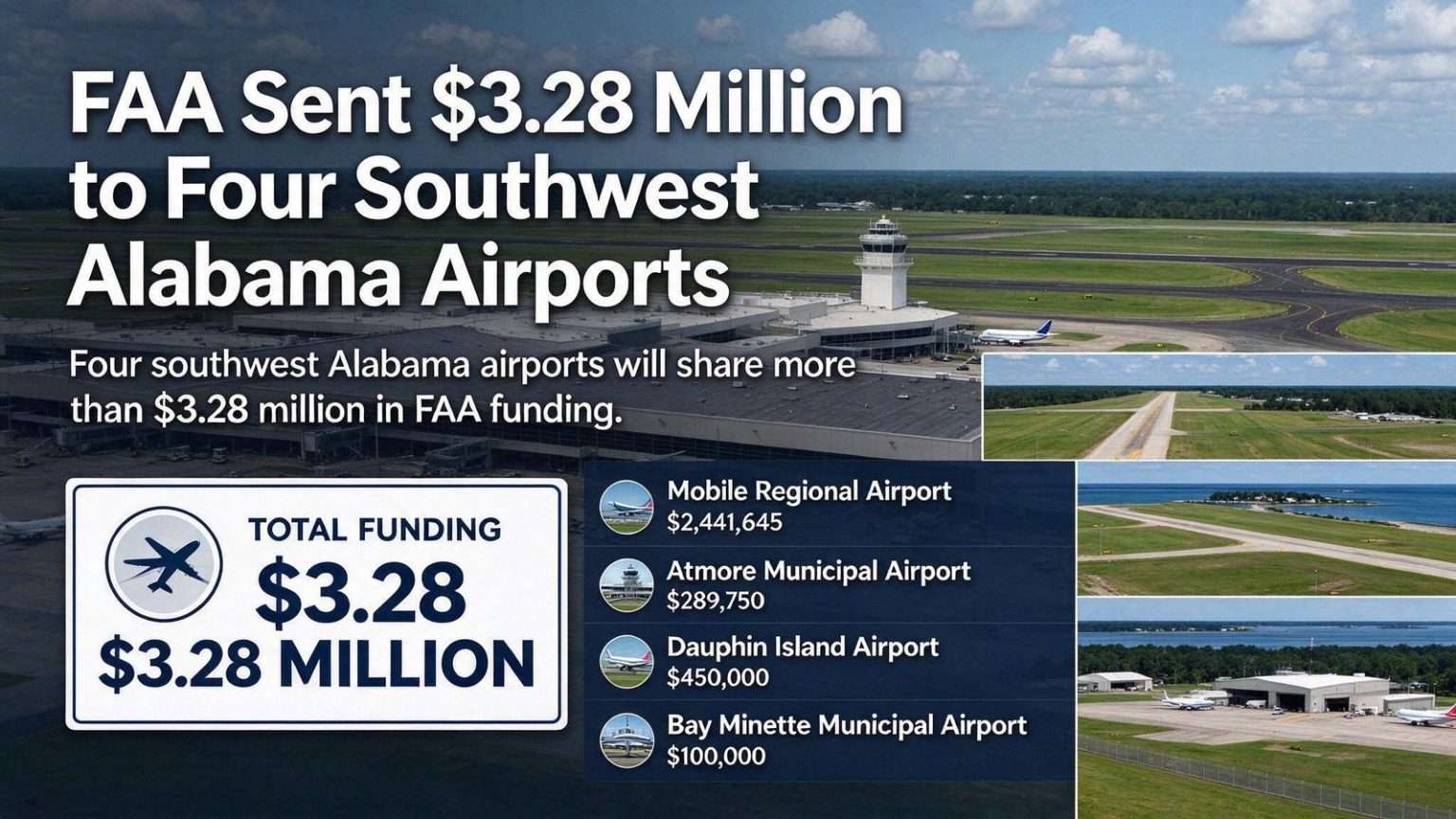
Four airports in southwest Alabama were awarded more than $3.28 million in federal funding from the U.S. Department of Transportation’s Federal Aviation Administration, U.S. Rep. Jo Bonner announced. The grants ranged from a major terminal safety overhaul at the region’s commercial airport to a security fence at a small municipal field, and they landed at a moment when the congressman was explicitly tying aviation to the region’s economic prospects.
The awards came through the FAA’s long-running airport grant program, which sends a share of federal aviation revenue back to airports of every size for safety and infrastructure work. For the largest commercial fields the money buys terminal upgrades and runway improvements; for the smallest municipal strips it buys fencing, lighting and land, and without it, many small airports could not afford either.
Where the Money Went
Mobile Regional Airport received the largest single award, $2,441,645, to install a sprinkler system in the terminal building, relocate the emergency exit stairwell, replace lighting fixtures in the main lobby and improve access roads. The package addressed both fire safety inside the terminal and the unglamorous work of getting passengers to and from the building by car.
Atmore Municipal Airport received $289,750 to acquire property establishing runway protection zones. The Escambia County field serves general aviation traffic along the Interstate 65 corridor between Mobile and Montgomery, and the grant extended the airport’s control over the ground at the end of its runway.
Dauphin Island Airport received $450,000 to acquire property establishing a runway protection zone for runway 30. The island’s airstrip sits at the western end of a barrier island community reachable by a single causeway, a geography that gives the small field an outsize role whenever storms or accidents close the road.
Bay Minette Municipal Airport received $100,000 to install security fencing at the terminal area and the aircraft parking apron. Fencing is one of the most basic security measures an airport can take, separating parked aircraft and the terminal from anyone wandering in from surrounding property, and it is exactly the kind of project a small municipal budget struggles to fund on its own.
What a Runway Protection Zone Is
Two of the four grants went to the same unglamorous purpose, and it is worth explaining, because it accounts for a large share of the money the FAA distributes to small airports. A runway protection zone is the trapezoid of ground immediately off the end of a runway. It is the area an aircraft would occupy if it came down short or overran the pavement.
Federal standards call for that ground to be kept clear of people and buildings. The reasoning is simple arithmetic: an approach gone wrong does not stop neatly at the threshold, and the safest place for an aircraft to end up is an empty field, not a dining room. The size of the zone grows with the size and speed of the aircraft the runway is designed to serve.
The trouble is that airports do not always own it. Land at the end of a runway is often privately held, and as the surrounding area develops, a house, a store or a gathering place can appear precisely where an airplane might one day land uninvited. Airports built in open country decades ago have watched development creep toward their approaches all across Alabama, and the FAA’s answer is to buy the land before someone builds on it.
By buying the property, or the development rights to it, the airport gains permanent control and can guarantee it stays empty. The zone may sit idle for the entire life of the grant, and that is the point — the money buys certainty that nothing will ever be there.
Both Atmore and Dauphin Island were buying certainty. For a few hundred thousand dollars each, the two fields locked in the safety margins around their runways for the long term, protecting both the pilots who use them and the neighbors who live under the approach paths.
The Mobile Regional Package
The largest award, nearly $2.5 million, addressed the terminal itself. A sprinkler system, a relocated emergency exit stairwell and replaced lighting are the kind of improvements passengers never notice unless they are missing on the worst possible day.
Fire protection in a terminal building is a matter of code, but the difference between an older facility and a modern one can be substantial, and retrofitting sprinklers into a building that predates current standards is disruptive and expensive — which is why it lands on federal grant requests rather than local budgets. The relocated stairwell similarly brought the terminal’s emergency egress into line with modern expectations, the kind of improvement that only registers with the traveling public if it is ever needed.
Access road work, meanwhile, addressed the ordinary friction of getting to the gate. An airport’s first impression is formed on the road leading to it, and smoother, better-marked access roads mean fewer frustrated passengers and safer circulation for the shuttles, taxis and private cars that serve the terminal.
Mobile Regional, at the time, was the region’s primary commercial airport, sitting west of the city off Airport Boulevard, and its facilities dated to an earlier era of air travel. The airport has served as the Gulf Coast’s front door for millions of travelers over its history, connecting the region to hub cities and, through them, to the rest of the country, and keeping its terminal current is a standing obligation for anyone who wants the region taken seriously by airlines and travelers alike.
The Economic Development Frame
Bonner tied the grants directly to news that had just transformed the region’s outlook. “I commend the FAA for providing this funding for these airports in southwest Alabama,” Bonner said. “Just this month, our area learned we will be the site of the largest economic development project in the United States, and improvements to our area airports will provide even greater accessibility to our region.”
The reference was to the ThyssenKrupp steel plant, the $3.7 billion project bound for north Mobile County near Calvert, which had been described as the largest such project in the country. The German steelmaker’s decision to build on a site above the Tombigbee River put southwest Alabama at the center of a global industrial competition and promised thousands of construction jobs followed by permanent employment at the mill itself.
A plant of that scale would bring executives, engineers, contractors and suppliers flying in from Germany, Brazil and across the United States, and the airports they landed at would form the region’s first impression. Bonner’s argument was that the grants were not merely safety housekeeping but economic infrastructure: a modern terminal in Mobile, secure fields in the outlying counties, and protected approaches everywhere were part of the package a global company would evaluate when deciding whether the region could support its operations.
The announcement also illustrated how federal aviation money flows to southwest Alabama. The FAA’s grant program is funded largely by taxes on airline tickets and aviation fuel, collected nationally and distributed to airports through a competitive and formula-driven process, and a congressional office’s announcement is typically the last step in an application trail that began months earlier at the airport itself.
Small Airports, Real Stakes
The three general aviation fields on the list, Atmore, Dauphin Island and Bay Minette, do not carry airline traffic. They carry crop dusters, charter flights, medical transports, business aircraft, flight training and, on an island in the Gulf, the only fixed-wing link when weather or traffic closes the causeway.
That last function is easy to overlook until it is needed. Dauphin Island sits at the end of a three-mile bridge and causeway across Mississippi Sound, and tropical weather, wreck collisions and routine maintenance all periodically cut the island’s road link. When that happens, a runway within sight of town becomes the fastest route for medical evacuation and emergency supply, which is why protecting the ends of that runway with federal money makes sense even for a field that sees modest daily traffic.
Aerial application operators, meanwhile, depend on small fields across south Alabama every growing season, treating timber and row crops across the coastal plain from the air. Medical transport flights, pipeline and utility patrols, and the business aircraft of companies scouting the region for opportunities all add to the traffic. For the small towns of Escambia, Baldwin and Mobile counties, a municipal airport is an economic asset that a prospective employer checks before it checks anything else: a community that can accept corporate jets and light cargo is a community that can host a plant, a distribution center or a hospital service line.
Federal aviation grants are how those fields stay in compliance with federal standards, and how a town of a few thousand people can afford a fence, a light system or a strip of protected ground at the end of its runway. The local match that accompanies each grant is a fraction of the total cost, which is precisely the arrangement the program was designed around: the federal government shares the cost of keeping the national aviation system safe, and small communities contribute what they can toward projects they could never fund alone.
Together, the four awards were a small but concrete illustration of how federal money reaches the ground in south Alabama: a terminal in Mobile, dirt in Atmore, dirt on Dauphin Island, and a fence in Bay Minette. None of it was glamorous, all of it was consequential, and taken together it added up to a region preparing its front doors for the biggest economic development project the country had to offer.