Mobile Police Tie Two Teens to Robbery Ring Targeting Waffle House Locations
Mobile police said two teenagers arrested after a chase and crash were part of a larger armed robbery ring that had targeted at least six Waffle House restaurants across the city since March.
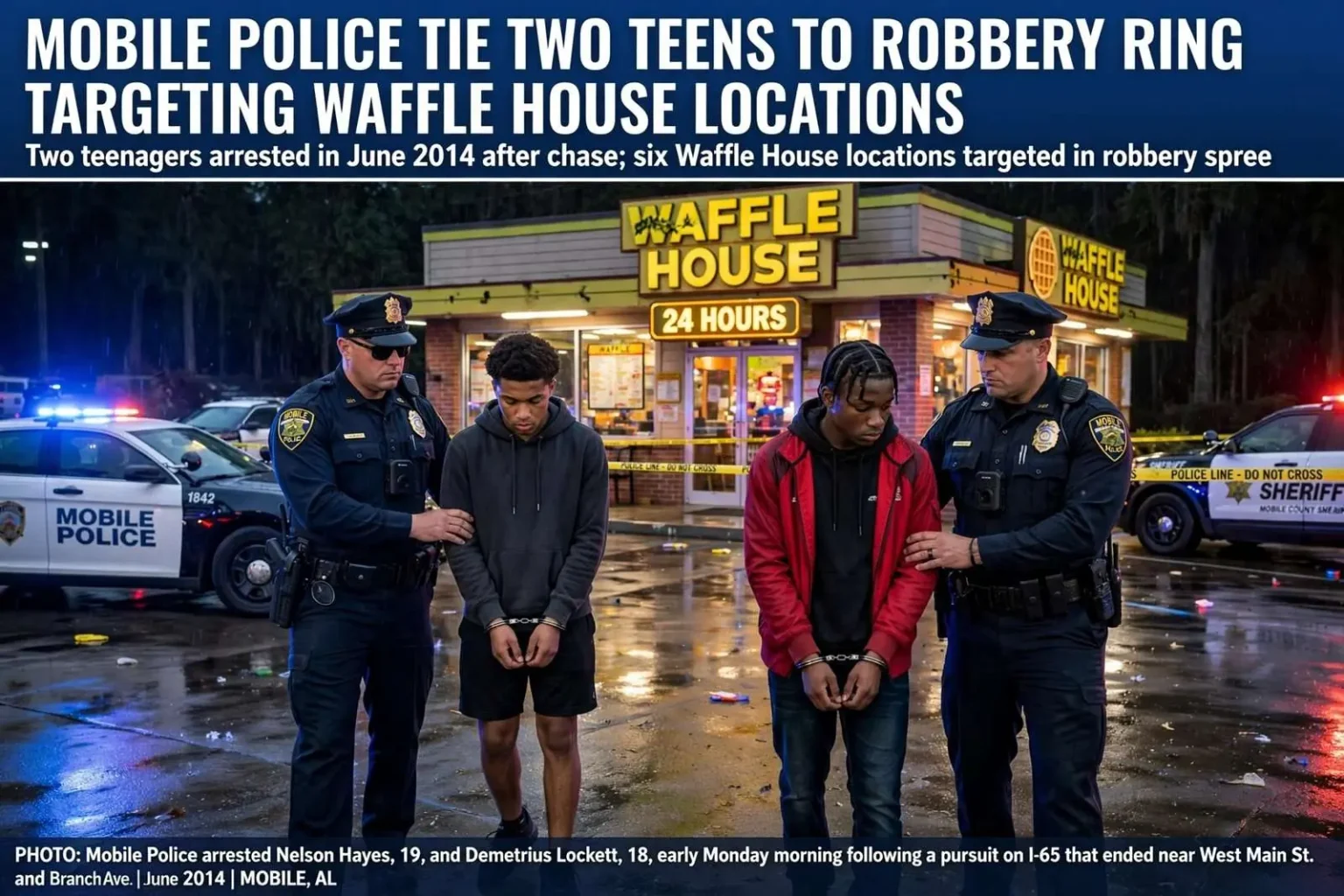
Mobile police arrested two teenagers in June 2014 whom they described as part of a larger armed robbery ring that had targeted Waffle House restaurants across the city, capping an investigation that began when officers noticed a spike in cases starting in March.
Nelson Hayes, 19, and Demetrius Lockett, 18, each faced charges of first-degree robbery, said police spokeswoman Ashley Rains. Officers arrested Hayes on 12 counts of robbery, while Lockett faced three.
A String of Restaurant Holdups
Six Waffle House restaurants were robbed by the suspects or others tied to the ring, Rains said, with some hit more than once. Investigators did not believe anyone involved worked for the restaurant chain.
“They knew there was cash on the premises,” Rains said. “Once they hit one, they figured they were all the same.”
The logic the suspects allegedly followed was simple, and it is what made the pattern so damaging to the restaurants involved. A Waffle House at 3 a.m. holds a register drawer fed by a steady overnight flow of customers, staffed by a small crew with little ability to resist, in a building designed with large glass windows facing a parking lot. Robbery detectives know the profile well; the suspects, according to the pattern police described, had learned it too.
The timeline mattered as well. Beginning in March and running into June, the holdups came in bursts across different quadrants of the city, with repeat visits to some of the same stores. That spacing — long enough to avoid immediate saturation of any one patrol beat, short enough to keep the proceeds coming — is characteristic of robbery crews that work multiple areas, and it is exactly the kind of rhythm that crime analysts look for when they connect cases into a single series.
For the restaurants, each holdup carried costs beyond the cash taken. Employees who work overnight shifts are the backbone of any 24-hour business, and repeated robberies put that workforce on edge, complicate hiring for late shifts, and force operators to weigh security changes against the all-night model that defines the brand. Regular customers, too, feel the difference when a familiar stop becomes a crime scene.
An Arrest After a Chase
Hayes and Lockett were apprehended that Monday morning after officers responded to a reported robbery in progress at the Waffle House on Dauphin Island Parkway. Three suspects fled in a stolen Dodge Dakota that had been spotted at other robberies, police said. Officers located the pickup on Interstate 65 and pursued it into the Mobile County Sheriff’s Office jurisdiction, where deputies joined the chase.
The truck wrecked near the intersection of West Main Street and Branch Avenue, and one suspect escaped. Hayes and Lockett were caught after an extensive search of the surrounding woods and swamp, according to police. Both were taken to Mobile County Metro Jail.
Where the Robberies Occurred
Police released a list of locations where robberies were attributed to the pair, spanning much of the city:
Waffle House, 3651 Airport Blvd. — first-degree robbery
Waffle House, 3428 Springhill Ave. — first-degree robbery (multiple counts)
Waffle House, 1754 Dauphin Island Pkwy. — first-degree robbery (multiple counts)
Waffle House, 3761 Government St. — first-degree robbery
Chevron, 5454 Ziegler Blvd. — first-degree robbery
Circle K, 6111 Lott Road (Mobile County Sheriff’s Office) — first-degree robbery
Spread across the map, the locations trace the corridors a mobile crew would use: Airport Boulevard running east-west through the heart of the city’s commercial strip, Springhill Avenue serving the central city, Government Street cutting through the older neighborhoods, and Dauphin Island Parkway heading south toward the coast. The gas station robberies — the Chevron on Ziegler Boulevard and the Circle K on Lott Road investigated by the Sheriff’s Office — show the ring’s reach extended beyond one chain and across jurisdictional lines, which is precisely what made a coordinated multi-agency response necessary.
A Pattern That Drew Police Attention
What set the case apart, in the department’s telling, was its scale and repetition. Rather than a single holdup, investigators described a coordinated series of armed robberies that concentrated on one type of target across several parts of Mobile, from Airport Boulevard and Springhill Avenue to Government Street and Dauphin Island Parkway. The clustering of cases, police said, was what first tipped them off to a ring beginning in March.
Robbery patterns are among the cases detectives track most closely for that reason. When the same type of business is hit repeatedly in a short window, with similar methods and descriptions, departments begin linking scenes, comparing surveillance footage and watching for the vehicle used. The stolen Dodge Dakota spotted at multiple robberies became the thread that connected them — and, ultimately, the vehicle that led to the arrests.
First-degree robbery, the charge each teen faced, is among the most serious property crimes under Alabama law, reflecting the use or threat of force during a theft. The dozen counts lodged against Hayes signaled how many separate incidents investigators believed they could connect to him as the inquiry advanced. Under Alabama’s sentencing structure, a first-degree robbery conviction carries a potential prison term measured in decades, which is why such charges anchor the early stage of a case and shape the decisions defendants make about trial or plea.
The Investigation Continues
Rains indicated the case was not closed. “We know from footage that we have suspects that we haven’t identified yet,” she said, referring to surveillance images gathered during the investigation. Police asked that anyone with information about the robberies contact the Mobile Police Department.
The acknowledgment that additional suspects remained at large underscored how robbery rings of this kind typically operate: a small core identified and charged, with associates who drove, cased locations or participated in individual holdups still to be found. Surveillance cameras at restaurants and gas stations — often the only witness to a masked robbery — were central to building that picture, and investigators were counting on the public to put names to the faces captured on them.
The arrests, officials suggested, had disrupted a pattern that had unsettled workers and late-night customers at a chain long associated with round-the-clock service across the Gulf Coast. Waffle House locations are woven into the rhythm of Gulf Coast life — open through hurricanes for emergency workers, busy after bar closings, packed with travelers on the interstate corridors — which is part of why a string of robberies targeting them resonated so widely in Mobile.
The pursuit itself became its own case study in how a chase crosses jurisdictions in a few minutes of driving. A robbery call originating on Dauphin Island Parkway put city officers behind a vehicle that reached Interstate 65, where the pursuit crossed into territory the Mobile County Sheriff’s Office covers, bringing deputies into the chase under the mutual-aid arrangements that bind the area’s agencies. By the time the truck wrecked near West Main Street and Branch Avenue, two departments were invested in the outcome — and both shared an interest in what the man who escaped on foot might know about the rest of the series.
What the Case Means for Overnight Businesses
The case also illustrates the security realities facing any business that keeps cash on hand through the night. Chains like Waffle House operate on a model that cannot simply close its doors — the all-night diner is the product — so operators manage risk through camera systems, drop safes, controlled cash handling and coordination with police rather than by locking up. When a robbery pattern emerges, those systems become the evidence trail that detectives follow.
For residents, the episode offered the practical lessons police repeat in nearly every robbery case: note descriptions rather than intervening, remember direction of travel, and report even partial information. The Dauphin Island Parkway call that led to the arrests worked because a robbery was reported in progress, giving officers a vehicle description and a head start — the stolen Dodge Dakota still in view on Interstate 65. Minutes mattered, and the coordination between city officers and sheriff’s deputies during the pursuit turned a fleeing truck into two arrests and a map of connected cases.
Court records in cases like this one typically unfold over many months. Charges are presented to a grand jury, counts may be consolidated or amended as evidence from surveillance footage is matched to individual incidents, and co-defendants can face different outcomes depending on the strength of the evidence tying each of them to each scene. With Hayes facing a dozen counts and Lockett three, the disparity itself reflected how investigators allocated the series among the people they had caught.
The remaining suspects, police said, were still out there in the footage — and the department’s request for help remained open to anyone who recognized them.