
Should Mobile Pay Its Mayor Like a CEO? A Council Idea Stirs Debate
A Mobile city councilor is expected to propose more than doubling the mayor's salary to $200,000, making the case that the city must pay a market rate to attract executive talent.
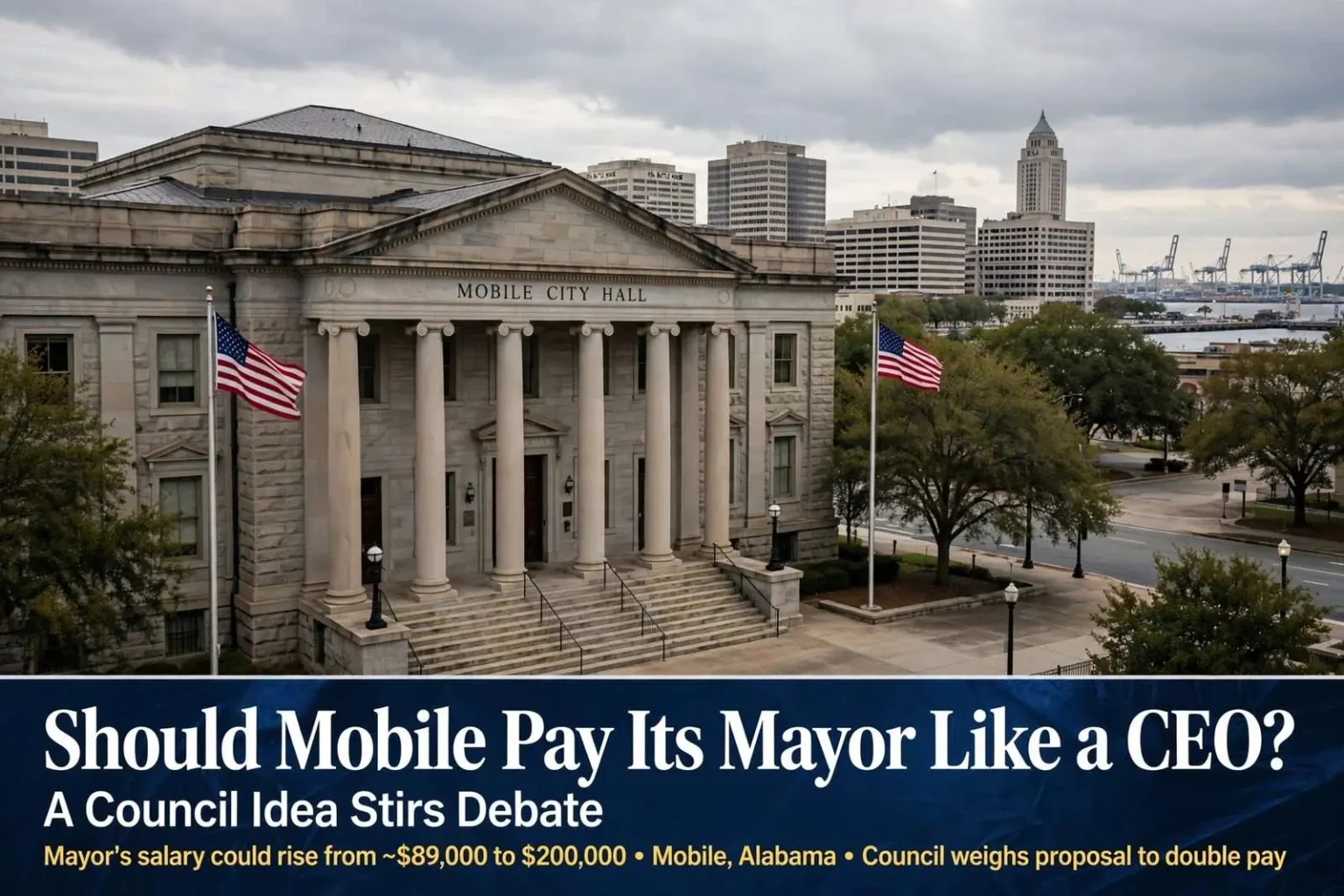
A Mobile city councilor is expected to propose a substantial raise for the city’s mayor, lifting the salary from its current level of about $89,000 a year to $200,000, a move that would more than double the pay of the city’s chief executive and reopen a perennial debate over what municipal leadership is worth. The proposal is certain to draw scrutiny in a city where the mayor’s office dominates the day-to-day business of government, and where every dollar of city spending has lately been examined with unusual care.
The Reasoning Behind the Proposal
The reasoning behind the proposal drew on a comparison to the private sector. In business, the argument went, any chief executive officer worthy of the title commands a salary of at least $200,000. If Mobile wanted genuine competence in its top executive, the thinking held, it should expect to pay the going market rate. The comparison assumes that the skills the job demands — managing thousands of employees, negotiating contracts, selling the city to employers and investors, and answering to a governing board — are the same skills the market pays for in the corporate suite.
Critics of that framing counter that public service has never been, and should not be, priced like the private market. The mayor of Mobile holds elected office, answers to voters rather than shareholders, and accepts a level of public scrutiny no corporate officer faces. Under that view, the salary needs to be enough to attract serious candidates without turning City Hall into a prize that draws office-seekers for the paycheck. The tension between those two ideas — government as an enterprise to be run well, and government as a public trust priced differently — sits at the center of the debate the proposal is expected to open.
A Raise for the Office, Not the Officeholder
Crucially, any increase would not take effect until after the municipal elections two years off, a structure intended to insulate the measure from the appearance of enriching the sitting mayor. By deferring the change, supporters could frame the proposal as an investment in the office itself rather than a benefit for any particular individual. The timing also gives voters a practical role in the decision: whoever wins the next election is the first person who would actually collect the higher salary, and residents who object to the raise have a direct remedy at the polls.
The distinction mattered in a city where the mayor’s pay had long lagged behind the compensation of executives running organizations of comparable size and complexity. Mobile’s mayor presides over a full-service city government — police, fire, public works, parks, ports-adjacent infrastructure, planning and economic development — and the gap between the office’s pay and the private market has grown over the years as the city’s operations have expanded. A salary fixed in an earlier era erodes in real terms, and by the measure supporters use, the $89,000 figure had fallen well behind the executive benchmarks they cited.
Advocates of the raise contended that a salary competitive with the private sector would widen the pool of qualified candidates willing to seek the job. A sitting business executive or a rising professional asked to walk away from a career to run a city government full-time gives up income, advancement and privacy; the current salary makes that sacrifice steep for anyone who is not already wealthy or retired. A market-rate salary, the argument runs, lets the city recruit from the same talent pool its largest employers draw from.
The Case for Competitive Pay
Under Mobile’s mayor-council form of government, adopted in the mid-1980s when the city moved away from a three-member commission, the mayor functions as a full-time chief executive responsible for a sprawling municipal operation with a budget in the hundreds of millions of dollars. Supporters of the increase pointed to that scope in arguing that the position demanded, and deserved, executive-level compensation. The 1985 change remade city government: it concentrated executive authority in a single elected mayor, gave the city a governing council drawn from districts, and created the strong-mayor structure that every subsequent administration has operated under.
The comparison to corporate salaries was meant to sharpen the point. A city the size of Mobile, proponents suggested, effectively asked its mayor to run an enterprise rivaling a substantial private company — with a workforce measured in the thousands, capital projects in the tens of millions, a port-adjacent economy to support, and a credit rating to protect. No board of a company that size would expect to hire a capable chief executive for the salary Mobile has paid its mayor, the argument concludes, and city government should not pretend otherwise.
The counterargument is partly about optics and partly about structure. Council members, who share the governing authority, earn a fraction of what the proposal would pay the mayor, and some question the signal sent by widening that gap. Others note that Alabama’s municipal salaries in general lag the region, and that a city raising its mayor’s pay to $200,000 would stand out among comparable Southern cities rather than blend in. Whether that distinctiveness is an asset in recruiting or a liability in public opinion is precisely what the council debate is expected to sort out.
What Comparable Jobs Pay, and Why It Is Hard to Compare
Executive compensation is a blunt benchmark. A private CEO’s package typically includes bonuses, equity and retirement contributions that dwarf base salary, while a mayor’s pay is the whole of the compensation and the term is fixed at four years, with no severance and no guarantee of re-election. Public-sector pay studies generally adjust for those differences, but a headline number — $200,000 — invites exactly the simplistic comparison the debate turns on.
There is also the question of what the office actually requires. Mobile’s mayor appoints the city’s department heads, proposes the budget, negotiates with the county, the state and federal agencies, and serves as the city’s principal salesman to industries considering the Gulf Coast. The job is closer to a chamber-of-commerce presidency, a construction-program manager and a chief executive rolled into one, and the busiest stretches — hurricane seasons, industrial recruitments, budget fights — do not observe business hours. Defenders of the raise argue that the breadth of the role is the strongest case for treating it as genuine executive work.
Skeptics respond that the résumé requirements of the office are different from those of a corporation: no one is elected to a board seat by 100,000 voters, and no CEO faces a council that can investigate, subpoena and override. The accountability structures of city government, they argue, justify pay that reflects the public character of the post rather than a market proxy.
The Politics of a Pay Raise
Whatever its merits, the proposal arrives in a politically delicate season. Council actions that touch salaries are among the most visible votes a member takes, and a measure that more than doubles anyone’s pay is guaranteed to generate constituent reaction. The two-year deferral blunts the sharpest criticism, but it does not eliminate the question every councilor will face: whether Mobile’s taxpayers should fund an executive salary at the level the proposal sets. Members will also have to weigh the timing against the city’s broader budget picture, in which public safety, drainage and paving needs compete for every available dollar.
There is a procedural dimension as well. Municipal salaries in Alabama are set by the governing body, and changes typically require an ordinance adopted on multiple readings — a process that gives opponents several chances to slow the measure and supporters several chances to build a record. Public hearings, if the council holds them, will give residents a direct voice, and the debate is expected to draw commentary from civic groups, the business community and former city officials who have watched the mayor’s responsibilities grow since the strong-mayor era began.
What It Means for the Next Election
If the ordinance passes, the raise becomes part of the landscape of the next municipal race. Candidates who might have skipped the contest for financial reasons gain a reason to look again, and the field that emerges — whether it includes sitting council members, business figures, or newcomers to public life — will be shaped in part by the pay attached to the job. Voters, in turn, will be choosing the first mayor to receive the new salary, which makes the raise itself a de facto referendum item even though it never appears on a ballot.
Supporters of the change argue that this is exactly the point: the city is pricing the office at what it believes the work is worth, and then letting the electorate decide who deserves it. Opponents argue that a salary of $200,000 risks narrowing the office to candidates who already see themselves as executives, rather than public servants drawn from neighborhoods and civic life. Both camps agree on one thing — the debate will say as much about how Mobilians see their city as about arithmetic.
Mobile has grown into a city with ambitions that outstrip its old formulas: a port investing in its future, a downtown that has revived over two decades, an aerospace and shipbuilding corridor that has brought national employers to the region. The question the council has put on the table is whether the pay of the person who leads that city should reflect those ambitions. The answer, after whatever debate the proposal produces, will be written not in a council chamber but in the budget that takes effect after the next election — and in the candidates the new salary attracts.