
Insurance Reform Panel to Hear Coastal Voices in Mobile
The Alabama Affordable Homeowners Insurance Commission scheduled a public forum in Mobile, and Sen. Ben Brooks urged a strong coastal turnout on the anniversary of Hurricane Katrina.
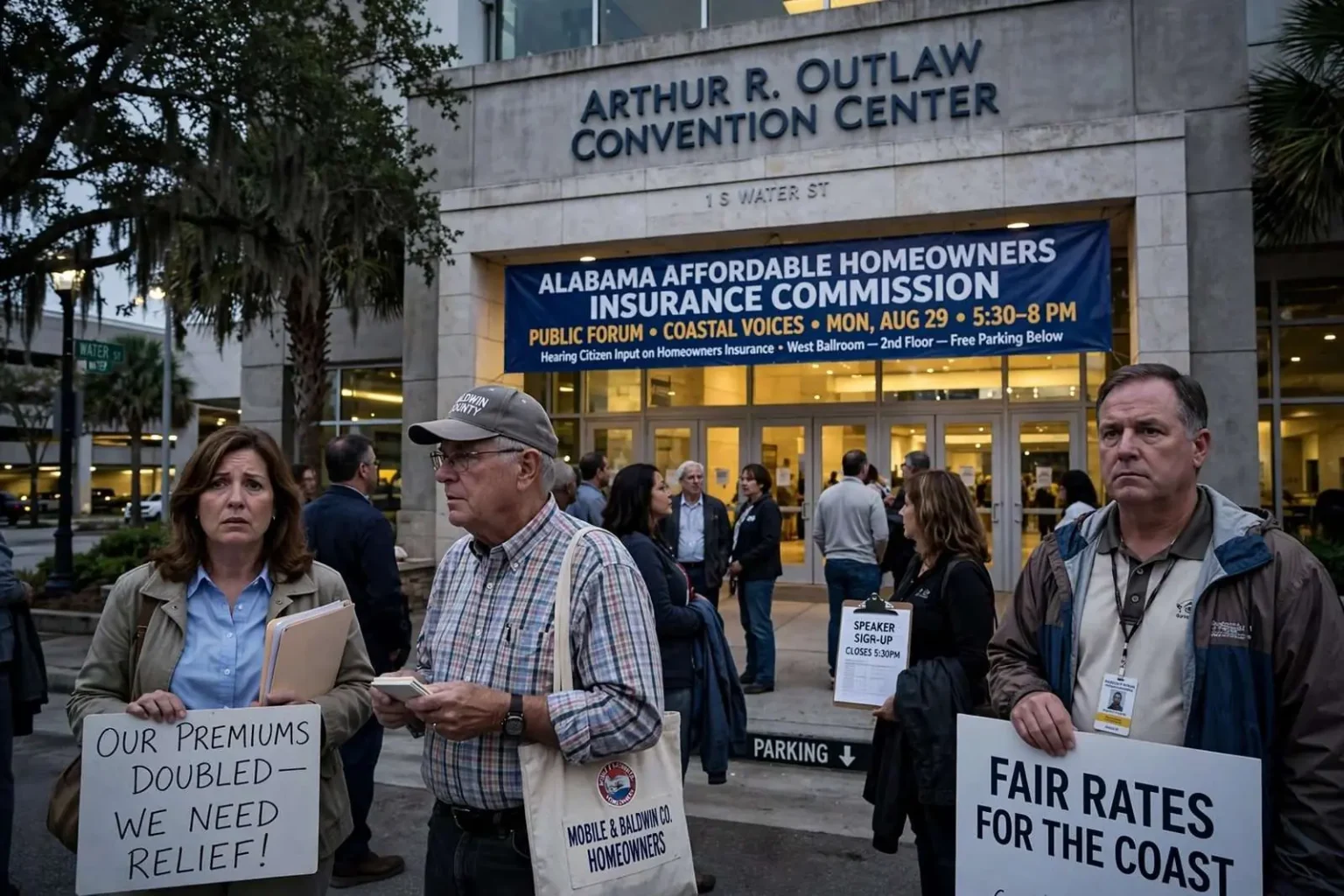
The state commission studying Alabama’s troubled homeowners insurance market scheduled a public forum in Mobile, offering coastal residents a chance to describe firsthand the premium increases that had strained households and businesses across the region. The Alabama Affordable Homeowners Insurance Commission planned to host the forum on Monday, Aug. 29, from 5:30 to 8 p.m. at the Arthur R. Outlaw Convention Center downtown, according to commission member and state Sen. Ben Brooks.
As it happened, the date fell on the anniversary of Hurricane Katrina, a coincidence that underscored the storms driving the crisis. Katrina came ashore on the Gulf Coast on Aug. 29, 2005, and its aftermath reshaped the insurance market across the entire northern Gulf rim. In the years that followed, carriers across the region raised coastal premiums sharply, pulled out of markets entirely or stopped writing new policies in South Alabama, leaving homeowners with fewer choices and higher bills.
For Mobile and Baldwin county residents, the consequences arrived in renewal notices. Homeowners reported premium increases that doubled or worse after the 2005 storms, and policyholders across the coastal counties described companies declining to renew, requiring new roofs as a condition of coverage, or quoting prices that made coverage unaffordable. The April 2011 tornado outbreak across central and north Alabama added inland voices to the complaint, reminding the state that the insurance problem was not confined to the coast.
A panel with a mandate
Appointed by Gov. Robert Bentley, the 30-member commission was charged with developing solutions to the upheaval in the insurance market stemming from recent hurricanes and tornadoes. Bentley had said he would call a special session of the Legislature that fall if the commission produced proposals guaranteed to pass, a condition critics grumbled would hand an advantage to industry interests that preferred the status quo.
The commission’s membership drew from across the state’s insurance landscape: legislators, industry representatives, consumer advocates and local officials from the affected counties. Its creation answered years of complaints from coastal residents that their premiums bore little relationship to their claims history, and that the market’s retreat from South Alabama had left them with effectively no choice of carrier.
Former Foley mayor and Baldwin County Probate Judge Tim Russell chaired the commission, and he had tapped Brooks to serve as the Baldwin and Mobile regional chairman. Brooks would moderate the Mobile forum. Russell’s background gave the chairmanship deep Baldwin County roots — Foley’s growth and the probate court’s role in property records both sit at the center of the coastal insurance question — and Brooks’s district spans the heart of the affected territory.
The stakes for the coast were straightforward. Homeowners insurance is not a luxury in a hurricane state: mortgage lenders require it, and a home that cannot be insured cannot be sold to most buyers. When premiums climb or carriers withdraw, the damage shows up in property values, in the ability of families to stay in their homes and in the willingness of businesses to invest along the Gulf.
How the evening would run
The session was set for the second-floor West Ballroom of the convention center on Water Street, with free parking available beneath the building. Brooks said the program could run past its allotted two and a half hours if participation warranted, and that guests would be allowed to sign up to speak until 5:30 p.m. The plan called for two hours of citizen input, with a short break, followed by roughly an hour of brainstorming among commission members.
The public was welcome and encouraged to remain for that discussion, and speakers would be chosen at random. The random selection was designed to prevent the best-organized groups from monopolizing the microphone, and to give individual homeowners — the people whose renewal notices created the crisis — the same standing as representatives of trade associations and government agencies.
The structure reflected the commission’s working method: rather than drafting proposals in committee rooms in Montgomery, members wanted to hear the specific, local details of the problem in the places where it bites hardest. What carriers had left a particular ZIP code, what new roof requirements were being imposed, how wind and hail deductibles had changed, how long policyholders were waiting on adjusters — those were the kinds of accounts the evening was built to collect.
The Outlaw Convention Center location put the forum within reach of both counties at the center of the dispute. Mobile residents could reach the Water Street venue from downtown, and Baldwin County residents had a direct drive across the bay — fitting, since the commission’s regional structure pairs the two counties in both its membership and its approach.
A plea for turnout
Brooks emphasized the importance of a strong showing from Alabama’s coastal communities. A paltry turnout, he warned, would allow the issue to fade in Montgomery, where coastal insurance reform competes with every other claim on the Legislature’s attention. A packed ballroom, on the other hand, would send the commission back to the capital with evidence that the problem was broad, documented and politically real.
The argument for turnout was grounded in how the commission’s recommendations would be used. Bentley’s promise of a special session hinged on proposals guaranteed to pass, and legislation that passes is legislation with demonstrated public support. Residents who stayed home, Brooks suggested, would be counted by opponents of reform as evidence that the crisis was exaggerated.
For homeowners deciding whether to attend, the forum offered a rare direct line to the people drafting the state’s response. Complaints that ordinarily arrive through an insurance agent, a letter to a legislator or a call to the state insurance department would instead be spoken into a public record that commission members would carry into their deliberations — and, potentially, into a special legislative session that could reshape how coastal Alabama buys and keeps its homeowners coverage.
The Aug. 29 forum was one of the commission’s public hearings, and its Mobile location made it the closest to the heart of the affected market. Residents were encouraged to arrive early to sign up to speak, since registration closed at 5:30 p.m., and to stay for the commission’s discussion that followed the citizen input segment.
The broader background of the crisis explains why the commission exists at all. Before 2005, coastal Alabama’s insurance market was competitive enough that most homeowners never thought much about their carrier. After Katrina, the national and regional insurers that had written the coast reassessed their exposure to a Gulf that had just demonstrated what a major hurricane could do to a densely built shoreline. Some raised rates to levels that priced policyholders out. Some imposed new underwriting standards — age of roof, distance to the water, condition of wiring — that disqualified homes that had been insured for decades. Some simply stopped writing new business in the coastal counties and let the book shrink through attrition.
The result was a market in which the homeowners with the greatest need for coverage had the fewest options. Policyholders who lost their carriers had to find replacement coverage wherever they could, often at far higher prices, and the state’s insurer of last resort carried more of the load than it had been designed to bear. Similar dynamics played out across the Gulf Coast after Katrina, making Alabama part of a regional problem that states like Mississippi and Louisiana were confronting at the same time.
Then came April 2011. The tornado outbreak that tore across Alabama on April 27 of that year was among the deadliest in American history, and it shifted the state’s insurance debate overnight. Communities far from the Gulf — including suburbs of Birmingham, Tuscaloosa and Huntsville — saw entire neighborhoods destroyed, and policyholders inland began to experience versions of the same story coastal residents had been telling since 2005: non-renewals, steep increases and shrinking options. The commission’s mandate, written to address “recent hurricanes and tornadoes,” reflected that expanded geography.
For coastal residents, that shift cut both ways. The influx of inland voices into the insurance debate meant more political weight behind reform, but it also raised the question of whether coastal-specific problems — wind coverage, distance-to-coast pricing, the availability of hurricane deductibles — would remain the focus once the tornado aftermath dominated the conversation. The Mobile forum gave the coast a chance to keep its own experience at the center of the record.
What reform could change
The proposals under discussion in statehouses across the hurricane-prone Southeast shared common themes, and Alabama’s commission was expected to weigh versions of all of them: encouraging homeowners to strengthen their houses against wind so losses fall before they reach the insurer; expanding the capacity of the state’s backstop mechanisms so the private market can price coverage more reasonably; requiring greater transparency from insurers about their rate filings and their underwriting decisions; and using tax or regulatory tools to encourage carriers to write in the coastal counties.
Each approach carries a different price and a different constituency. Mitigation incentives ask homeowners and the state to invest up front in stronger construction, with savings on premiums over time. Market-based incentives ask the state to make coastal coverage more attractive to write without dictating prices. Transparency measures ask the industry to open its books to the policyholders whose rates those books set. Critics of the industry have long argued that the status quo reflects the industry’s preference, and Bentley’s “guaranteed to pass” condition was read by some as a sign that the final package would lean toward voluntary, industry-friendly measures rather than mandates.
That skepticism is precisely why the public forums matter to the commission’s design. Whatever the final recommendations contain, the record built at hearings like the one at the Outlaw Convention Center determines how the problem is understood in Montgomery: as an actuarial dispute, a regulatory failure or a crisis of affordability affecting real households. The testimonies gathered on Aug. 29 — a Monday evening on the anniversary of the storm that started it all — would become part of that record, spoken by the people living it.


