University of South Alabama Bayou La Batre
Shelby Presses NOAA: Red Snapper Rules Are Choking Alabama’s Fishing Economy
U.S. Sen. Richard Shelby wrote to NOAA in December 2009 arguing that federal red snapper limits were punishing Alabama's charter and recreational fishermen even as the stock appeared to be rebuilding.
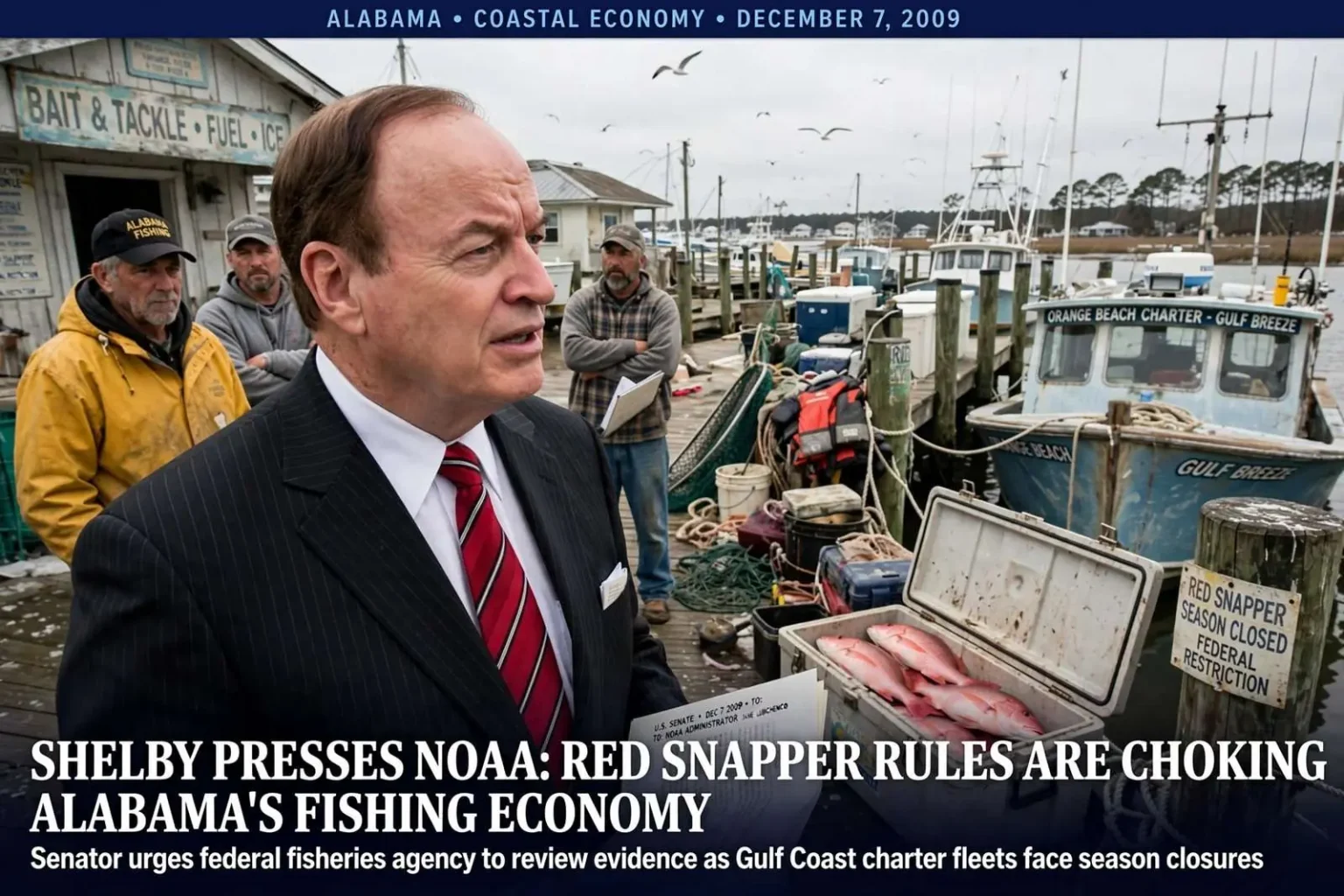
U.S. Sen. Richard Shelby, R-Ala., took Alabama’s long-running quarrel with federal fisheries managers directly to the top in December 2009, writing to the administrator of the National Oceanic and Atmospheric Administration to argue that red snapper regulations had grown so strict they were damaging the state’s coastal economy.
The letter, dated Dec. 7 and addressed to NOAA Administrator Jane Lubchenco, laid out the case that has animated dockside conversation from Dauphin Island to Orange Beach for years: that the fishermen who are on the water every day see more and bigger red snapper than the federal models seem to acknowledge.
The argument
“Alabama’s fishing industry represents hundreds of millions of dollars of economic impact for the state each year,” Shelby said. “However, due to overly stringent federal regulations, Alabama fishermen have suffered severe reductions in their red snapper catch for a number of years — at a time when fishermen are encountering record numbers of, and increasingly large, red snapper.”
That disconnect, he wrote, was troubling. “During these tough economic times it appears imprudent to tighten restrictions on Alabama fishermen if the resource is as healthy as many contend.”
The economic claim behind the senator’s letter was not rhetorical padding. The charter fleets and party boats that run out of Orange Beach, Gulf Shores and Dauphin Island carry a large share of the coastal tourism economy, and the red snapper — Alabama’s signature offshore sport fish — is the trip most of those customers book. Every day the federal season is closed, those boats sit at the dock, and the losses ripple through tackle shops, bait houses, fuel docks, motels and restaurants. When the closures began stacking year after year, the Gulf Coast’s business community treated snapper management not as a fisheries dispute but as an economic emergency.
The National Marine Fisheries Service, a division of NOAA, had reduced the recreational red snapper season to four months beginning in January 2008 and had closed the season early every year since. Shelby noted that the agency believed even shorter seasons might be warranted in the future.
The trajectory explains the alarm. A recreational snapper season that had once stretched across most of the year had been cut to four months, and even that window had failed to hold — closures arrived before the quota was caught, in early summer, precisely when the charter fleet’s calendar is fullest. The suggestion that future seasons might be cut shorter still read, on the Gulf Coast, as a death sentence in slow motion: a fishery being ratcheted out of existence one assessment at a time.
The science question
Shelby’s letter pressed hardest on the quality of the data underlying those decisions. A stock assessment update was being prepared and was expected soon, and Shelby noted with evident approval that the University of South Alabama’s Dr. Sean Powers was chairing the 2009 Gulf of Mexico Red Snapper Stock Assessment Update Panel. He said he intended to review the resulting report closely.
Powers’ chairmanship mattered to Alabama anglers for reasons both practical and symbolic. A University of South Alabama fisheries scientist whose own research program worked Alabama’s artificial reefs had a direct, professional acquaintance with the water the regulations governed — and Gulf Coast fishermen regarded his appointment to chair the assessment panel as the first time in years that someone who had actually surveyed their reefs sat at the head of the table. Shelby’s approval was pointed: the federal science process, long criticized from the docks as closed and self-referential, had been handed to a panel led by a scientist from the state with the most to lose.
He also pointed to unfinished business. A key recommendation of the 2005 Southeast Data, Assessment and Review report — that fishery-independent surveys for adult red snapper be expanded — had not been met, he wrote. The existing surveys appeared to cover only a fraction of the historical range of the species and were therefore unlikely to capture the full extent of the stock’s recovery.
That criticism went to the heart of the dispute. Alabama’s waters hold one of the largest artificial reef zones in the country, built over decades from concrete, bridge rubble and retired vessels, and it has made the state’s narrow stretch of coastline extraordinarily productive for reef fish. Alabama anglers have long argued that surveys designed for a broader Gulf do not measure what is actually swimming off Baldwin and Mobile counties.
The reef argument deserves its full explanation, because it is the reason Alabama’s fight over snapper data has never simply been a complaint about paperwork. For half a century, the state has permitted and promoted the deliberate construction of artificial reefs — deployment zones stretching miles offshore where concrete rubble, obsolete bridge spans, tanks and ships have been sunk to create hard-bottom habitat on a coast that has almost none naturally. Snapper, grouper and triggerfish colonize that structure in numbers the natural bottom of the north-central Gulf cannot support, and the result is a fishery concentrated in Alabama’s permitted reef zones that federal trawl and longline surveys, built to sample the whole Gulf, sample thinly.
The consequence, fishermen argued, was a systematic blind spot. If the surveys under-represent the habitat where Alabama’s snapper actually live, the stock assessment models fed on those surveys will undercount the population — and every quota, season length and bag limit derived from that undercount will be tighter than the real fishery requires. That was precisely the 2005 SEDAR panel’s warning about expanding survey coverage, and precisely the unfinished work Shelby’s letter flagged: four years later, the recommendation had not been carried out, and the seasons had been cut anyway.
A meeting in Mobile
Shelby closed with a specific request. The Gulf of Mexico Fishery Management Council was scheduled to meet in Mobile in February 2010, and he asked that the fisheries service meet with his office beforehand to discuss the assessment panel’s findings, and that it make a concerted effort to answer his constituents’ questions at the council meeting itself.
The request was shrewd in its staging. A council meeting held in Mobile would draw the charter captains, seafood dealers and anglers whose livelihoods the regulations governed, and a federal science agency that answered their questions in person — on their own docks, at their own meeting — could not dismiss the local evidence as anecdote from a distance. Shelby’s demand for a pre-meeting briefing with his office, meanwhile, guaranteed that the senator would enter the council session knowing the assessment panel’s findings in detail, with the ability to press the agency on any gap between the science and the season.
“I want to ensure that the Council and NMFS act fairly, adequately, and swiftly to address any findings indicating that current regulations are overly restrictive,” he wrote. He acknowledged the agency’s legal obligation to end overfishing and rebuild depleted stocks, but added: “If the science shows the stock is as healthy as it seems to be, it is time for fishermen to benefit from their sacrifices.”
The concession embedded in that sentence is what made the letter credible rather than merely political. Shelby did not dispute the federal law’s mandate — the requirement that councils end overfishing and rebuild stocks on a timetable — and no senator could wish that obligation away. His argument was narrower and harder to refute: if the sacrifices have already rebuilt the stock, the law’s own logic requires loosening the restrictions, and the only question is whether the science is good enough to see the recovery. That framing turned the debate from a fight about regulation into a fight about data — a fight Alabama was better positioned to win.
What was riding on it
For the charter fleets at Orange Beach, the marinas on Dauphin Island and the seafood houses of Bayou La Batre, the length of the red snapper season is not an abstraction. It determines how many trips a captain can book, how many deckhands he can keep, and whether the tackle shops, motels and restaurants that depend on visiting anglers can survive a slow year. A four-month season that closes early is, for many operators, the difference between a viable business and a hobby.
The arithmetic is unforgiving. A charter boat’s earning season on the Gulf Coast runs from spring break through the height of summer, and snapper trips are its core product. A federal season that opens in June and closes in July strands the fleet during the very weeks its bookings are guaranteed — and a customer who cannot book the trip he came for does not book a substitute next year; he books a different destination. The closures also compress the open window into a frantic race: every boat that can run runs at once, which strains ramps, fuel supply and safety, and leaves deckhands, bait shops and fish houses with a feast-then-famine income curve no small business can plan around.
Bayou La Batre’s stake ran in a different direction. The commercial side of the fishery — longline boats and bandit-rig vessels landing snapper for the fish houses — had already absorbed years of quota cuts and gear restrictions, and every tightening of the recreational seasons sharpened the political pressure to cut the commercial allocation to match. For a town whose docks and processing houses depend on year-round landings, the assessment fight was as much about the commercial fleet’s future as the charter industry’s.
The fight over red snapper would continue well beyond 2009, but Shelby’s letter framed the terms that Alabama would press for years: better data, wider surveys, and a management system that gives weight to what the state’s fishermen see from the deck.