University of South Alabama Mobile
State Sen. Ben Brooks Sets His Sights on a Mobile County Judgeship
State Sen. Ben Brooks informally confirmed plans to seek a Mobile County circuit judgeship in 2012, promising to hold off on campaigning until after a special session on coastal insurance.
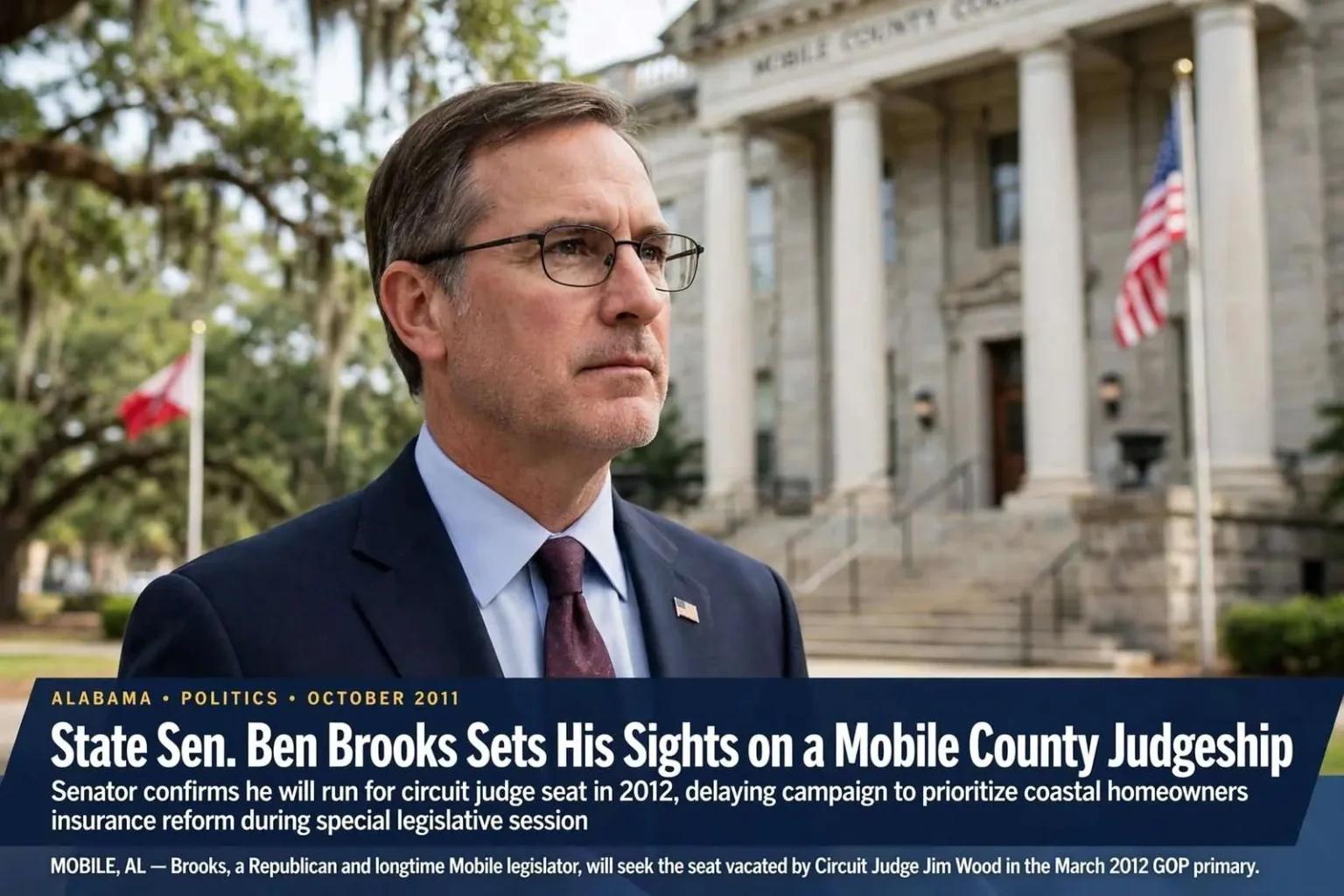
State Sen. Ben Brooks informally confirmed his intention to run in 2012 for a Mobile County circuit judgeship, notifying members of the Mobile County Bar Association of his plans in a mailing and setting up one of the marquee courthouse contests of the coming cycle.
Brooks said he would seek the seat being vacated by Circuit Judge Jim Wood, who under state law was too old to seek re-election. Wood was one of just three Democrats, all circuit judges, then holding office in county-wide voting.
Alabama’s judicial retirement framework sets a maximum age for judges to stand for election again, a rule that periodically opens seats on otherwise stable benches. When a sitting judge ages out, the vacancy sets off a round of private phone calls and soundings among the local bar, where potential candidates gauge support before committing to a race. Circuit judgeships, which carry broad authority over major civil and criminal dockets, are among the most sought-after judicial posts in any county, and a rare open seat draws interest quickly.
The electoral math gave Brooks’s entry added significance. With only a trio of Democrats holding county-wide offices in Mobile County, each such seat attracted intense attention from both parties, since a single election could shift the balance of the courthouse. A Republican primary victory would position a candidate strongly for the general election in a county that had been trending steadily toward the GOP in county-wide contests.
Brooks, a Republican, would enter a primary field that already included Mobile attorney Eaton Barnard, who was making his first run for public office. The primary was scheduled for March.
Judicial primaries in Mobile County tend to be decided in that spring vote rather than in November, because the county’s electorate had favored Republican candidates in county-wide races for years. That dynamic makes bar-association support, name recognition and early fundraising especially decisive in judicial contests, where candidates face restrictions on discussing issues they might rule on and campaigns usually turn on qualifications and reputation rather than platform.
Brooks’s dual identity as a sitting senator and a prospective judge shaped the contours of the race from the outset. Legislative service gives a candidate visibility and a record, but it also means the campaign unfolds while the candidate is actively doing another public job — filing bills, attending committee meetings and answering constituent mail in Montgomery during session. Timing mattered accordingly: by signaling early and building support before the legislative calendar consumed his schedule, Brooks positioned himself to run a campaign that could be sustained largely on its own infrastructure once the special session and the regular session took over his weeks.
Insurance First, Campaign Later
Even as he confirmed his plans, Brooks emphasized that he would not campaign in earnest until after the special legislative session on homeowners insurance expected that fall. Representing much of coastal Mobile County, where residents had been battered by soaring premiums in the wake of recent hurricanes, Brooks had been at the forefront of legislative efforts to reform insurance practices in Alabama. There would be plenty of time to campaign for the bench, he said, once coastal insurance reform had received his best effort.
The homeowners insurance crisis had become the defining pocketbook issue for coastal Alabama in the years after the hurricanes of the mid-2000s. Premiums across Mobile and Baldwin counties had climbed to levels far above the state average, some carriers had withdrawn from the market entirely, and coastal policyholders found themselves with fewer choices and higher deductibles. A State Farm decision to stop writing new policies in Alabama and disputes over existing coverage added to the anxiety, and residents along the bay and the beaches organized to demand legislative action.
The special session on insurance was convened to address exactly those grievances, taking up measures aimed at strengthening the market, encouraging new carriers to write policies in the state and creating programs to help homeowners harden their houses against storm damage. For coastal legislators, the session represented the best opportunity in years to deliver relief to constituents, and Brooks’s decision to delay campaigning until it concluded was both a political calculation and a statement about priorities.
The stance allowed him to keep faith with constituents on the issue that had come to define coastal politics while still staking his claim to the judgeship early. His early notification to the bar association, delivered by mail to one of the most connected professional communities in the county, functioned as a trial balloon and an announcement at once — giving other potential primary rivals a chance to weigh the race while allowing Brooks to begin assembling support months before any formal entry.
A Broad Committee
Brooks lined up a large campaign committee chaired by veteran GOP attorney Mike Druhan and studded with names from across the Mobile legal community. The roster ran to well over a hundred attorneys and judges, a show of institutional support intended to signal the seriousness of his candidacy.
In judicial races, the composition of a campaign committee operates as a proxy for a candidate’s standing within the local bar. Prosecutors, civil litigators, defense lawyers and retired judges who lend their names to a committee are vouching for a colleague’s temperament and qualifications, and their collective weight matters to voters who know little else about the race. A list exceeding a hundred members of the legal profession is an unusually deep bench of support, and the involvement of Druhan — a fixture of Mobile’s Republican legal establishment — gave the committee immediate credibility within the party’s fundraising network.
Early committee-building also served a deterrent purpose in a primary field that was still taking shape. Potential rivals reading the roster would find the county’s most connected Republican attorneys already committed, and the practical arithmetic of challenging an opponent with more than a hundred backers, a legislative platform and a decade of name recognition made entry unattractive. Judicial campaigns are won in the bar long before ballots are printed, and Brooks’s mailing and committee together made his claim on the race difficult to ignore.
The insurance session Brooks refused to campaign through was, for his coastal constituents, the most consequential work of his career to that point. Homeowners along the bay had watched premiums climb year after year, deductions had grown, and some families had gone without coverage altogether — a gamble with their largest financial asset. Legislators from Mobile and Baldwin counties had pressed for reform sessions before, and the special session represented another chance to shift the market. Brooks’s insistence that the work come before the campaign sent a message to both constituencies at once: the voters of coastal Mobile County still had his full attention, and the voters of the judicial race were being asked to wait their turn.
A Long Record
A former Mobile city councilman, Brooks brought a lengthy resume to the race. He had served as a special judge of the Mobile County District Court, sat on the executive committee of the Alabama Law Institute and the Alabama Judicial System Study Commission, and built a legislative record centered on the legal and insurance issues that dominate coastal politics.
The district court experience carried particular weight for a judicial campaign. Serving as a special judge means presiding over actual dockets — hearing cases, ruling on motions and sentencing defendants — rather than merely observing the system from a legislative desk. Voters evaluating a judicial candidate are effectively hiring a referee, and hands-on time on the bench answers the most common objection raised against sitting legislators who seek judicial office.
The Alabama Law Institute, the state’s statutory revision body, and the Judicial System Study Commission both involve the kind of technical, behind-the-scenes work that shapes how Alabama’s courts operate. Service on their executive bodies signaled that Brooks had engaged with the machinery of the judiciary beyond his own legislative portfolio, from code revisions to structural questions about how the court system is organized and funded.
His city council service added an executive and constituent-service dimension that most judicial candidates cannot claim. Council members answer directly to neighborhood associations, balance budgets and make zoning and infrastructure decisions — experience that shapes the pragmatic temperament voters often say they want on the bench. It also gave Brooks two decades of accumulated name recognition across Mobile County, an asset no first-time candidate in the primary field could match.
What the Race Meant for the Courthouse
For Mobile County’s legal community, the 2012 cycle’s marquee race promised a rare moment of genuine competition for a county-wide judgeship. Open circuit seats do not come often, and when they do, the primary election effectively decides who will preside over major felony trials, multimillion-dollar civil disputes and the everyday flow of justice for a six-year term. The combination of an experienced legislative incumbent, a first-time challenger and a retired incumbent’s seat guaranteed the contest would command attention in courthouse circles through the March primary and beyond.
The campaign also unfolded against the backdrop of a changing courthouse. Mobile County’s circuit bench handles one of the heavier dockets in the state, spanning everything from capital murder trials to the complex civil litigation that follows from a port city’s commerce. A single judge’s retirement opens a seat that carries decades of accumulated caseload and precedent-shaping responsibility, and the lawyers who appear before the winner every day — the same lawyers whose names filled Brooks’s committee list — had a professional stake in the outcome that ordinary legislative races never generate.