Coastal Lawmakers Pressed an Insurance Bill as Farm Lobby Weighed a Rival Plan
Mobile and Baldwin legislators pushed a property insurance reform bill aimed at homeowners south of Interstate 10, while ALFA searched for a sponsor to carry its own version through Montgomery.
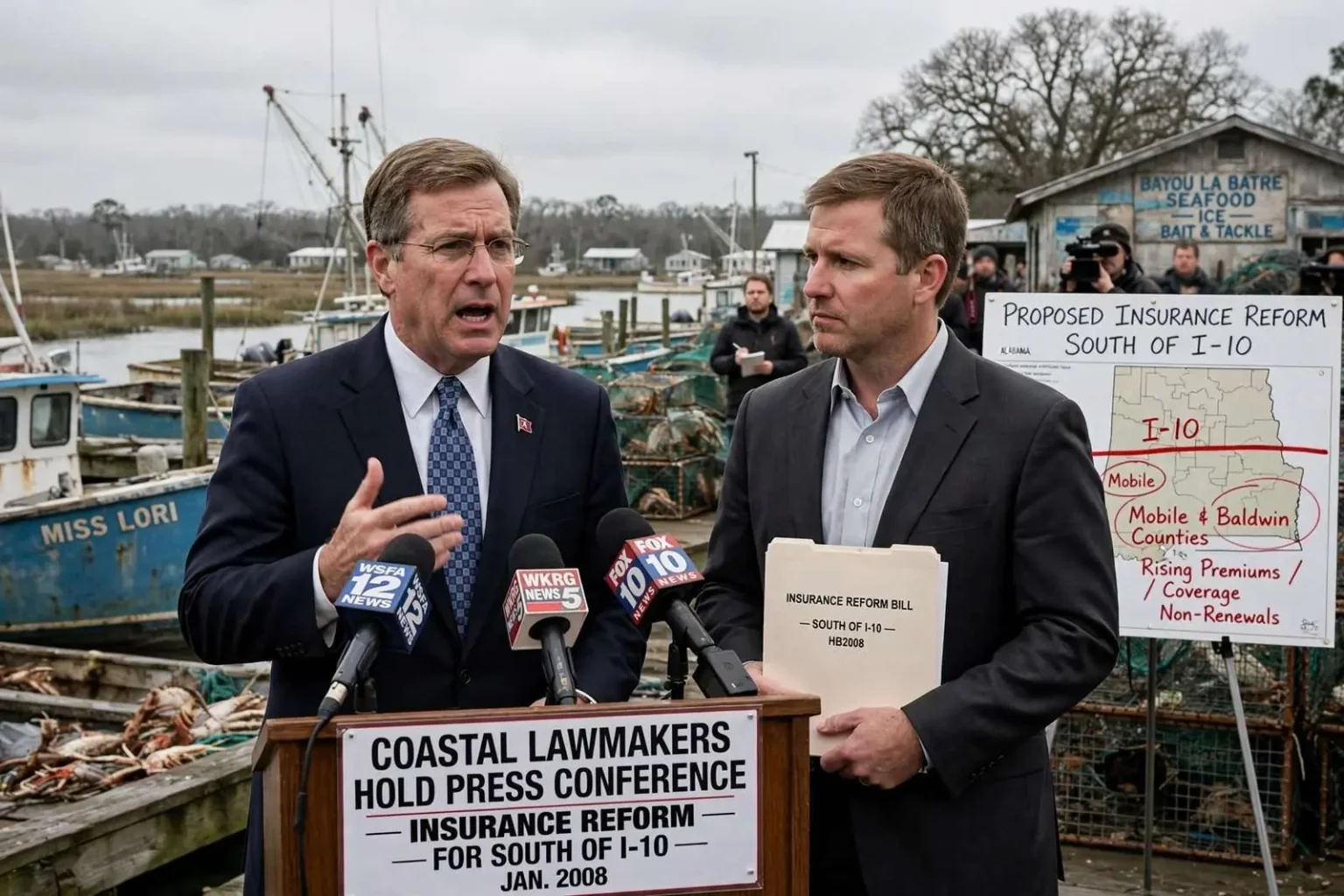
Two and a half years after Hurricane Katrina, the cost of insuring a house in south Alabama had become the defining pocketbook issue of coastal politics. In January 2008, the Mobile and Baldwin county legislative delegation moved to do something about it — and quickly discovered it would not have the field to itself.
Nothing had soured coastal residents on Montgomery more reliably than the insurance renewal notice. After the storms of 2004 and 2005, homeowners across the two coastal counties opened envelopes containing premium increases of 50, 100, even 200 percent, or letters announcing that coverage would not be renewed at all. The result was a constituency united across every other line — Democrats and Republicans, waterfront and inland, retired and working — on a single question: why could they no longer afford to insure the homes they could afford to live in?
A bill aimed south of I-10
Legislators from the two coastal counties, led by state Sen. Ben Brooks, had already advanced an insurance reform bill designed to address soaring premiums for property owners south of Interstate 10. Supporters were careful to frame the measure broadly: this was not, they insisted, a bill for beachfront condominium owners. It was aimed at ordinary homeowners across a swath of territory where carriers had been raising rates, tightening wind coverage or withdrawing altogether.
The Interstate 10 line was the bill’s central argument. In the insurance industry’s models, coastal exposure fell off rapidly with distance from the water, and legislators from north of the line had grown weary of statewide proposals that asked their constituents to subsidize beach houses. Brooks and the coastal delegation inverted that logic: the crisis, they argued, had spread miles inland, to brick ranch homes in west Mobile and subdivisions in Foley, and a solution calibrated only to the waterline would solve nothing for the hundreds of thousands who lived south of the interstate but well east of the beach.
State Rep. Spencer Collier of Bayou La Batre was expected to partner with Brooks and carry the legislation in the House. The pairing made geographic sense. Bayou La Batre sat at the heart of the problem — a working seafood community where storm exposure was highest and household budgets thinnest.
Bayou La Batre had been flattened by Katrina’s storm surge and again battered by Hurricane Katrina’s predecessors along the Gulf, and its crab boats, shrimp houses and modest frame homes embodied the version of the insurance crisis that never made the industry’s slide shows: a homeowner with a $90,000 house facing a $4,000 premium, if a carrier would write it at all. Collier’s district gave the bill a spokesman who did not have to imagine what non-renewal meant; his constituents lived it.
ALFA looks for a sponsor
Complicating the picture, legislative sources reported that ALFA — the Alabama Farmers Federation and its affiliated insurance company, among the most powerful lobbying forces in Montgomery — was on the prowl for a legislator to sponsor its own bill on insurance reform. A competing bill from ALFA would have shifted the debate considerably.
The organization’s political influence in the Alabama Legislature was such that any measure it opposed faced long odds, and any measure it wrote had a built-in constituency. ALFA’s legislative clout was not a matter of speculation: the federation organized one of the most effective grassroots networks in the state, and its affiliated insurer — Alfa Insurance — was itself one of the largest homeowners’ carriers in Alabama. A reform bill that Alfa’s company regarded as intrusive would be fought with every tool the federation possessed; a bill it sponsored would arrive with a signature that half the Senate recognized as dispositive.
For coastal lawmakers, the arrival of a rival plan raised the prospect that the reform they had spent months assembling could be amended into something they no longer recognized, or simply displaced. In the legislature’s arithmetic, a bill that never reaches the floor accomplishes nothing, and a bill that reaches the floor against organized opposition can be amended into irrelevance. The coastal delegation’s task, therefore, was not merely to write good policy but to move it fast enough, and broad enough, that no rival could claim the issue.
Why the fight mattered
The 2004-2005 hurricane seasons — Ivan, Dennis and Katrina in rapid succession — had permanently altered the insurance market along the Gulf Coast. Carriers reassessed their exposure, reinsurance costs climbed, and homeowners in Mobile, Baldwin and the smaller communities of the lower delta absorbed the difference. Premiums doubled and tripled. Some policies simply were not renewed.
The mechanics were global. Catastrophe models had been rebuilt after Katrina’s losses, reinsurance — the coverage insurers themselves buy — repriced sharply, and national carriers began redrawing their coastal maps to shed risk they no longer wanted at any price. A homeowner in Daphne or Tillman’s Corner had no quarrel with any of that in the abstract, but its effects arrived in the mailbox: a renewal notice that read like a tax increase, or the name of a new carrier never chosen, or nothing at all.
The political consequence was a sustained grassroots revolt that produced homeowner advocacy groups, packed public meetings and, eventually, a run of legislation in Montgomery on transparency, rate filings and discounts for storm-hardened construction. The 2008 bill was an early chapter in that longer story, and it established a pattern that persisted for years: coastal legislators, united across party lines by geography, negotiating against statewide interests with far more leverage in the capital.
The public meetings gave the issue its theater. Insurers’ representatives stood before hotel ballrooms of furious homeowners and explained catastrophe models; legislators took notes; the newspapers carried the rate complaints week after week. What emerged from that season was a durable coalition — coastal insurance reform groups that outlived the news cycle and kept the pressure on every subsequent session, winning incremental victories over filing transparency and mitigation credits even as the underlying market problem resisted every fix.
Montgomery comes to Mobile
The timing was pointed. That same weekend, more than 60 state legislators were expected in Mobile for a legislative tour organized to familiarize lawmakers with recent activity and development in the area. Sixty sponsors had signed on to underwrite it. Such tours were part hospitality and part lobbying.
Lawmakers from north Alabama, who had little personal stake in wind coverage on the Gulf, would be shown the port, the industrial corridor and the neighborhoods where insurance bills were climbing. Coastal legislators understood that a bill affecting property south of I-10 would ultimately be decided by colleagues who lived hundreds of miles from salt water. Bringing them to town was the first step in the argument.
The tour’s agenda made the case visually. A delegation that rode through Bayou La Batre, watched the container cranes at the state docks, and stood in a subdivision where half the houses carried for-sale signs would understand the insurance crisis in a way no amount of testimony in a Montgomery committee room could convey. The tour was, in effect, an exhibit: here is what the Gulf Coast contributes to the state’s economy, and here is what it costs to live here now.
Whether the bill advanced or ALFA’s rival plan displaced it, the January maneuvering marked the opening of a legislative contest that would run for years: coastal Alabama versus the insurance market, fought through bills, studies and sessions, with the pocketbooks of everyone south of I-10 as the prize. The delegation’s first move — a bill with a geographic line drawn deliberately through the state’s largest insurance debate — announced that they intended to fight it on their own map.
The session ahead
The stakes extended past the 2008 session. Everyone involved understood that insurance reform, once attempted and failed, would be harder to attempt again — the industry would adapt its lobbying, the public would lose urgency, and the legislature would move on to fresher crises. That knowledge compressed the timetables and sharpened the maneuvering on both sides.
The legislative calendar gave the coastal delegation both its constraint and its opportunity. Sessions in Alabama run in the spring and are limited in the bills they can absorb, so a bill introduced in January had weeks, not months, to build support before committee deadlines began culling the field. A rival bill introduced later by a better-positioned sponsor could ride the same deadlines to the floor instead — which is why the coastal delegation treated the ALFA rumors not as background noise but as a countdown clock.
Inside the delegation, meanwhile, the discipline that geography imposed held firm. Mobile County’s senators and House members had spent years divided over everything from roads to municipal boundaries, but on insurance they were one bloc, and they knew it. The bill’s breadth — ordinary homeowners south of I-10, not just the beachfront — was the product of that unity, drafted to keep every coastal member on board and to deny the opposition the easy argument that the coast was asking the rest of the state to protect its wealthy waterfront.
What happened to the bill in the 2008 session would say much about how Montgomery now weighed the coast’s complaints. The tour weekend put the argument in person before dozens of colleagues; the bill itself put it on paper. Both moves had the same objective — to establish, before the session’s deals were cut, that insurance was not a coastal grievance to be indulged but a statewide problem wearing a coastal face.