Creola and Saraland Explore a Merger, With Schools at the Center
Municipal leaders in Creola and Saraland quietly explored merging the smaller city into the larger, with access to Saraland's school system and I-65 commercial property driving the discussion.
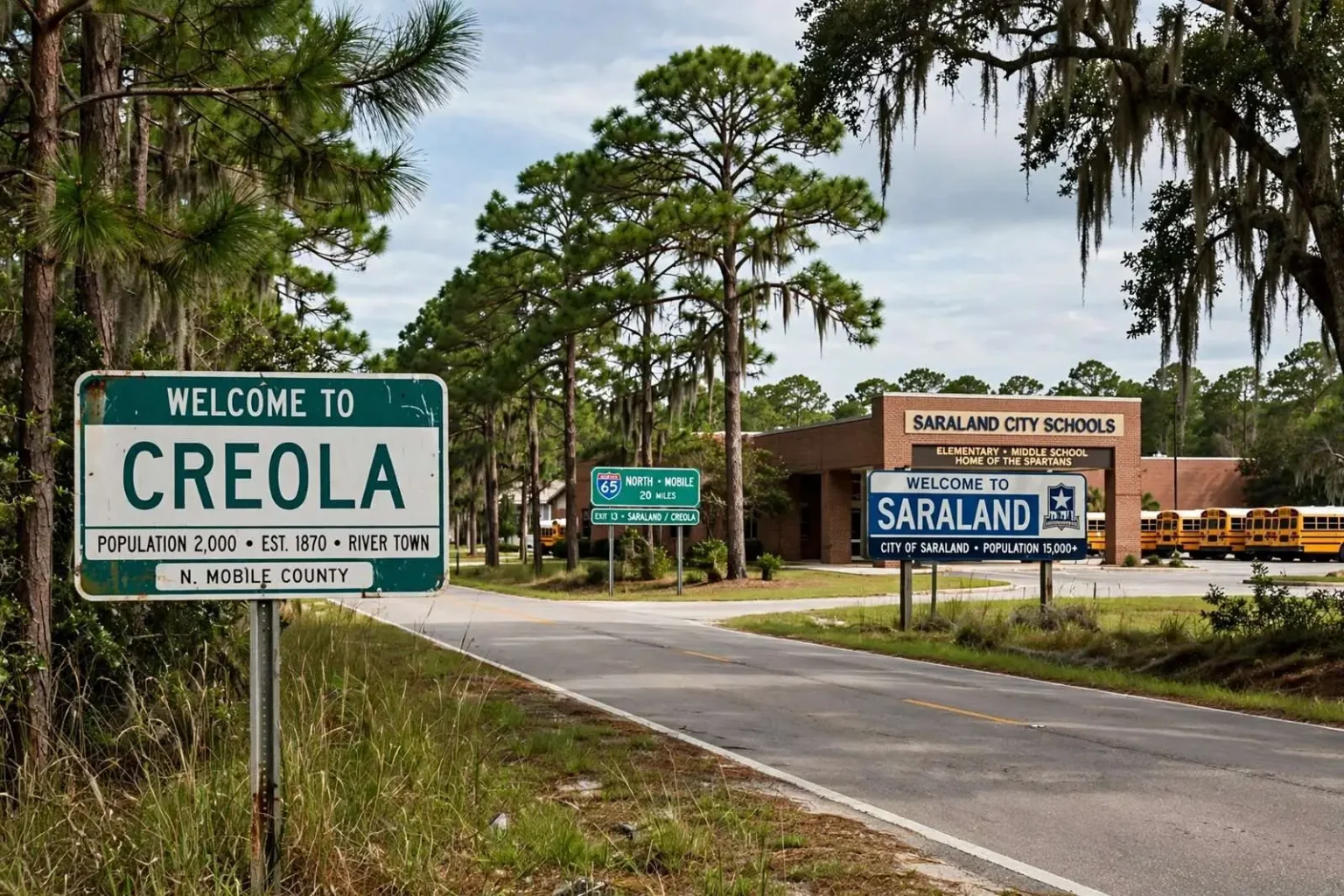
Preliminary talks began quietly among municipal leaders in Creola and Saraland aimed at merging the smaller city into the larger, a discussion that turned as much on schools as on economics in the fast-growing corridor of north Mobile County. The conversations, held out of public view, explored one of the most consequential questions a small Alabama town can face: whether its future is better pursued on its own or as part of a larger neighbor.
While economies of scale in providing services entered into the conversation, the participants identified two central motivations. For Saraland, the primary attraction was greater access to commercial property along Interstate 65. For Creola, the appeal lay in securing a place for its schoolchildren within the Saraland city school system. Each city wanted something the other controlled, and that symmetry gave the talks their early momentum.
The geography makes the logic plain. Creola and Saraland sit side by side in north Mobile County, sharing the I-65 corridor that runs from Mobile toward the rest of the state. Creola, with roughly 2,000 residents spread along the river bluffs and the highway frontage, has a small tax base and a modest municipal budget. Saraland, its larger neighbor, has grown steadily for years, annexing, developing and building the institutions — including schools — that attract families to the area.
A Question of Schools
The education angle carried particular weight in Creola, a community of just 2,000 residents. Some families there considered themselves unhappy participants in the Mobile County Public School System, and the prospect of joining Saraland’s independent city school district offered an alternative that resonated with parents. For a community of Creola’s size, the school question is not abstract: it shapes property values, determines where young families settle and defines how much say local residents have over the classrooms their children attend.
Saraland had established its own school system relatively recently, and city school districts across Alabama often served as powerful draws for families seeking local control over education. The pattern is well established across the state: when a city splits from a county system to form its own district, residents gain a school board they elect directly, budgets spent entirely on their own students, and a sense of ownership that countywide systems, stretched across dozens of communities, struggle to replicate.
Saraland’s own split had become one of the region’s most closely watched success stories, with the city system’s growth tracking the city’s residential boom. That track record was precisely what made the district the centerpiece of Creola’s interest. For Creola households frustrated with their current arrangement, a merger represented a potential path into a smaller, city-run system — something they could not achieve through annexation alone, since school district boundaries do not automatically follow municipal lines.
What Saraland Stood to Gain
For Saraland, the calculation ran in a different direction. Absorbing Creola would extend the city’s reach along the I-65 corridor, opening access to commercial property and the tax revenue that came with it. In a region where interstate frontage translated directly into development potential, that access amounted to a meaningful prize. Interstate interchanges concentrate the gas stations, hotels, restaurants and retail centers that generate the sales and lodging taxes cities rely on, and north Mobile County’s growth has followed the corridor’s exits.
Saraland had already demonstrated the pattern within its own borders, using annexation and infrastructure to capture commercial growth along its stretches of highway. Absorbing Creola’s territory would add frontage and development sites to the city’s inventory, along with the population — and the federal and state funding formulas that count population — that come with it.
The pairing of interests, Creola’s desire for schools and Saraland’s appetite for commercial territory, gave the discussion a logic that both sides could recognize. Each community brought to the table something the other wanted, the kind of complementary fit that can make consolidation attractive.
Early and Discreet
The talks remained preliminary and discreet, and municipal mergers in Alabama involve legal and political hurdles that can slow or halt even well-matched proposals. Questions of governance, representation, debt and identity typically accompany any effort to fold one municipality into another, and residents often hold strong feelings about surrendering a community’s independence. For that reason, the early-stage nature of the conversation counseled caution about its prospects.
The legal mechanics alone are substantial. Consolidating two cities requires careful attention to each municipality’s outstanding debt, its enterprise funds, its franchises and contracts, and the status of its employees. Representation raises its own questions: how a merged council would be apportioned, whether Creola residents would receive a district or council seat of their own, and how quickly the merged government’s ordinances and fee structures would be harmonized. None of these questions has an off-the-shelf answer in Alabama law, where completed municipal consolidations are rare.
Identity may prove the most stubborn hurdle of all. Creola’s history as a river town and a railroad community long predates the interstate corridor’s boom, and many residents value the town’s small scale precisely because it differs from its rapidly growing neighbor. A merger would ask those residents to trade a mayor and council of their own for a place in Saraland’s government, a trade whose appeal depends heavily on whether the promised benefits — above all, the schools — actually materialize.
Leaders had begun to explore the idea rather than commit to it, and the path from informal discussion to a completed merger is rarely short or smooth. Discreet talks of this kind typically precede any public process: feasibility analysis, consultation with attorneys, and soundings of state legislators whose support any legislative route would require. Only after those foundations are laid would residents see a formal proposal — and vote on one.
A Corridor in Flux
The discussion reflected the broader dynamics of north Mobile County, where growth along the interstate and the pull of city school systems had reshaped the choices facing small communities. The corridor’s towns have watched Saraland and, in different ways, Satsuma and other neighbors convert school independence and commercial annexation into growth, while communities without those levers have struggled to hold population and investment.
For Creola and Saraland alike, the merger talks offered a glimpse of how those pressures might redraw the local map. Municipal boundaries in fast-growing regions rarely stand still; annexations, incorporations and, occasionally, consolidations adjust the lines as communities compete for tax base and schools. North Mobile County, where interstate access and school quality drive residential decisions, has been a textbook setting for that competition.
Whether the two cities would ultimately join remained uncertain. But the fact that leaders had begun to weigh the question underscored the degree to which schools and commercial development had become the twin engines driving municipal decision-making in the area. In Creola, a merger was discussed not as an act of civic surrender but as a transaction: school seats for Saraland’s children, interstate frontage for Saraland’s budget, and a shared future for two towns that already share a highway.
The Mobile County School Landscape
Creola’s frustration with its school arrangement reflects a statewide phenomenon. The Mobile County Public School System, one of the largest districts in Alabama, serves communities ranging from the city of Mobile’s neighborhoods to the county’s small municipalities and rural stretches, and its scale means decisions about zoning, staffing and resources are made for a student population larger than many Alabama cities. Families in small towns often feel far from those decisions, and the feeling has fueled a series of city-school movements across the county in recent decades.
Saraland’s departure from the county system became the model that other communities studied. The city negotiated the transfer of its schools, elected its own board and built a district whose growth paralleled the city’s residential expansion. Nearby, Satsuma pursued the same path, and Chickasaw formed a city system as well — a wave of splits that transformed education governance in the northern part of the county and demonstrated both the demand for city-run schools and the financial complexity of achieving them.
Against that backdrop, Creola’s interest in a merger reads less as a novelty than as the next step in an established pattern. A standalone Creola city school district, with a tax base of 2,000 residents, would be difficult if not impossible to fund; joining Saraland’s established system through a merger offers the only realistic route to the outcome parents want. That arithmetic — small city, unaffordable dream, capable neighbor — is exactly what made the merger framework attractive where other options were not.
What Residents Would Be Watching
If the talks advanced, the first public signs would likely appear in Creola itself: town-hall discussions, council deliberations and the slow formation of public opinion. Residents would weigh the school promise against practical questions — whether property taxes would change under Saraland’s rates, how city services would compare, and what voice Creola neighborhoods would retain in a larger government.
Saraland residents, for their part, would weigh the costs of absorbing a small city against the commercial upside of corridor frontage. Mergers ask the larger partner to assume liabilities and share institutions, and Saraland’s leadership would need to show its own voters that the exchange strengthens the city without diluting the services and schools that made it attractive in the first place.
Both sides have history to draw on. Alabama communities have merged, annexed and separated many times over the decades, and the outcomes have depended less on the elegance of legal mechanics than on whether the promised benefits arrived. The Creola-Saraland talks, in their quiet early stage, were the beginning of that longer test — an exploration of whether two towns sharing an interstate corridor could also share a government, and whether the schools at the center of the idea could anchor a deal large enough to carry them.