Mobile County Commissioners Tell Residents They Have No Legal Power to Halt the Calvert AI Data Center
Residents pressed Mobile County commissioners to block Beacon Data Centers' multi-billion-dollar Calvert Infrastructure Hub. Commissioners said the county has no legal authority to stop it.
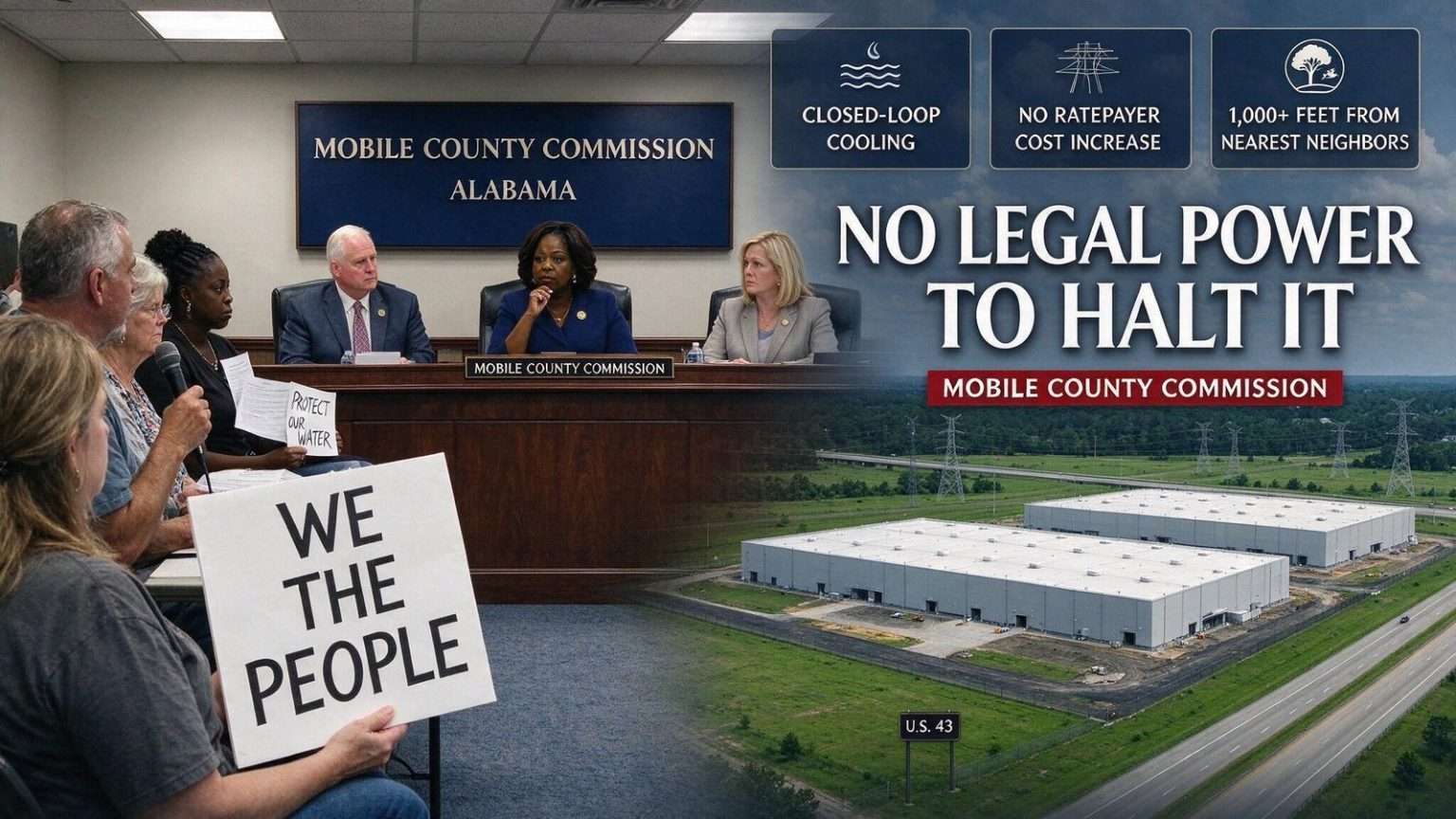
A group of North Mobile County residents brought their objections to a proposed multi-billion-dollar artificial intelligence data center directly to the Mobile County Commission on Monday morning, July 13 — and left with an answer few of them wanted to hear: the county says it does not have the legal authority to stop the project.
The Calvert Infrastructure Hub, proposed by Beacon Data Centers, was not on the commission’s regular agenda. Residents raised it anyway during the public hearing portion of the meeting, questioning Commissioners Randall Dueitt, Connie Hudson and Merceria Ludgood about water use, power costs, wildlife, agriculture and property values.
What Is Actually Being Built
According to Beacon Data Centers, the Calvert Infrastructure Hub would consist of two buildings on 95 acres west of U.S. Highway 43 and north of Shepard House Road. The facility is designed to support artificial intelligence workloads, cloud computing and other internet services — the sort of compute-heavy infrastructure that has driven a national data center construction boom over the past three years.
The company’s public materials make three specific claims that go directly to the concerns raised at the meeting. Beacon says the facility will use “no more water than a small office building” because it runs a closed-loop cooling system; that it will not affect residents’ power bills; and that it will sit at least 1,000 feet from the nearest neighbors.
Ground is expected to be broken later this year.
The Residents’ Case
Creola resident Melissa Bailey urged the commission to stop Beacon from breaking ground, arguing the project would draw an inordinate volume of water from the local supply and drive down surrounding property values. Describing herself as “a tree-hugger,” Bailey also raised concerns about wildlife being displaced from forested land.
“We are already struggling with bears in the Saraland and Creola area,” she said. “They’ve become so accustomed to people they are just walking into people’s yards, which is not good for us or them.”
Linda Poiroux, who lives in West Mobile, told commissioners the facility would double residents’ utility costs and damage local agriculture, making a series of striking claims about heat and livestock.
“It will increase the heat up to 20 degrees five miles around that data center, so you can’t grow crops,” she said. “There are incidences of cattle that have stopped producing. They’re sterile since they put data centers next to farms. We’re talking about stillbirths and not being able to have cattle. What will that do to us?”
Poiroux also argued that light pollution from the site would mean Calvert residents “won’t be able to look at their stars” from their own property. Noting that the company Edged is developing a similar data center for Prichard, she warned that Mobile County’s investment in nearby Africatown as a cultural and historical tourism destination could be undermined by heavy industrial development in the corridor.
It is worth noting for readers that some of the claims raised at the meeting — particularly the assertions about a 20-degree temperature increase across a five-mile radius and data centers causing cattle sterility and stillbirths — are not supported by published research on data center operations. The concerns about water withdrawal, electricity demand and grid cost allocation, by contrast, are the subject of active and legitimate debate in communities across the country hosting similar facilities.
A Petition and a Request for a Moratorium
Washington County resident Lucille Campbell-Foster brought a petition to the meeting that she said carried signatures from more than 300 area residents. She asked whether any commissioner would make a motion to impose a moratorium on the project, and argued that an environmental impact study and a public hearing should be held before any work begins.
Protecting county residents from projects like the data center, Campbell-Foster told the commission, falls within its “statutory authority.”
The Commission’s Answer
District 3 Commissioner Randall Dueitt said he would not make that motion, because in his view Mobile County simply does not possess the legal authority to block the data center from proceeding to construction.
County attorney Jay Ross went further. Because the site lies in an area set aside for industrial development, he said, the county does not even have the power to issue the project’s construction permit. “There is no authority the commission has to impose a moratorium or in any way stop this project,” Ross said. “We can’t stop it. There’s no statutory authority to do so.”
Commission President Connie Hudson, who represents District 2, said commissioners sympathize with residents but that the county’s lack of zoning leaves them without tools to act. “We live in this community. We don’t live where you live, but we understand the concerns,” she said. “When you say ‘statutory authority,’ we don’t have that.”
That answer reflects a structural reality of Alabama county government rather than a policy preference. Alabama counties operate under limited home rule, and unincorporated areas of Mobile County have historically had no comprehensive zoning ordinance of the kind that would give a commission the power to deny a land use outright. When a private company purchases private land in an unincorporated area and its use is otherwise lawful, county commissioners have few levers — a reality that has surfaced repeatedly in disputes over industrial siting in the county.
The Statewide Backdrop: Moratoriums Elsewhere, and a Senator Pushing Back
Mobile County’s position — that it lacks the authority to stop the project — sits against a statewide picture in which other Alabama local governments have found ways to act. Data centers have been proposed in communities from Foley to Lowndes County, and multiple local governments across the state have passed temporary moratoriums on data centers or tightened regulations on the projects in recent months, which is precisely the step Washington County resident Lucille Campbell-Foster asked Mobile County commissioners to take.
The gap between those outcomes generally comes down to zoning authority. Municipalities that have adopted comprehensive zoning ordinances have a lever to pull. Counties operating in unincorporated territory without one, as Mobile County does, largely do not.
At the state level, the politics are running the other way. Speaking Monday to the Alabama Sheriffs Association in Opelika, U.S. Sen. Tommy Tuberville — the Republican nominee for governor — defended data center development directly, framing it as a revenue engine for local public safety budgets.
“We’ve got to grow our state, but one of the big things that’s bringing in a lot of tax money across this country is these data centers,” Tuberville said, tying the projects to sheriffs’ requests for more funding for jails, mental health resources and staffing.
“We’re going to do data centers,” he said.
That statement matters for Calvert. It signals that residents hoping for intervention from above — a state-level check on the project — are unlikely to find a sympathetic audience in the state’s likely next governor.
Why Calvert, and Why Now
Calvert sits in a corridor that has already been shaped by heavy industry, most notably the massive steel plant north of the site. The area offers what data center developers look for: large parcels, proximity to transmission infrastructure and highway access via U.S. 43.
According to the project’s website, Calvert was chosen as the site of Beacon’s sixth American facility because the north Mobile County community offers “available industrial land with compatible surrounding uses, close connectivity to sufficient power sources and a strong regional workforce with industrial experience.”
Beacon executive vice president and co-founder Joe Shovlin has described the data center as “a meaningful benefit” to Mobile County. “We’ve taken great care to design this project to ensure that any impacts to neighbors are eliminated or minimized and that there won’t be any utility bill increases for ratepayers,” he said in a statement, adding that meetings with stakeholders and community leaders had helped refine the project into “one of the best-designed and least impactful projects of its type in the country.”
The tension playing out in Mobile County is the same one now surfacing in dozens of communities nationwide. Data centers bring substantial capital investment and tax base, but comparatively few permanent jobs relative to their footprint, and they draw heavily on two resources residents are protective of: electricity and water. Whether those tradeoffs are worth it is a genuinely contested question — but as of Monday, it is not a question Mobile County’s commissioners believe they have the power to answer with a veto.
Update: Opponents File Petition for Moratorium as Commissioners Debate Options
At Monday’s commission meeting, Creola resident Melissa Bailey pressed commissioners on noise, health concerns and property values, telling them roughly 120 people were informed in May that the project was proceeding, with more than half expressing opposition. Commissioner Merceria Ludgood reiterated that the commission has no authority to permit or deny the data center because the county has no zoning, with that power resting only with the Alabama Legislature. Bailey noted the project’s property line had shifted from Mount Vernon to Calvert; Ludgood and Commission President Connie Hudson said Mount Vernon, as an incorporated municipality, would have had some regulatory control had the site remained there.
Lucille Kimble-Foster of McIntosh, representing a citizens’ coalition, presented a petition with more than 360 signatures asking the commission to impose an immediate moratorium suspending any conditional-use, zoning-variance, land-disturbance or tax-abatement approvals until an independent environmental and impact assessment is completed and a widely publicized public hearing is held. Commissioner Randall Dueitt said a moratorium isn’t legally possible without home rule, and suggested residents petition the Alabama Legislature directly for home-rule and zoning authority, noting Mobile County voters have twice rejected home rule in the past. Only Baldwin and Shelby counties currently have home rule under Alabama’s 1901 constitution.
Company officials have said the project is expected to create up to 1,000 construction jobs at peak and roughly 250 permanent jobs once operational, at an average annual salary of about $115,000. Opponents, including Tanner-Williams resident Linda Poiroux, have raised concerns about aquifer depletion during drought months, water contamination, and a constant humming noise they say could be audible up to five miles away.
Update: Utility Officials Address Water and Power Concerns as Commissioners Field New Public Comment
Utility officials and Mobile Chamber representatives appeared before the Mobile County Commission again Tuesday to address lingering concerns about the Beacon Data Centers project, this time laying out specific figures on water use, electricity costs and expected tax revenue. The session came a day after a community meeting at the Mt. Vernon Community Center, and residents again pressed commissioners for stronger guarantees and more oversight.
Donnie Cunningham, executive director of South Alabama Utilities, told commissioners the facility’s water usage is expected to run about 7,500 gallons per day, which he compared to the demand of a roughly 50-lot subdivision. He said the project’s closed-loop water system was designed to minimize its footprint, and that Beacon Data Centers, not area ratepayers, would cover the cost of any additional sewer infrastructure the project requires. Cunningham said residents should not expect any water or sewer rate increases tied to the project.
Erin Delaporte, Alabama Power’s Mobile division area manager, told the commission that large electricity users like data centers are billed for the full cost of their operations, and that residential customers would not be left covering the facility’s costs even if the company eventually left the area. She noted that Southern Company, Alabama Power’s parent, recently signed a ratepayer protection pledge meant to ensure the cost of serving large data centers isn’t passed on to households and small businesses.
David Rodgers, vice president of economic development for the Mobile Chamber, told commissioners the project is projected to generate more than $1 billion in property tax revenue over 20 years, based on an estimated $25 billion investment that includes recurring equipment upgrades. He said that could mean roughly $50 million a year for the Mobile County Public School System — enough, he said, to theoretically provide up to $500,000 in new funding for each county school — along with about $49 million a year for the county commission, which he described as around 20 percent of the commission’s current budget. Rodgers also noted that, unlike some data center projects elsewhere in Alabama, Beacon Data Centers is not seeking tax abatements or incentives from state or local government.
Despite those figures, several residents said assurances alone were not enough. Gina Daniels of Mt. Vernon said she hopes enough public pressure can push officials to secure written guardrails and regulatory oversight on the project. She pointed to Mt. Vernon’s economic struggles since the 2012 closure of Searcy Hospital and said she remains skeptical that the project’s financial benefits will trickle down into improved services such as ambulance coverage and fire protection.
Commissioner Merceria Ludgood, whose district includes the project site, pushed back on the idea that officials have withheld information, saying Beacon Data Centers has answered every question she’s asked. She suggested some of the public’s fear stems from outdated, generalized information about data centers rather than specifics tied to this project. Commission President Connie Hudson said Beacon has presented itself as a “good corporate citizen,” and Ludgood said she believes the company would be open to discussing financial support for projects and services in Mt. Vernon and northern Mobile County.
Not all of Tuesday’s comments were critical. Terry Williams of Mt. Vernon, who said he initially opposed the project, told commissioners he now believes Beacon Data Centers will operate more responsibly than some data center developers elsewhere in the country, calling the company “very conscientious.”
The exchange came the same week Prichard’s City Council is expected to take up its own proposed moratorium on new data center permits, as that city weighs a separate $93 million project near historic Africatown. Construction on the first phase of the Beacon project is still expected to begin later this year.