Saraland Teen Killed in Single-Vehicle Crash in Creola
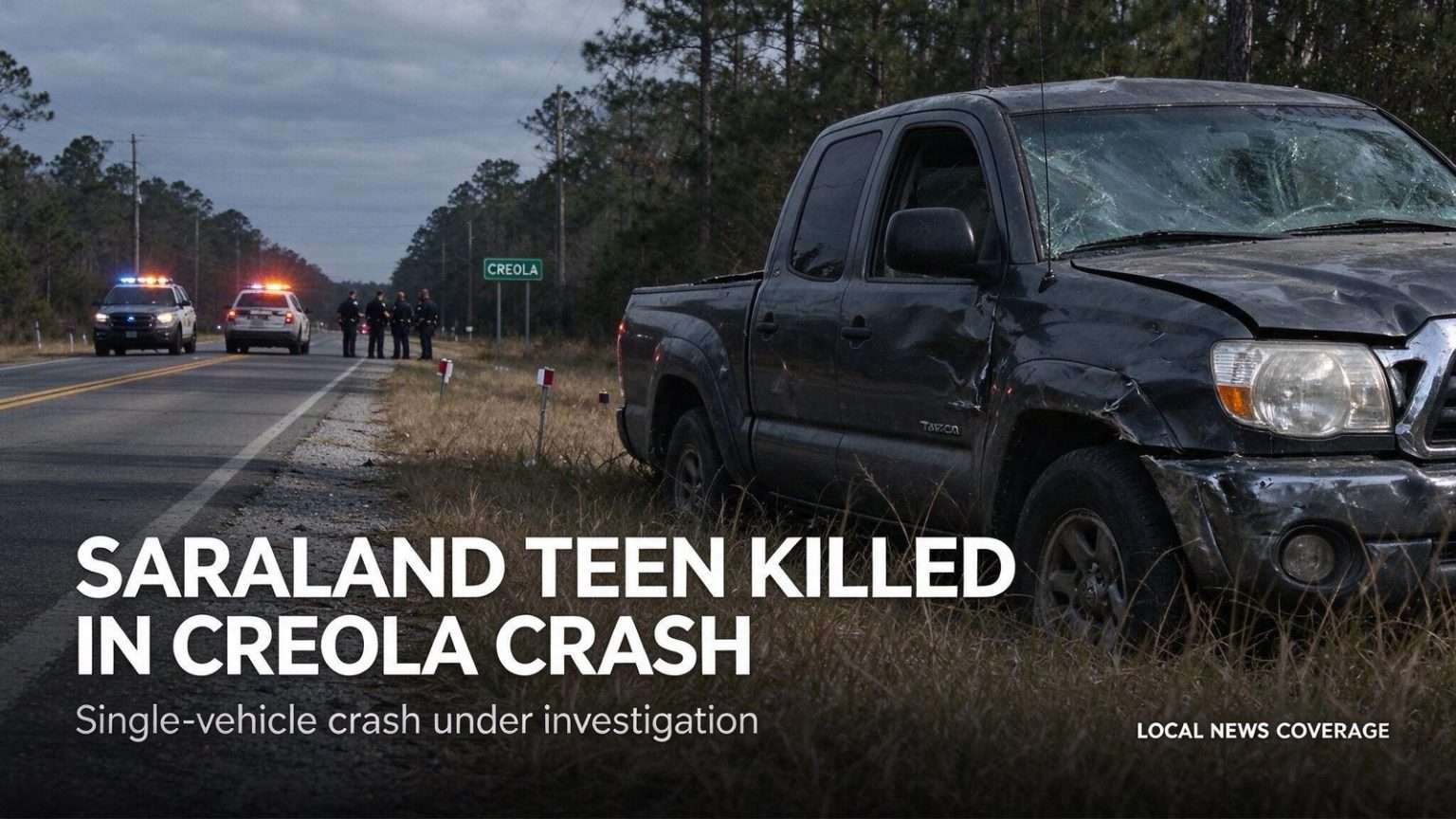
A 19-year-old Saraland man died after his truck left the road and overturned on Dead Lake Marina Road in Creola Thursday night, according to ALEA.
Saraland Teen Killed in Single-Vehicle Crash in Creola
A Saraland teenager has died following a single-vehicle crash in Creola, according to the Alabama Law Enforcement Agency. ALEA said 19-year-old Halstyn J. Baggett was killed when the 2008 Toyota Tacoma he was driving left the roadway and overturned. Single-vehicle crashes of this kind are among the most common fatal crash types on Alabama roads, particularly on the two-lane highways that thread through the smaller municipalities of north Mobile County, where curves, shoulder drop-offs and limited lighting can turn a brief loss of control into a fatal rollover.
The story is one of many that play out across high school campuses from Mobile to Baldwin County each year, where athletics and academics together shape a community’s sense of itself. In towns along the Mobile River delta, the loss of a young resident reaches well beyond one family, touching classmates, teammates and neighbors who have watched the same young people grow up on the same ballfields and in the same classrooms.
Public schools across Mobile and Baldwin counties compete under the Alabama High School Athletic Association, with regular-season and postseason play organized into regions and classes. The AHSAA classification system sorts schools by enrollment so that smaller communities are not forced to compete against the largest urban programs, and the playoffs that follow each regular season run from region play through the state finals. The state championships are held at venues around the state each year and are one of the biggest events in Alabama high school sports, drawing teams, bands and student sections from every corner of Alabama for a single weekend of finals.
Friday Night Football and South Alabama’s School Communities
Friday night football in particular remains a fixture across south Alabama, where the Saraland Spartans, the Fairhope Pirates, the Daphne Trojans, the Foley Lions, the McGill Toolen Jackets, the Murphy Panthers, the Blount Leopards, the Baker Hornets, and a host of other programs each field teams that draw thousands of fans to their home stadiums during the fall. In Saraland, the Spartans have become one of the defining institutions of the city — the identity of the school system and the city’s rapid growth reinforcing one another, with packed bleachers each autumn and a community that follows the team from preseason scrimmages through the playoffs.
Programs such as Fairhope, Daphne and Foley anchor the Baldwin County side of the bay, while Murphy, Blount and Baker represent long-established traditions within the Mobile city system, and McGill Toolen carries the Catholic school lineage that has produced teams and athletes known across the state for generations. The shared calendar of Friday games, region standings and playoff brackets gives residents on both sides of Mobile Bay a common rhythm to the fall, and it is the backdrop against which news of a young life lost lands hardest in a community like Saraland.
Creola and the North Mobile County Corridor
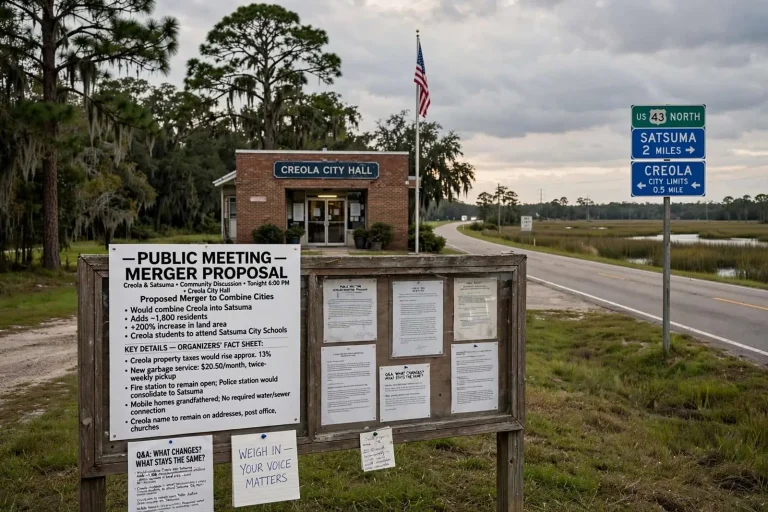
Creola is a small city in north Mobile County along the Mobile River delta, just north of Saraland. The community sits in the corridor where the Mobile metropolitan area gives way to the river’s marshlands and timber country, and its roads carry a mix of local traffic and commuters moving between the growing suburbs and the city of Mobile. Saraland itself lies along U.S. Highway 43, just north of the Mobile city limits, and has grown into one of the larger suburbs of Mobile, with its own school system and a population that has more than doubled since 2000. The two cities are close enough that residents move between them daily for work, school and shopping, which is why a crash in Creola resonates immediately in Saraland.
Mobile County is the second-most-populous county in Alabama and stretches from the city of Mobile across the Mobile River delta to the Mississippi line. The county is governed by a three-member commission and includes the city of Mobile as well as smaller municipalities and unincorporated communities. County government sits alongside the city’s own in Mobile Government Plaza downtown, and the commission’s decisions on roads, emergency services and growth management reach every municipality from Creola to the southernmost communities on the bay.
How the Region Moves
Transportation planning is a long-running topic in the Mobile area, where the bay, the river, the port, and the interstate system together define how the region moves. The Mobile area’s road network is anchored by Interstates 10 and 65, by the Bankhead Tunnel, by the Cochran-Africatown USA Bridge, and by the Jubilee Parkway that connects the city of Mobile to the Eastern Shore. Those links carry commuters from Saraland and Creola into downtown Mobile each morning and move freight between the Port of Mobile, the industrial corridor along the river, and the beaches of Baldwin County.
Long-running discussions over a potential additional Mobile River crossing and a renewed push for downtown rail service are part of the region’s ongoing transportation conversation. Planners, elected officials and residents have debated for years how best to relieve congestion on the existing crossings, and the future of the tunnel and bridge network remains one of the most consequential infrastructure questions facing south Alabama. Mobile and Baldwin County together form a single regional economy, with commuters, students, and shoppers moving daily across the bay, and with shared concerns about transportation, schools, public safety, and growth that play out in both counties’ public meetings and local news coverage.
The Larger Regional Picture
Alabama is a southeastern U.S. state bordered by Mississippi, Tennessee, Georgia, Florida, and the Gulf of Mexico. Its state capital is Montgomery, its largest city is Birmingham, and Mobile serves as the major urban center of the lower Gulf Coast. Mobile is the third-largest city in Alabama, situated at the head of Mobile Bay where the Mobile River meets the Gulf of Mexico. Founded by French colonists in 1702, it is the oldest city in the state and the site of the original capital of French Louisiana. Today the city serves as a major regional hub for shipping, aerospace, steel manufacturing, and healthcare, and is home to the University of South Alabama and Spring Hill College.
News from across south Alabama frequently highlights the ways in which local decisions in city halls, county commissions, school board meetings, and state offices in Montgomery interact with daily life for residents from Saraland to the Eastern Shore and from downtown Mobile to the Gulf beaches. Long-running coverage of the Port of Mobile, the Brookley aeronautics complex, and the industrial corridor along the Mobile River connects stories about steel, shipbuilding, aerospace, and shipping into a single regional narrative.
Local school systems, including Mobile County Public Schools and the Baldwin County Public Schools system, are among the largest employers in the region and are a focus of ongoing community attention, particularly around school construction, teacher staffing, and student performance. Hurricane and severe-weather preparedness is a recurring topic for residents across the coast, with annual public drills, sandbag distributions, and updates from local emergency management agencies as the Atlantic hurricane season progresses each year.
Residents who want to follow ongoing coverage of the issues that affect their community can typically find it in the daily local newspaper, on regional television stations, and in a growing number of local digital outlets that focus specifically on the cities and towns of south Alabama. For Saraland and Creola, the week’s news carries a quieter weight: a 19-year-old from the community is gone after a crash on a road he traveled near home, and the town’s schools, teams and neighbors are left to absorb it.
For the Baggett family and the wider Saraland community, the weeks ahead will bring the arrangements and commemorations that follow such a loss. High schools across the region typically respond to the death of a student or recent graduate with moments of silence at games, memorial displays in school hallways, and counseling resources made available to classmates, and those gestures tend to matter most in the small, tight-knit cities of north Mobile County, where the school system is the center of civic life.
Regional coverage of such crashes also tends to spark renewed public discussion of roadway safety in the corridor — the condition of shoulders and pavement on U.S. Highway 43 and the connecting roads through Creola, the frequency of patrol presence, and the habits young drivers develop in their first years behind the wheel. Those conversations surface at city council meetings and in comment sections alike, and they recur each time a crash like this one takes a young life in a community that knows the victim’s name.
Troopers with ALEA’s Highway Patrol Division investigate fatal crashes across the state, and their findings in cases like this one — roadway conditions, speed, restraint use — are reported as they are confirmed. The 2008 Toyota Tacoma in this crash is the kind of mid-size pickup common across south Alabama, used by students, tradesmen and families alike, and its rollover in a single-vehicle incident reflects the crash pattern investigators see repeatedly on rural and suburban roads: a vehicle leaves the lane, drops off the shoulder, and overturns before it can be recovered.