Creola Residents Weigh Proposed Merger That Would Fold the City Into Satsuma
A resident-led proposal would annex Creola into Satsuma, adding 1,800 residents and 200% more land while raising property taxes about 13%.
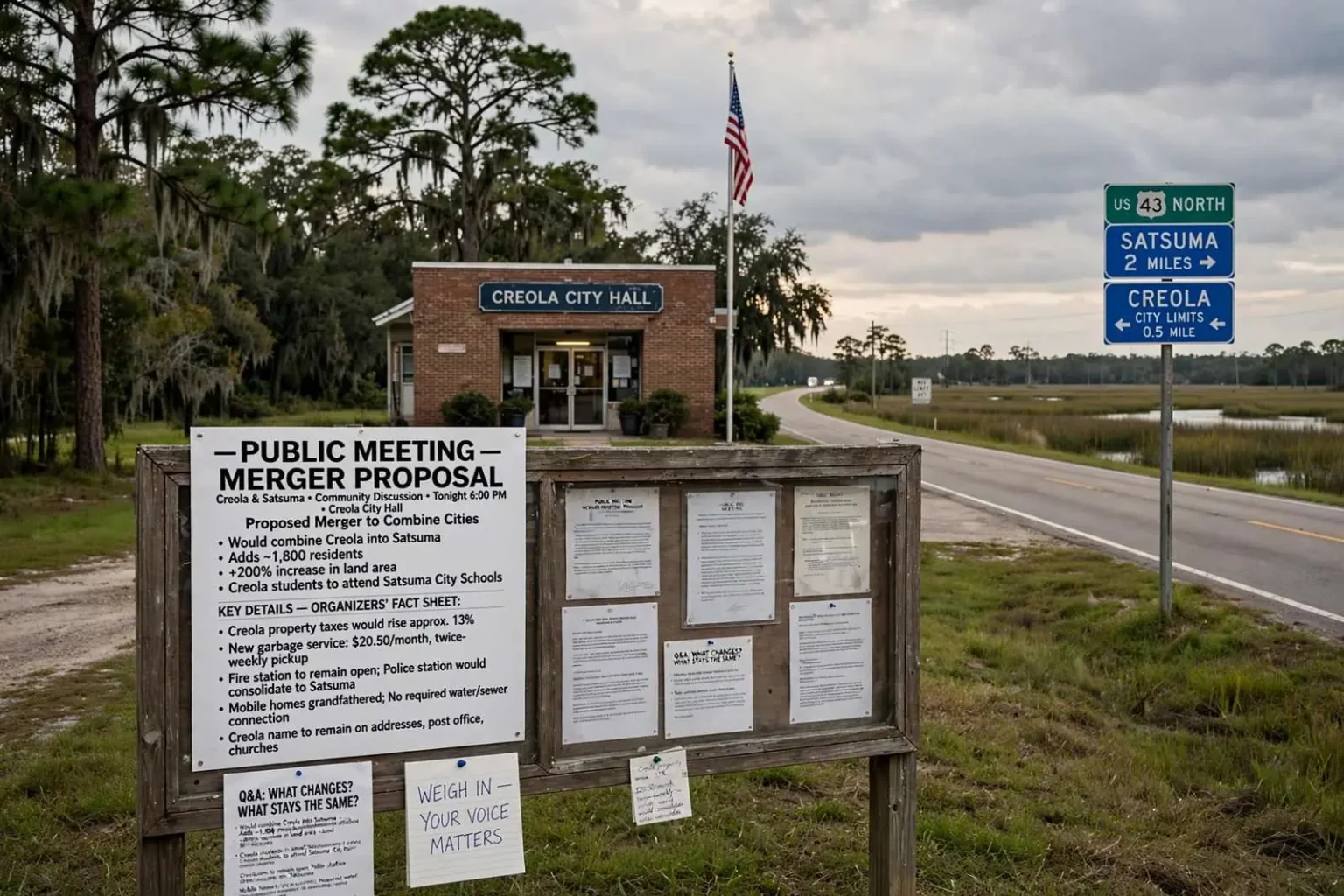
CREOLA, Ala. — A group of residents is pitching a plan that would dissolve north Mobile County’s smallest cities into one: annexing Creola into neighboring Satsuma. Under the proposal, the combined city would grow its land area by more than 200 percent and add roughly 1,800 residents. Organizers hosted a community meeting to gauge interest and let residents voice concerns about what a merger would mean for taxes, services and schools.
The idea touches a raw nerve in the small communities along U.S. 43 north of Mobile, where municipal identity runs deep even where municipal budgets run thin. Creola and Satsuma sit side by side in the timber-and-marsh country near the Mobile River’s upper delta, sharing a highway, a school footprint and increasingly, some residents argue, a set of problems neither can solve alone.
The Promise — and the Price
Supporters point to a larger population that could unlock more grant opportunities and a bigger tax base to support city services, parks and recreation. Education emerged as a selling point on both sides: Creola students would gain access to Satsuma City Schools, which are closer than their current assignments, and a larger student body could mean more funding for programs.
Skeptics aren’t convinced. Creola resident Helen Brown quipped that neither city has much revenue, calling a merger “like the blind leading the blind.” Fellow resident David Bouchea said he sees mostly losses — higher property taxes, more fees and the likely loss of a local police department, which could also drive up his insurance costs.
Organizers distributed answers to common questions: property taxes for Creola residents would rise roughly 13 percent; garbage service would run $20.50 per month with twice-weekly pickup; existing mobile homes would be grandfathered in; and residents would not be required to connect to Satsuma water or sewer. The current Creola fire station is expected to remain open, though the police station would likely close given its proximity to Satsuma’s. The Creola name itself would survive on addresses, churches, businesses and the post office.
The granular answers were an attempt to move the debate past rumor. Municipal mergers generate no shortage of speculation — that water bills will spike, that mobile homes will be condemned, that fire protection will lapse — and the organizers’ fact sheet tried to answer each item directly. The response from the crowd suggested that the facts helped, but that the deeper question, about whether Creola should continue existing as its own city at all, remained open.
A Familiar Idea
The concept isn’t new — Saraland floated a similar move years ago before Creola residents rejected it over many of the same concerns. Former Satsuma mayor Tom Williams reminded attendees that any merger is a legislative process and won’t happen overnight.
That history shadows the current effort. The earlier proposal died on the same fears now being raised: higher taxes, lost identity and the suspicion that a larger neighbor’s promises would not survive contact with the budget process. Organizers this time have tried to front-load the answers, publishing the tax and service figures before the campaign gathers momentum rather than after.
Williams’s warning about the legislative path is the procedural reality every such effort faces. Alabama municipalities cannot simply vote to absorb one another; the change requires action in the Legislature, typically through a local law, with public hearings and the formal consent mechanisms state law provides. The community meeting is the first step in a process that, even under the best circumstances, would take years of committee hearings, floor votes and implementation planning.
Two Small Cities, One Stretch of Highway
The geography of the proposal explains both its logic and its friction. Creola and Satsuma sit within a couple of miles of each other along U.S. 43, the old highway that predates Interstate 65 and still carries the commerce, churches and ball fields of north Mobile County. Residents of one community work, worship and shop in the other; children from both sides of the line already play on shared teams. To the proposal’s supporters, the municipal boundary is a century-old accident that no longer matches how people live.
What separates them is mostly scale. Satsuma, with its own city schools and a somewhat broader tax base, has functioned as the anchor community of the immediate area; Creola, one of the smallest incorporated cities in the county, operates on a budget that limits what it can offer beyond basic public safety. The merger would fold the smaller into the larger, producing a single city spanning everything from the river bottoms to the interstate interchange.
Schools sit at the center of the practical case. Satsuma broke away from the Mobile County public school system to form its own city system, whose proximity to Creola makes it closer than the campuses Creola students currently attend. A merged city would put every public school student in the new boundaries inside that system, and supporters argue that a larger student body would strengthen programs that depend on enrollment. Skeptics counter with the tax increase that any school system’s operation implies, and with the question of capacity — how many new students the system could absorb, and at what cost to the classrooms already there.
Public safety is the other half of the calculation. Losing Creola’s police department, which the proposal’s own organizers expect, would leave law enforcement in the area to a larger combined force operating from Satsuma’s headquarters — a department closer to Creola’s existing station than many residents might assume, but one that would not be stationed in Creola itself. Fire coverage would remain in place under the current arrangement, at least as the plan stands.
What Happens Next
Organizers say the meeting was a listening exercise, not a vote, and that the proposal will move forward only if community interest holds. The next steps they describe are the procedural ones: canvassing residents, refining the financial answers distributed at the meeting, and eventually taking the question to the Legislature if the support is there. Opponents, meanwhile, are organizing their own count of residents who prefer Creola remain Creola.
The debate is a small-scale version of a question playing out across Alabama, where dozens of towns with populations under a few thousand balance pride of identity against the rising cost of running a city. Municipal incorporation carries real obligations — police, fire, streets, garbage, drainage — at a scale where each service consumes a large share of a small budget. Some communities respond by sharing services; some by dissolving; a persistent few, like Creola, by debating the question every few years.
For now, the residents of the two cities are left with the fact sheet and the forum. The tax figures, the garbage price, the promise that the Creola name survives on the post office — those are the concrete terms of a question that is, at bottom, about identity: whether a place with a volunteer fire station, a mayor and a city hall is worth a 13 percent property tax increase, or whether the future of north Mobile County is a single city on the highway. The Legislature will not answer that. Creola’s residents will.
How Municipal Mergers Work in Alabama
The path Williams described runs through Montgomery, and it is narrow. Alabama law provides no simple mechanism for one city to annex another; consolidation proposals move through the Legislature as local laws, tailored to a single community, and they require the kind of public process — hearings, notice, and often a referendum or petition requirement written into the bill itself — that makes every step a vote of public confidence. Local legislators have historically been reluctant to carry such bills without clear, demonstrated support, which is precisely what organizers set out to measure at the community meeting.
The procedural caution is not bureaucratic fussiness. A merger touches property lines, tax rolls, utility service territories, court jurisdictions and school enrollments all at once, and unwinding any part of it after the fact is nearly impossible. The Legislature’s slow treatment of consolidation proposals reflects hard experience: municipalities in other states that merged hastily have spent decades sorting out pension obligations, debt assumptions and service contracts that no one priced at the front end.
That is also why the financial details distributed at the meeting matter more than they first appear. The 13 percent property tax figure, the $20.50 garbage fee and the grandfathering of mobile homes are the parts of the plan that would be written into law or ordinance, and each one became a commitment the moment it was handed to residents. If the merger effort advances, opponents will hold the organizers to those numbers, and any deviation — a tax rise beyond 13 percent, garbage service reduced to once weekly — will be cited as proof of the skeptics’ case.
The People in the Room
The meeting itself illustrated why the outcome is hard to predict. Brown’s “blind leading the blind” line drew laughter, but it voiced a real argument: that combining two small budgets produces one medium-small budget, not prosperity. Bouchea’s insurance concern — that losing a local police department could raise homeowners’ premiums — reflects how insurers score coverage distances and response times, and it is the kind of second-order cost that fact sheets rarely capture.
Against those voices stand residents of both cities who see the merger as the only realistic path to amenities neither can afford alone: a park worth the name, recreation programs, paved streets on a predictable schedule. The grant math drives much of that argument. Federal and state programs frequently award on population thresholds, and a combined city crossing into a larger population bracket can qualify for funding streams that each community misses today.
The proposal’s organizers, for their part, have learned from the Saraland attempt. Where the earlier effort was remembered for rumor and resistance, this one began with numbers, answers and an invitation to the skeptics themselves. Whether that approach can overcome the identity question at the heart of it — whether Creola stops being a city — will be decided not at the Statehouse but in the living rooms along U.S. 43, one household at a time.