Contractor Tilmon Brown Weighs a Run for Mobile Mayor
Mobile contractor and historic-preservation developer Tilmon Brown confirmed his interest in the mayor's office, saying he would form an exploratory committee by Labor Day.
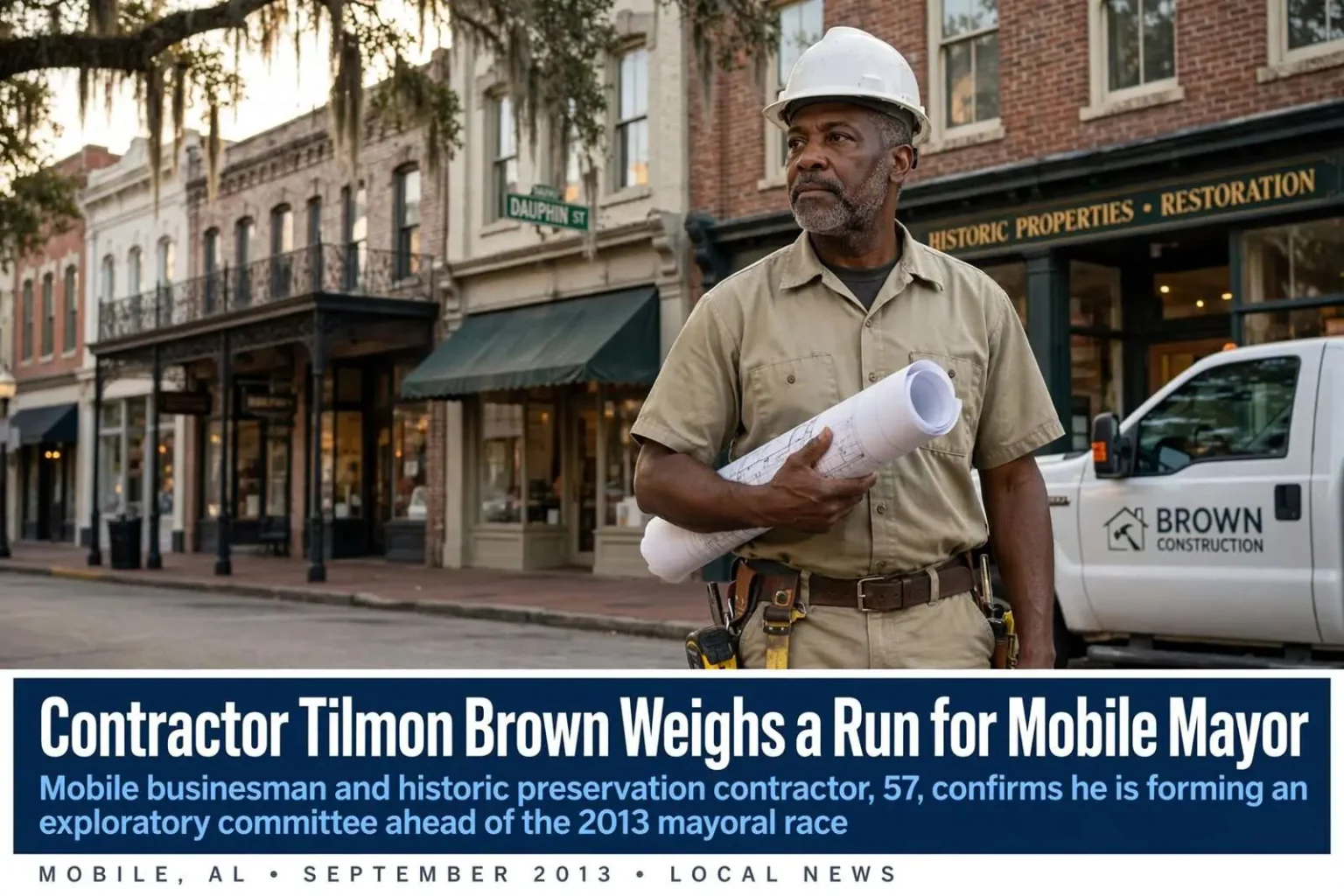
Mobile contractor and businessman Tilmon Brown confirmed that he was weighing a run for mayor in the 2013 municipal elections, joining the early maneuvering already under way as the city looked toward a change, or continuation, at City Hall. Brown said he would assemble an exploratory committee by Labor Day, the traditional first step that lets a candidate raise money, poll and travel while still keeping the word “exploratory” in front of the name.
His interest placed him alongside timber executive Sandy Stimpson, who had also begun testing the waters, while incumbent Mayor Sam Jones had said he planned to seek a third four-year term. With the field still forming months before anyone qualified, Brown’s move signaled that the challenge to City Hall would not be a one-man effort — Mobile’s business community was producing challengers, plural.
A Return to the Arena
For Brown, a mayoral bid would mark a return to politics after more than three decades away. He had run for the finance director slot on the old Mobile City Commission back in the 1970s, losing to incumbent Commissioner Gary A. Greenough — a race from an era when Mobile’s city government was structured around a commission whose members headed departments and answered directly at the polls.
He recalled the experience with a wry lesson learned in his early twenties, joking about the golden rule that whoever has the gold makes the rules, and noting that his own path since had led to broader business success. The quip doubles as a philosophy: Brown’s decades since the loss were spent accumulating the resources — in companies, properties and relationships — that a serious citywide campaign requires.
The time was right, Brown said, both for his return to public life and for a change in the city’s leadership.
From Technology to Old Buildings
Brown, 57, had built a career that spanned several fields. A Mobile native who grew up in the Oakdale neighborhood near downtown, he graduated from Williamson High School and earned a bachelor’s degree in political science from the University of Mobile. He had worked in the computer and internet industry before selling his company and moving into real estate development and contracting.
In recent years he had specialized in historic-district projects, several of them in downtown Mobile, describing his niche as historic preservation and the adaptive reuse of old buildings in urban settings — turning aging warehouses into commercial, retail and living spaces. That work had given him a distinctive vantage point on the fortunes of the city’s core: where developers see a floor plan, Brown’s career had trained him to see a neighborhood’s trajectory.
The portfolio matters politically as well as professionally. Downtown’s revival has been Mobile’s most-told civic story of the past two decades — loft conversions, restored storefronts and new life in blocks that emptied after mid-century — and a candidate who spent his own money helping to write that story can claim a credential that no career politician’s resume quite matches. Williamson and Oakdale, meanwhile, root him in the city’s African American community near downtown, a biography that bridges the constituencies any winning Mobile coalition must assemble.
Early Positioning in a Fluid Field
With the election still two years off in the original timeline of the campaign cycle, the field remained fluid, and Brown’s move amounted to a claim on the conversation rather than a launch. Exploratory committees are how Mobile businessmen have long tested the water: raise a little, listen a lot, and see whether the crowds at the civic club lunches grow or thin.
The dynamics he joined were familiar ones. Mayor Sam Jones, seeking a third term, would run on continuity — the convention center era, the city’s recovery from recession and a generation of public works. Sandy Stimpson’s early interest signaled the business community’s appetite for change, and Brown’s entry suggested that appetite extended into new corners of the city. Mobile’s mayoral races have historically turned on exactly this geography: downtown’s hopes, west Mobile’s growth politics and the neighborhoods in between.
Brown’s stated timeline — a committee in place by Labor Day — would put him in the field of possible challengers well before the qualifying deadline, with a year of fundraising and visibility ahead of any actual campaign. In city elections where name recognition is the currency, that early runway is the whole point.
What an Exploratory Committee Actually Does
The step Brown promised is more than a press release. An exploratory committee can accept contributions, hire staff and commission polling, all while the principal decides whether to commit. For a candidate without recent campaign experience — Brown’s last race was more than three decades behind him — the committee is where the learning happens: donor lists get built, the county’s political landscape gets mapped and a message gets tested on rooms full of voters.
For Brown, the pitch writes itself from his career. A builder who restores old buildings for a living can frame the whole city that way — infrastructure deferred, neighborhoods kept whole, a downtown treated as an asset rather than an afterthought. His technology background adds the modern-government angle: procurement, systems and services that a growing city runs on. And the 1970s loss, the joke about who has the gold, gives him a self-deprecating biography note that consultants generally have to manufacture.
The Landscape Around Him
Mobile’s 2013 cycle arrived at a hinge moment for the city. Airbus had announced its assembly line at Brookley the year before, setting expectations for growth that would shape every campaign conversation about jobs and infrastructure. The mayor’s race would be the first major citywide vote since the announcement, and the field forming around it — an incumbent seeking a third term, a timber executive with a business-reform message and a developer with a preservation record — reflected the city’s competing instincts about how to manage the moment.
Neighborhoods like Oakdale, where Brown grew up, sit at the center of a long civic conversation about who benefits from downtown’s revival — a question that runs through every Mobile election and that a candidate from the neighborhood, running on his own record in its historic districts, was positioned to press.
Brown’s confirmation stops short of candidacy, but it moves the field: two challengers exploring, an incumbent committed, and more than a year of civic season left before anyone files. For a city that had watched the same faces run City Hall for a generation, the possibility of a third way — a builder’s campaign, funded by the golden rule’s other half — was suddenly on the table.
The Historic Preservation Ledger
Brown’s niche deserves a closer look, because it is rarer than it sounds. Adaptive reuse — converting warehouses, storefronts and industrial shells into offices, shops and apartments — demands a blend of contractor’s craft and developer’s patience: structures that pencil out only if the builder respects the old walls while quietly replacing everything inside them. Mobile’s downtown historic districts, with their iron-front buildings and century-old commercial blocks, are exactly the stock that rewards that blend.
Every completed project also feeds the tax base the next mayor will manage. Restored buildings return to the rolls, house businesses and residents, and anchor the street-level vitality that visitors and conventions judge a city by. A candidate whose own projects demonstrate the model has a concrete answer to the standard debate question about economic development — and a set of walking-tour talking points no opponent can match.
The city’s preservation infrastructure — its historic development agencies, design review boards and the federal tax credits that make restoration financing work — is the apparatus a builder-turned-candidate knows from the inside, including its frustrations. That fluency is both an asset and a target: every approval fought over and every project delayed is a story an opponent can retell.
Reading the 2013 Field
Three names — an incumbent mayor, a timber executive and a contractor — framed the race as it stood in the months before Labor Day. Each carried a different map. Jones’s incumbency offered endorsements, a record and the advantages of the office. Stimpson’s exploratory effort marshaled the city’s business establishment, the constituency that had spent years urging a management-focused agenda at City Hall. Brown’s potential candidacy reached toward the neighborhoods near downtown and the city’s minority communities, with a record in the historic districts as his proof of work.
How those coalitions combined would decide the election. Mobile’s mayoral contests have often come down to turnout geography — which precincts show up, and whether the city’s westward growth or its historic core sets the agenda. A three-way or wider field scrambles those calculations, which is why early entrants spend so much effort watching each other’s committees.
Brown’s own framing suggested he intended to run on the city’s future tense: buildings restored, neighborhoods retained, a downtown managed as a portfolio rather than a project. Whether that message, delivered by a first-time-in-decades candidate, could cut through the summer noise was the open question his Labor Day committee was designed to answer.
Between Now and Labor Day
The near-term calendar is what exploratory phases are made of: breakfast clubs, neighborhood associations, church civics groups and the summer’s political fish fries, each stop a test of the message and a chance to recruit the precinct-level support that Mobile campaigns are built on. Donors, meanwhile, will be watching the committee’s early returns — the first filing report after Labor Day would tell the city whether Brown’s effort was a campaign in waiting or a conversation piece.
For the incumbent, a second announced explorer was its own news. A third-term race against one well-funded challenger is a referendum; against two, each pulling different constituencies, it becomes a choice about the city’s direction — the kind of election where a candidate’s biography does real work.
Brown, at 57, with a sold company, a restoration portfolio and a fifty-year-old lesson about who makes the rules, had put himself in position to find out. Whether he ultimately filed or folded, his confirmation made the 2013 race a real contest of ideas about Mobile’s future — and, for the exploratory season, that was the whole point.