Transit Money, Drainage Work and Tennis Courts on the Mobile City Council Agenda
The Mobile City Council took up a $650,000 budget increase for the Wave Metro Transit System, drainage contracts and a rebuild of the Mobile Tennis Center at its Aug. 1, 2006 meeting.
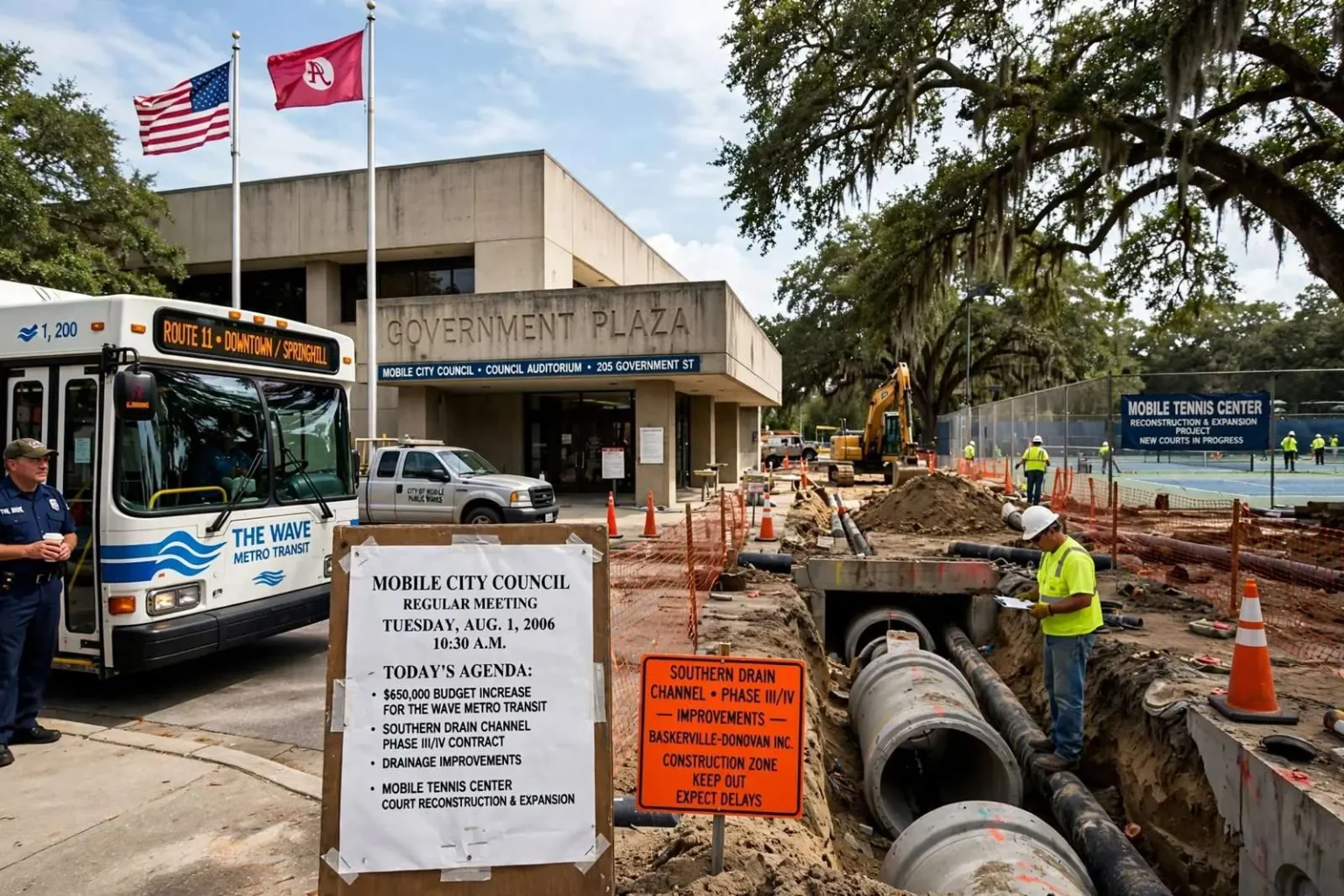
The Mobile City Council convened for its regular meeting at 10:30 a.m. on Tuesday, Aug. 1, 2006, in the auditorium of Government Plaza, with an agenda that ran from the daily grind of drainage engineering to a substantial infusion of cash for the city’s bus system.
Council agendas rarely make headlines, but they are where a city’s priorities are actually set. The items before the council that August morning offer a compact portrait of what Mobile’s government was worrying about in the middle of the decade: a transit system that needed help keeping up, a stormwater network being rebuilt one phase at a time, and a tennis facility the city had decided to grow rather than merely maintain.
None of the items involved a crisis. That is the nature of most council work — a list of contracts, budget amendments and authorizations, each modest on its own, that together determine what kind of city residents live in. A budget amendment for buses, a drainage contract, two tennis contracts: each one was the product of months of staff work, and each one would be noticed only when it succeeded, in the form of buses that ran and streets that drained.
A $650,000 boost for the Wave
The largest single item was a proposed budget increase of $650,000 for the Wave Metro Transit System, to be paid for out of city sales tax proceeds collected in excess of budget.
Two things are worth noting about that item. The first is the funding mechanism. The money was not new taxation or borrowing; it came from sales tax receipts that had run ahead of projections. Mobile’s economy in 2006 was producing more revenue than the budget had assumed, and the council was deciding what to do with the surplus.
That is a healthier position than most transit systems’ patrons would assume. Public transit everywhere lives on appropriations, and a mid-year increase drawn from surplus revenue means the city chose to spend its windfall on mobility rather than simply letting it sit. The Wave — the brand name for the bus system operated by the city’s transit authority — connected downtown workers to neighborhoods, shoppers to retail corridors, and students to campuses across the city.
The second is the recipient. Public transit in Mobile had long operated on thin margins, and the Wave, the city’s bus network, was a perennial candidate for supplemental appropriations. A $650,000 mid-year increase suggested the system was running beyond its allocation, whether because of fuel costs, ridership, maintenance or all three.
Fuel prices in the summer of 2006 were climbing sharply, a pressure felt by every transit agency in the country. Diesel costs that year strained operating budgets nationwide, and a bus system’s fuel bill is one of the few expenses it cannot defer. Every route mile driven cost more than it had when the budget was drafted, and the arithmetic of a mid-year supplemental appropriation followed almost mechanically from the price at the pump.
For riders, the practical meaning of the item was continuity. Mid-year supplements keep routes running when costs outrun budgets; their absence shows up as service cuts, reduced frequency or deferred maintenance. The council’s vote, routine as it looked on paper, was the difference between a transit system holding steady and one quietly shrinking.
Drainage: the unglamorous essential
The council also considered authorizing a contract with Baskerville-Donovan, Inc. for improvements to the Southern Drain Channel, covering Phase III and Phase IV of the project.
In a city built on low ground beside a bay, in a region that can absorb a foot of rain in an afternoon, drainage is not a minor municipal function. It is arguably the most consequential infrastructure Mobile maintains.
The Gulf Coast’s rainfall is among the heaviest in the United States, arriving in intense bursts that overwhelm undersized culverts and silted channels in minutes. When channels fail, water has nowhere to go but into streets and living rooms. Mobile’s network of drainage channels — engineered ditches and culverts carrying stormwater to the bay — is the invisible system standing between ordinary summer storms and chronic neighborhood flooding, and keeping it adequate is a job that never ends.
Channel improvements of the kind contemplated in the Southern Drain project determine whether neighborhoods flood during a summer thunderstorm or a tropical system, and the phased structure of the work reflected the long, expensive, incremental nature of stormwater management.
Phase III and Phase IV meant the Southern Drain project was well along — early phases completed, later phases queued up, each one budgeted and contracted separately. That phasing is how cities finance what they cannot afford all at once, and it also means drainage is perpetually a work in progress: the neighborhood protected by Phase III waits years for Phase IV. Engineering firms like Baskerville-Donovan, a Pensacola-based firm with a long Gulf Coast practice, made their living on exactly this kind of municipal water work.
Rebuilding the Mobile Tennis Center
Two items concerned the Mobile Tennis Center, the sprawling public facility that had become one of the city’s better-known amenities and a regular host of regional and national tournaments. A contract with Clark, Geer, Latham & Associates, Inc. covered reconstruction of courts at the center, and a contract with the Global Sports & Tennis Design Group covered expansion of the courts at the same facility.
Taken together, the two contracts pointed toward a serious commitment to the center rather than routine upkeep. Reconstruction and expansion are different undertakings, and pursuing both at once indicated the city saw the facility as an asset worth growing.
The distinction matters. Reconstruction replaces playing surfaces that have worn past the point of patching — the cracking, fading courts that come from years of Gulf Coast sun, rain and play. Expansion adds capacity, which is a bet on future demand. A city that only reconstructs is maintaining what it has; a city that reconstructs and expands in the same motion is positioning itself for more of something, and in the tennis center’s case that something was tournaments.
Tennis tournaments filled hotel rooms and restaurants, and cities across the Southeast were competing for exactly that kind of amateur sports tourism.
The economics of amateur sports events were well understood by the mid-2000s. A regional tennis tournament brings players, families and coaches who stay multiple nights, eat out every meal and shop between matches — spending that spreads across a local economy without the infrastructure costs of a professional franchise. Municipal tennis centers that could offer enough courts in good condition to host large draws were scarce, and the cities that built them captured the tournaments.
Global Sports & Tennis Design Group was one of the country’s recognized court design firms, and pairing a design specialist with a local reconstruction contractor was the standard structure for a project of this kind: the designer ensures the finished courts meet tournament standards for surface, orientation and drainage, while the local firm executes the work. The council’s consideration of both contracts in a single meeting suggested the two pieces had been planned together.
What the agenda says about the moment
An August 2006 council agenda catches Mobile at an interesting juncture. The city was flush enough that sales tax collections were exceeding budget, confident enough to invest in recreational facilities aimed partly at outside visitors, and prudent enough to keep grinding away at the drainage channels that protect the neighborhoods when the weather turns.
It is also worth remembering the context. Less than a year earlier, Hurricane Katrina had come ashore to the west and reordered the Gulf Coast’s sense of what was possible. Mobile escaped the worst of it, but the storm sharpened everyone’s attention to water, to drainage, and to the fragility of coastal infrastructure. A routine contract for channel improvements read differently in 2006 than it might have in 2004.
Katrina’s passage west of the city had still knocked out power for weeks, littered the city with debris, and reminded Mobilians that the drainage system’s performance in a major storm is not an abstraction. Every resident who watched the flooding that August of 2005 understood, in a way that no staff report could convey, why Phase III and Phase IV of a drainage channel mattered. The storm turned stormwater engineering from a line item into a personal concern.
The same logic applied to the transit item, in its own way. Fuel volatility after the 2005 hurricane season — when Gulf refining capacity was disrupted and prices spiked — had made energy costs the central uncertainty in every operating budget, public and private. A bus system’s mid-year shortfall was partly a Katrina echo: the region’s energy economy had been reordered, and municipal budgets were still catching up.
Council meetings in Mobile were, and remain, open to the public and held in the auditorium at Government Plaza on Government Street. The votes that shape a city are taken there, item by item, most of them without a single reporter in the room.
That last observation is not a complaint but a description of how municipal government actually works. The $650,000 for the Wave, the Southern Drain contract and the tennis center projects all began as staff recommendations, passed through committee review, and became city policy in a chamber where the public is always invited and rarely present. The Tuesday morning rhythm of council meetings is the metronome of a city — unremarkable, and indispensable.