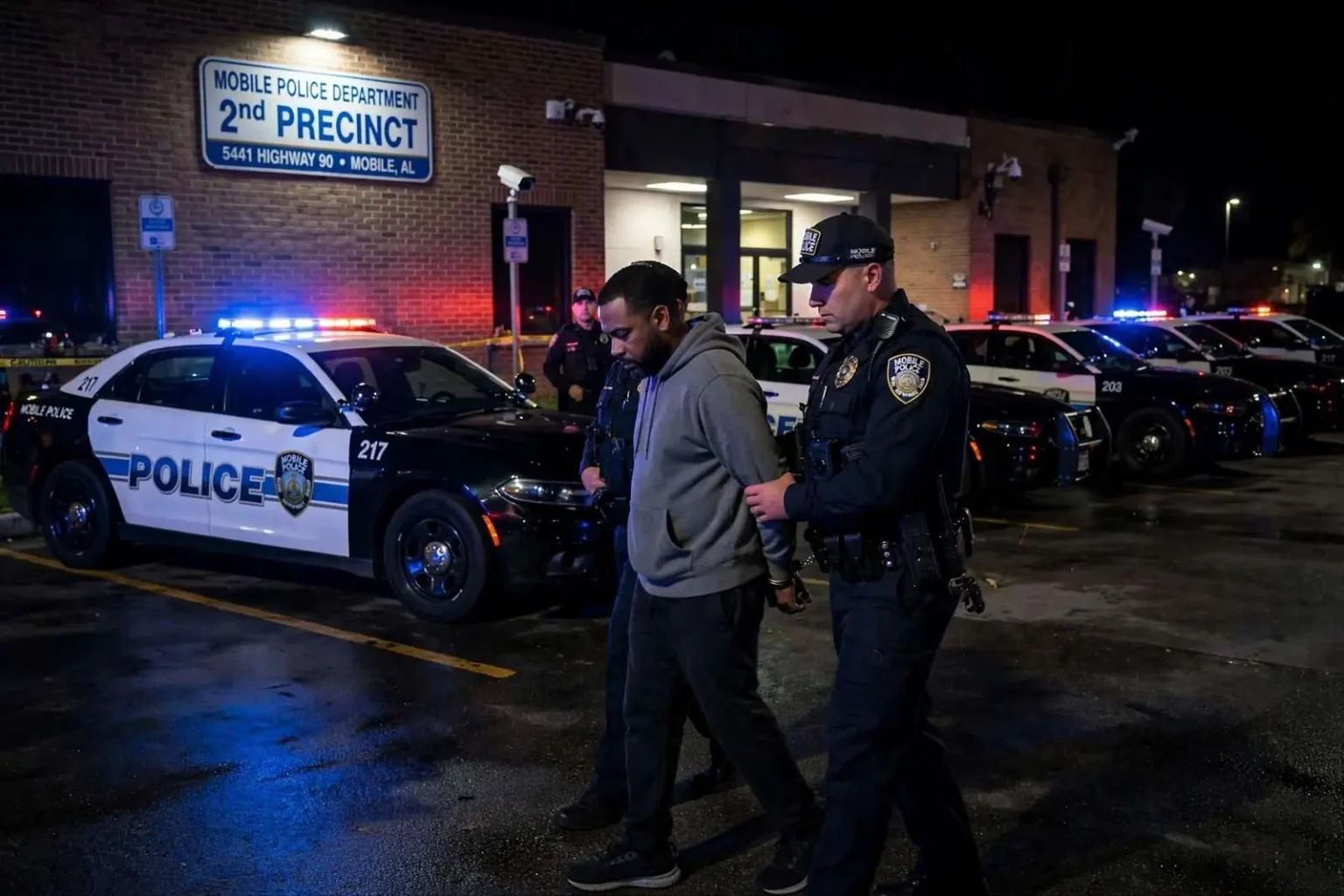
Marked police patrol vehicles parked at night, illustrating an arrest for breaking and entering police cars at Mobile's 2nd PrecinctOfficers say the man was pulling on handles of marked patrol cars outside the 2nd Precinct on Highway 90.

A 47-year-old Mobile man was arrested early Saturday after officers say they watched him working his way down a row of marked police vehicles, pulling on the door handles — in the parking lot of a police precinct. Ngozichukwu Ijiomah was charged with two counts of breaking and entering a vehicle and booked into Mobile County Metro Jail, according to the Mobile Police Department. The Location Is the Story The incident happened at approximately 2:30 a.m. on Saturday, July 11, in the parking lot of the Mobile Police Department's 2nd Precinct at 5441 Highway 90.

Officers on scene observed a man pulling on multiple police vehicle handles and detained him. There are few places in Mobile County less advantageous to attempt entry into a vehicle than a lot filled with police cruisers, staffed around the clock, and covered by departmental surveillance. What "Breaking and Entering a Vehicle" Means in Alabama The charge is defined under Alabama Code § 13A-8-11(b), and it is broader than many people assume. A person commits the offense by entering a vehicle with the intent to commit a felony or theft inside it.

It is a Class C felony — not a misdemeanor — which is why two counts represent a serious exposure. Two counts were filed, corresponding to the vehicles police say he attempted to enter. Alabama's Vehicle Burglary Statute in Context Alabama Code § 13A-8-11 distinguishes between burglary of a dwelling, a building, and a vehicle. Breaking and entering a vehicle is a Class C felony carrying a sentencing range of one year and one day to ten years in a state correctional facility.

The statute does not require forced entry — merely reaching into an unlocked vehicle with the intent to steal can satisfy the elements. This is a critical distinction for the public: leaving a vehicle unlocked does not diminish the seriousness of the offense for the person who enters it, but it does make the crime far easier to commit. When multiple vehicles are involved, prosecutors may charge each as a separate count, as appears to be the case here.

The Mobile County District Attorney's Office will evaluate the evidence from the precinct's surveillance system, officer testimony, and any physical evidence to determine how to proceed. A Recurring Problem With an Easy Fix Vehicle break-ins remain one of the most common property crimes in Mobile, and the overwhelming majority involve unlocked vehicles rather than smashed windows. Law enforcement agencies across the Gulf Coast have run "lock it or lose it" campaigns for years for exactly that reason: the crime is largely one of opportunity, and the opportunity is usually handed over.

Background and Context

Data from the Mobile Police Department and the FBI's Uniform Crime Reporting program consistently show that larceny from vehicles — often called "car burglary" or "breaking and entering a vehicle" — accounts for a significant share of property crime reports in Mobile County. The pattern is seasonal, with spikes during holiday shopping periods and summer months, but the underlying dynamic is constant: thieves walk parking lots and neighborhoods checking door handles, and unlocked doors are an invitation.

See also  Mobile Lands Bloomberg Grant to Build City Innovation Team

The practical advice from police has not changed — lock the doors, take valuables inside, never leave a firearm in an unattended vehicle, and do not leave a garage door opener clipped to the visor of a car parked in the driveway. A garage door opener in a vehicle parked outside effectively gives a thief access to the home as well. Firearms in Vehicles: A Specific Concern Mobile Police Department and Mobile County Sheriff's Office have repeatedly emphasized the danger of firearms stolen from vehicles.

A gun stolen from an unlocked car becomes an unregistered, untraceable weapon on the street, often used in subsequent violent crimes. Both agencies encourage gun owners to use vehicle-mounted safes or lockboxes if a firearm must be left in a vehicle temporarily, and to bring it inside whenever possible. Alabama law does not require a permit to carry a loaded handgun in a vehicle, but responsible storage remains the owner's obligation. The Alabama Crime Information Center tracks stolen firearms, and recovery rates for guns stolen from vehicles are low.

Highway 90 and the 2nd Precinct The Mobile Police Department's 2nd Precinct at 5441 Highway 90 serves the southwestern sector of Mobile, including the Theodore, Tillmans Corner, and surrounding unincorporated areas. Highway 90 (Government Boulevard) is a major east-west commercial corridor lined with retail centers, restaurants, and residential developments. The precinct's parking lot, like those of all MPD facilities, is monitored by security cameras and is routinely occupied by on-duty officers, making it an exceptionally high-risk location for any criminal activity.

The 2nd Precinct's jurisdiction covers a diverse mix of urban and suburban neighborhoods, and its officers handle a significant volume of property crime calls, including vehicle break-ins, residential burglaries, and theft from construction sites. The precinct also participates in the department's community policing initiatives, including neighborhood watch coordination and business security assessments. The Legal Process Ahead Ijiomah has been charged and is presumed innocent unless and until proven guilty in court. The two counts of breaking and entering a vehicle will proceed through Mobile County District Court for a preliminary hearing, where prosecutors must establish probable cause.

Background and Context

If the case is bound over, a Mobile County grand jury will consider whether to return an indictment. If indicted, the case moves to Mobile County Circuit Court for arraignment and, ultimately, trial or plea resolution. The Mobile County District Attorney's Office will handle the prosecution, and Ijiomah will be represented either by retained counsel or by the Mobile County Public Defender's Office if he qualifies for appointed counsel. The Alabama Rules of Criminal Procedure govern the proceedings, and both the U.S.

See also  Judge Ordered to Stop Faxing the Court After Calling Ruling 'Illegal, Immoral'

and Alabama Constitutions guarantee the right to a jury trial, the right to confront witnesses, and the privilege against self-incrimination. Community Prevention Efforts Beyond individual precautions, Mobile neighborhoods have organized formal and informal prevention efforts. Neighborhood Watch groups coordinated through the Mobile Police Department's Community Services Division share alerts about suspicious activity, and some communities have installed license plate readers at subdivision entrances with the cooperation of residents and HOAs. Businesses along Highway 90 and other commercial corridors often share surveillance footage with investigators when break-ins occur in their parking lots.

The Mobile County District Attorney's Office also operates a pre-trial diversion program for certain first-time property offenders, which can include restitution, community service, and theft prevention education. Eligibility is determined case by case. Presumption of Innocence As with every criminal case in the United States, the constitutional presumption of innocence applies. Ijiomah will have the opportunity to present a defense, challenge the state's evidence, and, if the case proceeds to trial, require the prosecution to meet its burden of proof beyond a reasonable doubt before a jury of his peers.

The Mobile County Circuit Court will ensure that the proceedings adhere to the Alabama Rules of Criminal Procedure and the protections guaranteed by both the U.S. and Alabama Constitutions. Court records for this case will be accessible through the Mobile County Circuit Clerk's Office once formal charges are filed, and the docket will reflect each procedural step from arraignment through disposition.

Wider Significance for Coastal Alabama

This story is part of a broader set of changes playing out across Mobile, Baldwin and the wider Gulf Coast region. Local residents, businesses and government agencies have been watching developments like this one closely, because decisions made in Mobile and Baldwin counties often ripple outward into neighboring communities across south Alabama, Mississippi and the Florida Panhandle. Public meetings, council work sessions and state legislative hearings have all carried echoes of the underlying concerns, with stakeholders ranging from neighborhood associations to industry groups weighing in on what the outcomes will mean for daily life along the Gulf Coast. Reporters and editors in the region have worked to document how these issues affect ordinary people, from commuters on Interstate 10 to families visiting the public libraries and parks that anchor so many of the Port City’s neighborhoods. The deeper context often emerges over months rather than days, as projects move from announcement to planning to construction, and as the people most directly affected find their voices in the public record. Continued coverage remains important, both for accountability and for the historical record, and the unfolding situation is one that warrants attention from anyone with a stake in the future of south Alabama.

See also  Severe risk today as a complex of storms barrel in this afternoon

Looking ahead, observers across the region expect the conversation to continue evolving. Local officials have signaled their intent to monitor outcomes closely, and community organizations have indicated they will remain engaged as new information becomes available. The intersection of state policy, local implementation and on-the-ground impact is precisely where stories like this one tend to develop their lasting significance. For Mobile and Baldwin residents, the practical effects will play out over time, in everything from tax bills and utility rates to traffic patterns and the availability of public services. Following the developments requires patience and attention to detail, but it is also a reminder of how civic life in coastal Alabama continues to be shaped by decisions that begin far from the neighborhoods they ultimately touch. Residents who want to stay informed can do so by following local government meetings, attending public hearings when significant issues arise, and reading the regional reporting that tracks how these stories progress from one phase to the next.

Local news organizations continue to follow this story closely, and updates are expected as more details emerge. The developments have generated discussion across the region, with attention from both longtime residents and newcomers who are following the issue for the first time. Community leaders have emphasized the importance of staying engaged with local government and participating in public meetings when significant decisions are being made. As the situation continues to unfold, residents are encouraged to remain informed through reliable local reporting and official city and county communications channels. The story remains active, and additional information is anticipated in the coming days and weeks as the relevant agencies and stakeholders complete their work.