Prichard Names Retired Chief Michael Rowland Interim Leader as Mayor Vows to Move Past Speziale’s Exit
Prichard Mayor Troy Ephriam introduced retired Bay Minette Chief Michael Rowland as interim police chief and said the city would press ahead after Jerry Speziale left abruptly for a New Jersey post.
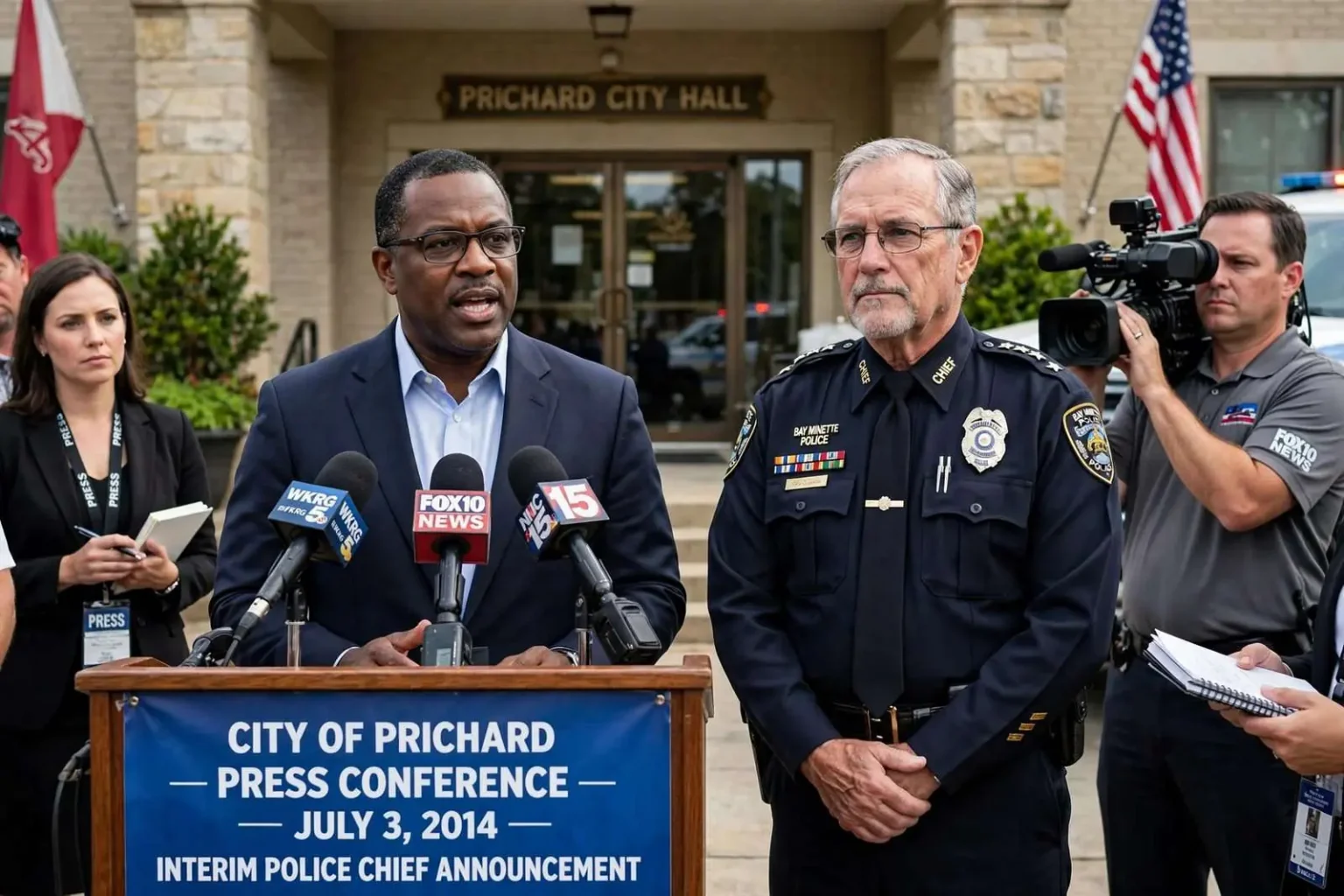
Standing before reporters on Thursday, July 3, 2014, Prichard Mayor Troy Ephriam sought to steady his city after an unexpected blow: the police chief it had recruited less than a year earlier was leaving for a job in New Jersey. In the same breath, Ephriam introduced the department’s new interim leader and promised that Prichard would move forward.
The mayor said he had first learned that Chief Jerry Speziale was departing through online media reports the day before. “It was something we couldn’t substantiate,” Ephriam said, describing efforts to confirm the news with his public information officer and Captain Walter Knight before issuing a press release and beginning the search for continuity in the department.
For a city of Prichard’s size, the departure of a police chief is never a small matter. The city, wedged between Chickasaw and Mobile in Mobile County, has long leaned on a compact police department to cover a demanding jurisdiction, and questions about leadership at the top carry weight with residents who have watched the department weather years of budget strain and staffing challenges.
A new interim chief
To fill the gap, Ephriam named retired Bay Minette Police Chief Michael Rowland, a Vigor High School graduate, as Prichard’s interim chief. Rowland, the mayor noted, had been the runner-up for the permanent job during the previous year’s search that ultimately selected Speziale.
“Chief Rowland was our No. 2 guy,” Ephriam said, “and him coming in today was not a consolation prize.”
The choice gave the department a leader already familiar to the city’s selection committee, already familiar with the region, and already retired from a full career in municipal law enforcement in Baldwin County. Rowland led the Bay Minette Police Department before stepping away, and his return to duty as an interim chief meant Prichard would not have to install a caretaker from outside law enforcement while it sorted out its next permanent hire.
Speziale, who had taken a position as the acting police director in Paterson, New Jersey, formally agreed to resign on Thursday morning after Ephriam spoke with him about the city’s need to move ahead. The mayor said Speziale’s departure was rooted in personal struggles and a bout with bronchitis rather than any dissatisfaction with Prichard.
Prichard, a city of roughly 22,000 residents, operates a police department scaled to its budget rather than its ambitions, and transitions at the top are felt in ways large departments rarely notice. Command staff double up on duties, community events go uncovered, and residents who know their officers personally watch closely to see who is leading them.
The mayor’s account of the timeline made clear how quickly events had moved. News of the departure surfaced online on a Wednesday, when the city could not confirm it; by Thursday morning, after a direct conversation between the mayor and the chief, the resignation was agreed and the interim appointment was ready to announce — all on the eve of the Independence Day holiday, one of the busiest stretches of the year for any police department.
Unresolved questions
Even as he praised Speziale’s work since October 2013, Ephriam acknowledged that the city was still sorting out the legal and financial implications of the exit. Speziale’s contract had stated he would serve as chief for as long as Ephriam was mayor, and it was unclear whether the former chief would continue to receive health benefits or other compensation.
“We haven’t had a chance to evaluate that,” Ephriam said, adding that the city’s attorneys would review the matter. “Preferably it would have been nice to have an idea. In the aftermath of that, it’s in our best interest to press ahead.”
Employment questions of that kind are not unusual when a hired executive departs mid-contract, but for a city operating with limited resources, every obligation matters. Prichard’s finances have been the subject of close attention for years, and the council and mayor alike have had to weigh commitments carefully. The review by the city’s attorneys would determine what, if anything, the city owed a chief who had agreed to resign nine months into a tenure that his contract had framed as open-ended.
Asked whether he felt disrespected at learning of the move through the media, the mayor declined to assign blame. “It’s hard to speak to the intention of an individual,” he said. “It is my hope that his decision will, in fact, make his life better for him and his family.”
Speziale, he noted, had expressed grave concerns about personal issues he had been unable to resolve, and family members who were expected to join him in Alabama by summer’s end now would not. The separation of a chief from his family during a demanding assignment, Ephriam suggested, had weighed on the decision even more than the professional opportunity waiting in New Jersey.
During his months in the job, Speziale had drawn attention for his credentials and his visibility in the community, and Ephriam’s praise for his work since October 2013 was unequivocal. The mayor credited the departing chief with bringing energy to the department and with engaging residents in a city where community trust in law enforcement has always required active cultivation.
The timing, just ahead of the July 4 holiday, added practical urgency to the announcement. Fireworks complaints, traffic control and ordinary patrol work would not wait for the paperwork to settle, and Rowland’s first days in the post would coincide with one of the busiest stretches on the municipal policing calendar.
Looking ahead
Ephriam framed the transition as a continuation of the search the city had completed the previous September rather than the start of a new process. He said the men and women of the Prichard Police Department would have a role in charting the department’s next steps, and he stressed that public safety remained unchanged despite the leadership shuffle.
“You’re going to see a better police force,” the mayor said, describing his approach as recruiting “peace officers and not just police officers.”
The distinction the mayor drew — between officers who merely enforce the law and officers who see themselves as guardians of their neighborhoods — has been a recurring theme in discussions of policing in small cities across Mobile County. Departments that cover a compact footprint know their residents by name, and the caliber of the people hired, Ephriam suggested, matters more than any single chief’s resume.
He indicated Speziale might, if needed, serve as a consultant, but said the city had capable leaders already in place. “If we need him, we’ll reach out to him,” Ephriam said.
Pressed on residents who were unsurprised that a high-profile officer might return north, Ephriam kept his focus on the future. “We endure, we overcome,” he said. “We’ll be a stronger Prichard, we’ll be a better Prichard.”
The remark captured the tone the mayor had struck all afternoon. Rather than dwell on the embarrassment of learning about a chief’s departure from news reports, Ephriam cast the episode as one more turn in a city that has endured worse — pension distress, budget shortfalls, and decades of economic change — and kept functioning.
For Rowland, the interim assignment puts a retired Baldwin County chief back in uniform in a city that faces a different set of challenges from the one he left. Bay Minette, the Baldwin County seat, is a growing city with its own pressures, but Prichard’s compact neighborhoods, older housing stock and strained budget present the kind of day-to-day demands that test any department’s leadership. Rowland’s familiarity with the Gulf Coast — and his roots in the community as a Vigor High School graduate — were part of what made him attractive to the city a year earlier, and those qualities did not change in the intervening months.
Interim appointments of this kind typically carry a dual mandate: keep the department running without disruption while the city decides whether the interim leader should be a candidate for the permanent job or the search should begin anew. Ephriam’s language suggested the department’s existing command structure, including Captain Walter Knight and the department’s other supervisors, would share the burden of the transition alongside the incoming interim chief.
The episode also underscored the perils small cities face when recruiting leaders from outside the region. Prichard had gone out of state, and out of a crowded field of candidates, to hire a chief with big-city credentials. Nine months later, the position was open again, and the city was left to absorb the costs of a search it had thought concluded — travel, relocation and onboarding expenses among them — while its attorneys reviewed the contract’s remaining obligations.
Whether the city ultimately promotes from within or launches another national search, the mayor’s message to residents was that the department’s work would not pause for the transition. Patrols would run as scheduled, investigations would continue, and the holiday weekend ahead would be staffed like any other.
In the end, the July 3 press conference accomplished what the mayor intended: a difficult piece of news delivered plainly, an interim leader in place, and a promise — offered in the mayor’s characteristic style — that the city would come through the episode stronger than it entered it.