Veteran Lawman Takes the Helm as Prichard’s Interim Police Chief
Michael Rowland, a 40-year law enforcement veteran and former Bay Minette police chief, stepped in as Prichard's interim police chief, pledging a renewed emphasis on training and community policing.
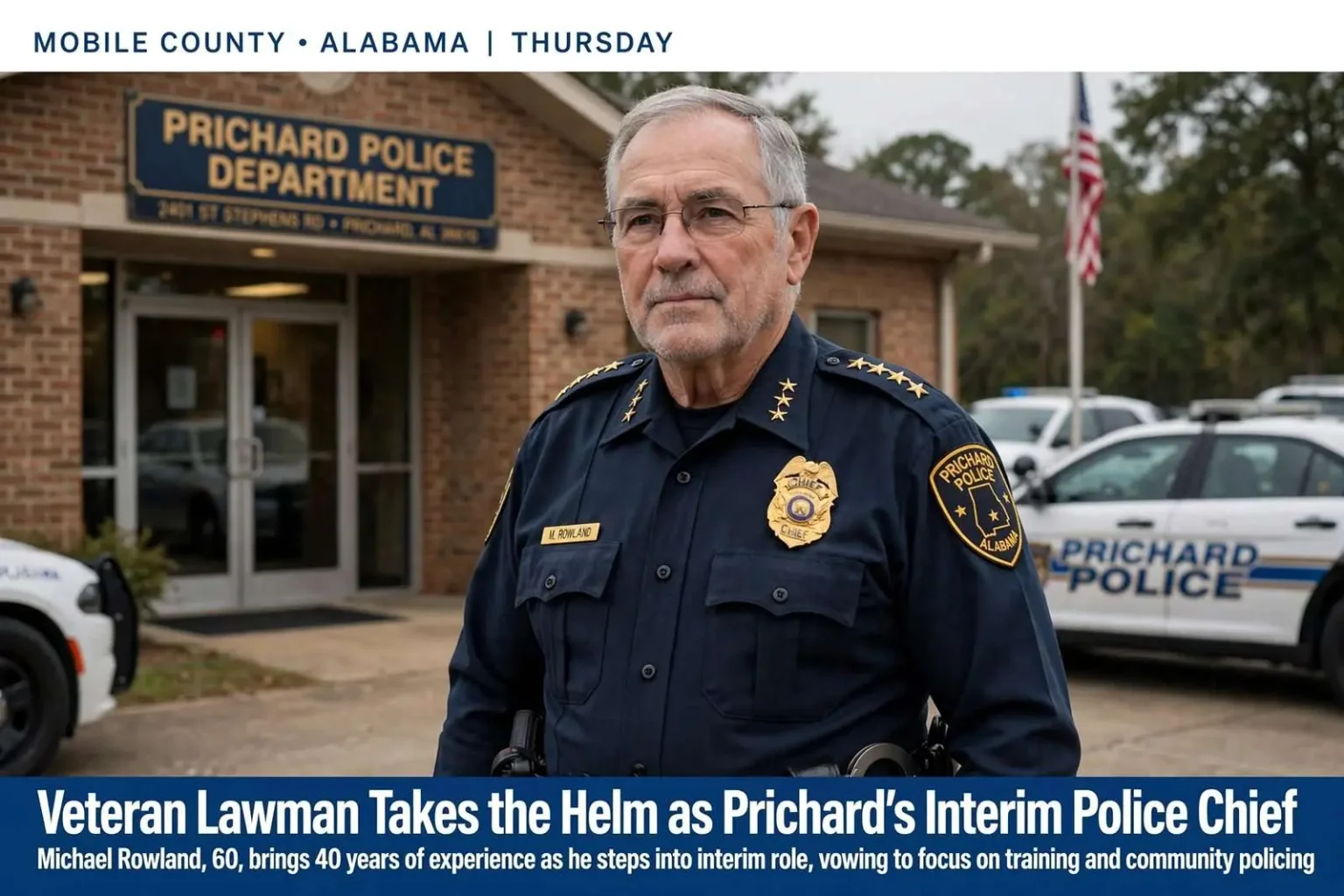
Prichard’s newest top law enforcement officer arrived with four decades of police experience, most recently as the chief of police in Bay Minette. Michael Rowland, 60, a graduate of Vigor High School, took over as the city’s interim police chief, saying he felt a “vested interest” in Prichard and its future. Rowland assumed the post on Thursday, following the resignation of former Chief Jerry Speziale. He said he was eager to serve, though he was careful not to predict how long the assignment would last.
The appointment put a veteran of departments across the region in charge of one of Alabama’s most chronically challenged cities. Prichard, a city of roughly 22,000 people in Mobile County’s northern corridor, has battled shrinking revenue, population loss and public safety strain for decades, and the revolving door at the police chief’s office had become a symbol of the broader instability.
Day by Day
“I will take it day by day,” Rowland said when asked whether he hoped to hold the permanent job or remain in the interim role. “The mayor and I have had many discussions over the last couple of years. We’ll see how that will go. I hope to stay here as long as possible.”
The new chief said he intended to re-evaluate some of the policing methods put in place by his predecessor and to place a stronger emphasis on officer training. “Training is a major factor, in my belief, to reinforce a Police Department and make it the best it can be,” Rowland said. “A lot of training will go on as I’m interim. I don’t know how long that will be. It’s an interim position and can change at any time. But as interim, I am the chief and will take the administrative role and help make this a better department.”
The emphasis on training reflected more than a philosophical preference. Small departments like Prichard’s often struggle to fund the recurring certifications — firearms qualification, defensive tactics, legal updates, crisis response — that larger agencies build into their calendars. For a department working through turnover and morale problems, a training push serves both as professional development and as a signal to officers that the city is investing in them.
Rowland also made clear he planned to move quickly on his own ideas. As Prichard’s interim chief, he said he intended to focus on community policing and to implement improvements without waiting for formal permanence. “We’ll move very fast,” he said. “I have some ideas I hope to integrate into the Police Department.”
Why the Interim Label Fits
Interim appointments are a familiar instrument in Alabama municipal government, and they carry both advantages and risks. A city gets an experienced hand immediately, without the months a national search requires, and without locking itself into a contract it may regret. In exchange, the department operates under a leader whose tenure — and therefore whose long-range plans — remain provisional, and officers inevitably watch the mayor’s office for signals about who will ultimately hold the job.
For Rowland, the interim label was softened by circumstances unusual for a temporary appointee: he had already retired once, held a chief’s position for seven years, and had no need to prove himself as a career move. That standing allowed him to speak about the department’s needs with the detachment of someone who had nothing to lose and the investment of someone who grew up in the community the department serves.
A Search for Stability
Both Rowland and Mayor Troy Ephriam said they wanted continuity for a department that had seen little stability in the chief’s role since Ephriam took office in 2012. After an earlier shake-up drew criticism, a blue ribbon committee headed by former Mayor A.J. Cooper was formed to lead a search, and the committee selected Speziale, a former high-ranking administrator with the New Jersey/New York Port Authority, in October 2013. Speziale, a high-profile figure who had made cameo appearances in several films and drew a television crew to Prichard earlier in the year, departed after a short tenure.
The contrast between the two men could hardly have been sharper. Speziale arrived with a national profile, media polish and ideas drawn from one of the largest port law enforcement agencies in the country; Rowland is a hometown product, a Vigor High graduate whose career was built in departments along the Mobile Bay area, including long service with the Mobile Police Department and, most recently, seven years as Bay Minette’s chief. Whether Prichard needed a showman or a steady hand was a question the city’s own recent history had effectively answered, the mayor suggested, by trying the first option.
Ephriam described the exit as disappointing but said he was not prepared to reconvene the search committee. “We will give these men and women the opportunity to figure out where we need to go next,” Ephriam said. “I think the men and women of Prichard need to know that public safety hasn’t changed. I think it’s important to remain consistent in the aftermath of what we were facing.”
The mayor’s decision to promote from outside the department but inside the region avoided both extremes that had defined the job in recent years: another national search and another outsider’s learning curve on one side, or an acting chief elevated from within a shaken department on the other. Although no final salary had been set, Ephriam said Rowland would likely be paid $85,000 a year, similar to what Speziale had earned — a figure that made the interim arrangement affordable without pretending it was a bargain.
A Long Career on the Coast
Rowland, who said he had retired before coming to Prichard, served as Bay Minette’s police chief from 2005 until November 2012, leaving after a new mayor was elected — a reminder that municipal police chiefs across Alabama serve at the pleasure of mayors and councils, and that administration changes in city hall routinely mean changes at the police department, whatever the merits of the sitting chief. He spent much of his earlier career as a member of the Mobile Police Department, the region’s largest law enforcement agency, where he rose through the ranks of a department responsible for patrolling Alabama’s third-largest city.
That background gave Rowland something Prichard’s recent leadership had lacked: familiarity with the specific geography, agencies and street-level dynamics of Mobile County. Prichard sits along the U.S. Highway 45 corridor north of Mobile, wedged between Chickasaw, Mobile and the county’s unincorporated stretches, sharing borders and crime patterns with all of them. A chief who spent decades working the same metro area arrives knowing the neighboring chiefs, the prosecutors and the patterns — an asset in a small city whose department depends on mutual aid and county cooperation.
What Prichard Is Working Against
The challenge Rowland inherits is structural as much as managerial. Prichard has spent years in and near municipal financial distress, with a tax base eroded by retail flight toward Interstate 65 and the Eastern Shore, an aging housing stock, and one of the oldest municipal pension burdens in the state. Public safety consumes the largest share of most Alabama cities’ budgets, and in Prichard that pressure is acute: a police department that must compete for trained officers against larger, better-paying neighbors while fielding one of the higher crime rates in the metro area.
Against that backdrop, the chief’s job in Prichard is less about dramatic initiatives than about retention, response times and trust. Community policing — the approach Rowland emphasized — depends on officers staying long enough to know their beats, which is precisely what turnover undermines. His promise to emphasize training and rebuild departmental morale addressed the same problem from the inside.
An Interim Role with No Timetable
Rowland was explicit that his status could change at any moment, and he made no promises about seeking the permanent appointment. That candor spared the city another round of speculation, but it also left open the question the blue ribbon committee had originally been convened to answer: who would lead the department for the long term? For now, the city had a chief with the experience to run the department and the local roots to want the job for reasons beyond a resume line.
“I feel a vested interest in Prichard and its future,” Rowland said, and for a city that has watched chiefs come and go with each turn of city politics, the word “vested” may have carried as much weight as any policy he proposed. Whether the day-by-day approach becomes a long-term tenure would depend, as he said, on how the discussions with the mayor go — and on whether a department in transition finds in its interim chief the stability it has been searching for since 2012.