‘Bridging Racial Disparity’: A Conservative Forum on Poverty Came to Mobile
U.S. Sen. Jeff Sessions, County Commissioner Juan Chastang and ADECA Director Bill Johnson headlined the Washington/Douglass Economic Forum, a Republican-sponsored think tank session on poverty and race.
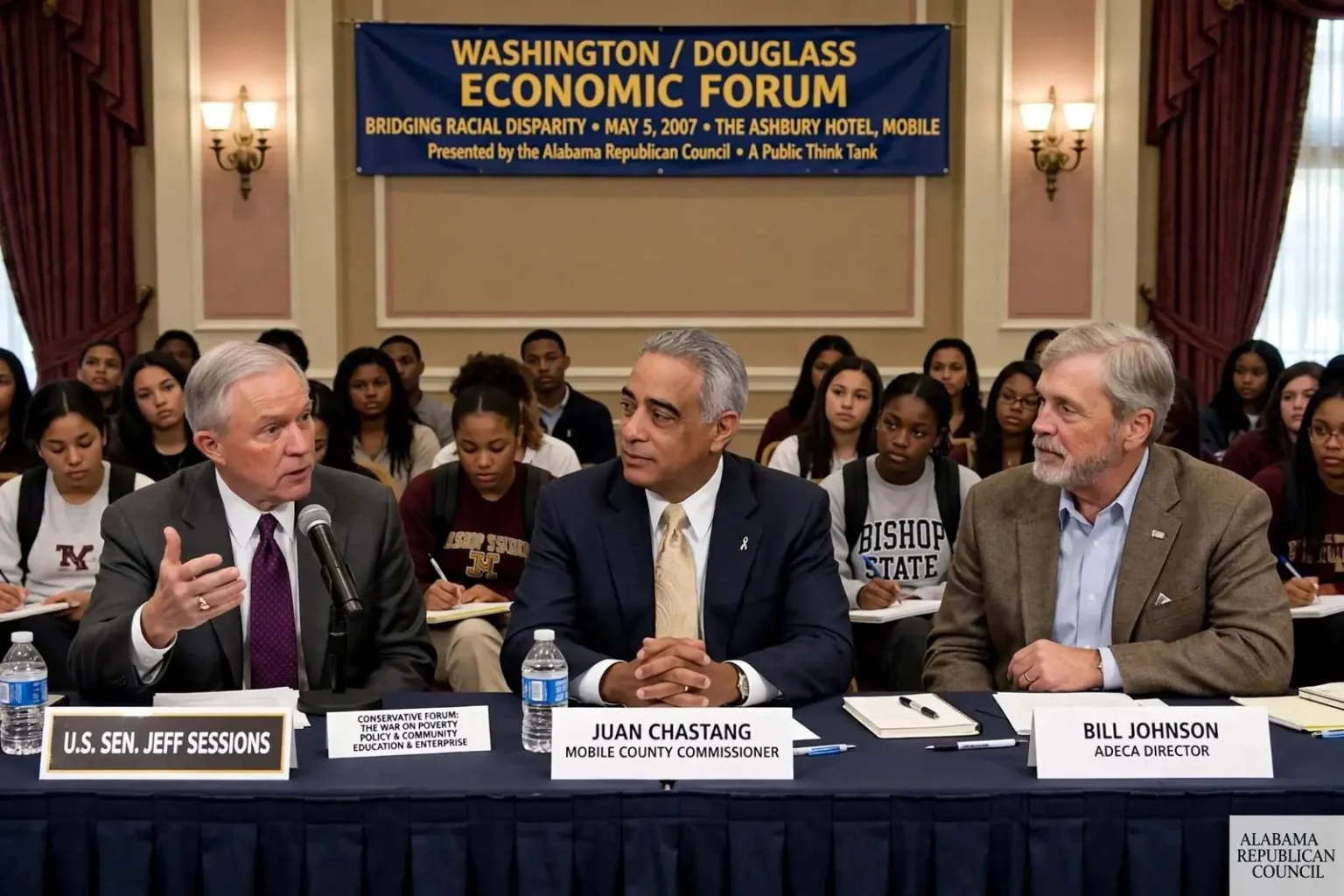
A conservative forum on poverty and racial disparity convened in Mobile, bringing a U.S. senator, a county commissioner and a state agency director to a hotel ballroom for a debate that the sponsors framed as a fresh look at an old problem. The Washington/Douglass Economic Forum opened at 9 a.m. Saturday, May 5 at the Ashbury Hotel on the beltline, under the theme “Bridging Racial Disparity.”
The program listed U.S. Sen. Jeff Sessions, Mobile County Commissioner Juan Chastang and Alabama Department of Economic and Community Affairs Director Bill Johnson, along with what organizers described as a host of elected officials, business leaders and community leaders, gathered to discuss conservative ideas and policies for what they called the “War on Poverty.” High school and college students were especially encouraged to take part in the debate about America’s future and their own role in it, a point the organizers emphasized. The forum was presented by the Alabama Republican Council as a public “think tank,” according to ARC chairman Richard Finley.
For a Saturday morning in Mobile, the lineup was unusual: a sitting United States senator, a county commissioner and the director of the state agency that moves most of Alabama’s community development money, all appearing under the banner of a minority-led Republican organization to argue about poverty. The sponsors were making a statement about who the conversation was for, and about who they hoped would be in the room when it happened.
The names in the name
The forum’s title was a deliberate act of political framing. Booker T. Washington, the founder of Tuskegee Institute in Alabama, argued that economic self-sufficiency, vocational training, property ownership and enterprise were the surest foundation for Black advancement. Frederick Douglass, the escaped slave who became the era’s most formidable orator and abolitionist, insisted on full civil and political rights as the non-negotiable starting point. Pairing the two names signaled the argument the sponsors wished to make: that the path out of poverty runs through business ownership, jobs and education rather than through government transfer programs, and that this argument has roots in Black American thought going back to the nineteenth century.
Washington and Douglass are, in that sense, shorthand for a debate that has run through American political life for more than a century — between those who emphasize building wealth and institutions within the system as it exists, and those who insist that rights and political power must come first. The Tuskegee model of industrial education that Washington championed at the turn of the twentieth century remains one of Alabama’s most significant contributions to that national argument, which gave the forum’s framing a local resonance beyond its rhetorical value.
The phrase “War on Poverty” carried its own charge. Coined for President Lyndon Johnson’s sweeping domestic program of the 1960s, it had become, in conservative usage by 2007, a shorthand for a federal effort that critics contended had spent enormous sums without dissolving the poverty it targeted. Using the phrase for a forum dedicated to conservative alternatives was the sponsors’ way of saying the first war had been lost — and that the second should be fought with different weapons.
Why Mobile
The location was not incidental. Mobile County in 2007 was a place where the disparity in question was measurable and visible. The county contained affluent neighborhoods and deeply poor ones, sometimes within a few miles of each other. Prichard, once a thriving city, was struggling with a shrinking tax base, decaying infrastructure and a municipal government under severe financial strain. Bayou La Batre was still recovering from Hurricane Katrina. Bishop State Community College, a critical rung on the ladder for many Black families in Mobile, was engulfed in a financial scandal. An honest conversation about racial disparity in Mobile County had no shortage of material.
Each of those places illustrated a different face of the problem the forum addressed. Prichard’s difficulties — erosion of its industrial and retail base, annexation battles, and the long-running pressures on its pension obligations — had made the small city north of Mobile a recurring example of municipal distress in Alabama. Bayou La Batre’s shrimp fleet and seafood processing economy had been battered by the 2005 hurricane, with rebuilding still incomplete more than a year and a half later. And the scandal at Bishop State had unsettled confidence in an institution that many families counted on as the affordable first step toward a degree.
Holding the forum in a county with that mix of wealth and want gave the speakers concrete ground to stand on. The organizers did not have to talk about poverty in the abstract; they could point across the county line, down the bay, or across town.
The politics of the invitation
The presence of Juan Chastang was notable in itself. Chastang, a Black Republican serving on the Mobile County Commission, embodied precisely the coalition the Alabama Republican Council was trying to build, and his participation gave the forum a credibility it would have lacked as an all-white panel discussing racial disparity. His seat on the three-member commission that governs Alabama’s second-largest county made him one of the most visible Black Republican officeholders in the state, and a living answer to the question of whether the party’s message could attract Black candidates and voters.
Sessions, then in his second Senate term and preparing for a re-election campaign, was among the more conservative members of the Senate. His appearance at a forum devoted to poverty and race represented an outreach effort by a party that had historically won little support from Black voters in Alabama. For decades, Black Alabamians had voted overwhelmingly Democratic at every level, and Republican campaigns had largely written off that vote; a senator lending his name to a forum on racial disparity was, at minimum, an acknowledgment that the party needed to show up in the conversation.
Bill Johnson’s role was the practical one. ADECA administers a substantial portfolio of federal and state money in Alabama, including community development block grants, workforce programs and energy assistance, the machinery through which state policy actually reaches a poor neighborhood. Whatever philosophy the forum espoused, Johnson’s agency was where the philosophy would have to be implemented — in grant formulas, workforce contracts and weatherization programs that determine which communities get help and how much.
The forum’s morning schedule also reflected the audience its sponsors wanted. By starting at 9 a.m. on a Saturday and urging high school and college students to attend, the Alabama Republican Council signaled that this was civic education as much as politics — an argument aimed at young people who would soon be voters, workers and, the sponsors hoped, entrepreneurs. Organizations that stage think-tank-style events tend to measure success not in headlines but in the room they fill, and the emphasis on students suggested the ARC was recruiting for a longer project than a single morning.
The Ashbury Hotel, on the beltline ring of commercial development well away from downtown, was itself a fitting venue: accessible from the suburbs and from the older neighborhoods of the city alike, a neutral room rather than a courthouse, a church or a party headquarters. Events about race and poverty in Mobile had traditionally been staged by churches, civic leagues and the city’s civil institutions; the ARC was deliberately positioning a Republican organization inside that public conversation.
What the forum did not promise was a plan. Conservative anti-poverty ideas — enterprise zones, school choice, ownership, work requirements in public assistance, support for minority contracting — each had track records somewhere in the country, and the speakers could be expected to make the case that those tools would serve Mobile County better than the transfer programs of the original War on Poverty. Whether any of it translated into policy was a question for the Legislature and the county commission, not the ballroom.
The stakes, in summary
What: Washington/Douglass Economic Forum, theme “Bridging Racial Disparity” — When: 9 a.m. Saturday, May 5 — Where: The Ashbury Hotel, on the beltline in Mobile — Sponsor: The Alabama Republican Council — Headliners: Sen. Jeff Sessions, Commissioner Juan Chastang, ADECA Director Bill Johnson.
Whether a Saturday morning of speeches would move anything in the neighborhoods under discussion was, as always, the harder question. Forums produce arguments, not appropriations, and the distance between a hotel ballroom and a struggling municipal budget in Prichard or a damaged shrimp dock in Bayou La Batre is measured in years of policy work. But the forum’s organizers had at least chosen to hold the conversation in a county where the stakes were plain, with a panel that included the senator, the commissioner and the agency director whose decisions would shape whatever came next.
For Mobile’s Black Republicans, the event was also a declaration of presence: an organization with a national founder’s namesake, a U.S. senator’s participation and a county commissioner’s credibility, claiming a seat at the table on the question of poverty and race — a seat they intended to keep.