Mobile Police Name Suspect in Morning Shooting on Valeria Street
Mobile police identified a 42-year-old man as the suspect in a Valeria Street shooting that sent a woman to a hospital one Tuesday morning, and asked the public for help locating him.
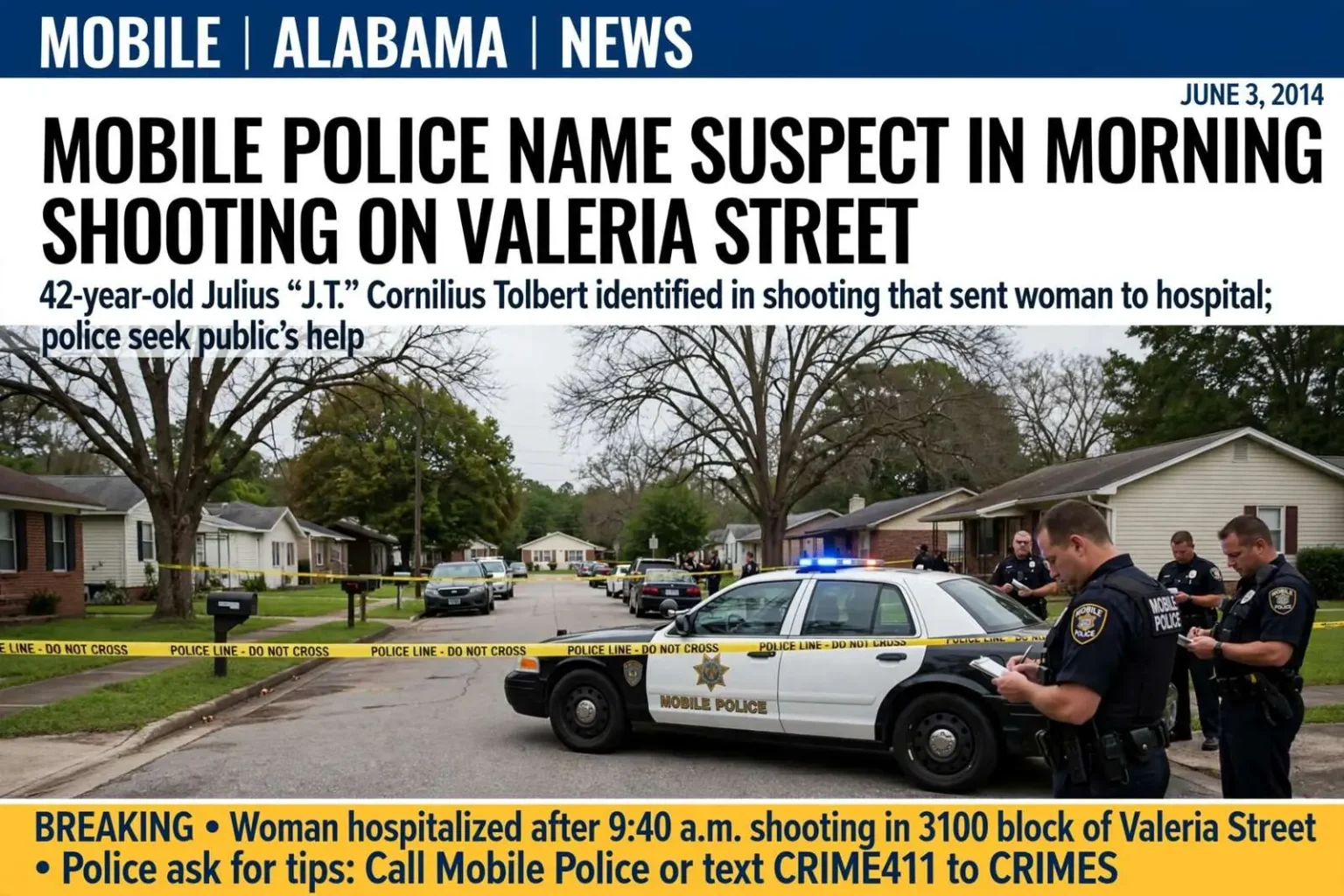
Mobile police in June 2014 identified a suspect in a morning shooting on Valeria Street that sent a woman to the hospital, and appealed to the public for help finding him. The Mobile Police Department said 42-year-old Julius “J.T.” Cornilius Tolbert was the suspect in the shooting, which unfolded on a Tuesday morning in a residential stretch of the city, and investigators asked anyone who knew where he was to come forward.
The case moved quickly from a hospital report to a named suspect, a pace that reflected both the seriousness of the injury and the department’s standard practice of enlisting the public’s help as soon as investigators have a person to look for.
How the case unfolded
According to police, officers were informed around 9:40 a.m. that a woman with a gunshot wound had arrived at Springhill Medical Center. At about the same time, the department received a report of a shooting in the 3100 block of Valeria Street. Investigators connected the two reports and, in the hours that followed, named Tolbert as the person they were seeking in the case.
The timing of the two reports — a wounded woman at the hospital and a shooting scene across the city within minutes of each other — gave detectives the threads they needed to establish where the shooting happened and who they were looking for. That kind of parallel reporting is common in morning shootings, when victims are driven to emergency rooms by family members or bystanders before officers have been called to the scene.
Police did not immediately release further details about the circumstances of the shooting or the relationship, if any, between the suspect and the woman who was wounded. Investigators held back those specifics while the case remained active, a discretion that serves both the integrity of the investigation and the privacy of the people involved.
Springhill Medical Center, in the Spring Hill neighborhood of west Mobile, is one of the city’s primary emergency facilities, and morning arrivals with gunshot wounds set in motion parallel tracks: medical staff treating the patient and detectives documenting her condition, gathering any statement she could provide and working backward from the hospital to the scene.
The neighborhood and the scene
The 3100 block of Valeria Street sits in a residential part of the city, the kind of block where a Tuesday-morning gunshot is an anomaly rather than a pattern. Officers securing the scene work the standard sequence — establishing a perimeter, looking for shell casings, canvassing for doors knocked and windows rattled, and checking whether any nearby cameras captured the moments around the shooting.
Neighbors on blocks like this one are often the investigation’s best resource. Someone was mowing a lawn, waiting for a ride or leaving for work when the shots rang out, and the accounts those residents provide — a description, a direction, a vehicle, a voice — are frequently what turns a scene into a case.
Police ask for the public’s help
The department asked anyone with information about the suspect to come forward. Residents were urged to call the Mobile Police Department or to contact Mobile Police Intel, and tipsters who preferred to stay anonymous could submit information by texting the keyword CRIME411 to the CRIMES tip line.
The text-a-tip system has become a fixture of modern policing in Mobile and departments across the country, lowering the barrier for witnesses who want to help but fear being seen doing so. Tips submitted through the line can be routed to investigators within minutes, and anonymity protections have made such systems among the most productive sources of information in suspect-location cases.
Appeals of that kind are a routine but important part of investigations in Mobile, where detectives frequently rely on tips from neighbors, witnesses and others who may have seen something to help locate a suspect quickly. A named suspect is only as useful as the information that follows; unless someone reports a sighting, an address or a vehicle, the search continues on its own timeline.
In naming Tolbert publicly, police signaled that they had developed enough information to focus their search while continuing to gather evidence. Public identification also serves a protective purpose — putting the name out ensures that anyone who encounters the suspect, including other officers, knows he is sought in connection with a shooting.
Detectives investigating a morning shooting follow a playbook that begins with the scene and the hospital simultaneously. While one team documents the block where the shots were fired, another interviews the victim’s medical team, seeks a statement from the woman herself and gathers the accounts of whoever drove her to the emergency room. Surveillance from nearby homes and businesses, canvass notes and physical evidence all feed the case file that supports the identification of a suspect.
The first hours matter most. Memories fade, vehicles move and physical evidence weathers, so departments treat the day of a shooting as the critical window. That the department had a named suspect within hours of the first report suggests the pieces came together quickly — a description, a connection to the scene or witnesses who saw enough to point investigators in one direction.
The role of public tips
The shooting was among the incidents that drew the attention of Mobile police that summer as the department worked to respond to reports of gun violence in the city’s neighborhoods. Like most cities of its size, Mobile tracks shooting incidents closely, and each case feeds the department’s understanding of where violence is occurring, what drives it and which interventions work.
Officials emphasized that identifying a suspect was a step in the process, not a conclusion, and that the case remained under investigation as they sought to bring the person responsible into custody. Between identification and arrest lies the harder work: developing probable cause through witness statements, forensic evidence and the routine legwork of detectives who spend their days reconstructing an hour of a summer morning.
For the woman who was wounded, the hours after the 9:40 a.m. report were spent in surgery and recovery while the investigation moved around her. Victims’ cooperation — when their condition allows it — often provides the most direct account of what happened, but detectives build cases that do not depend on it, knowing that hospital stays, trauma and reluctance to testify can change what a case has to rest on.
What happens when a suspect is found
Once located, a suspect named in a shooting case faces the standard sequence: arrest, booking, an initial appearance before a judge and, in felony matters, the preliminary stages that determine whether the case proceeds to a grand jury. Charges in shooting cases depend on the outcome of the victim’s injuries, the evidence of intent and the circumstances detectives document — factors that can mean the difference between an assault charge and a more serious one.
Bond conditions in such cases typically reflect the seriousness of the underlying incident, and judges routinely order no-contact provisions between defendants and victims in domestic or acquaintance shootings while a case is pending. The weeks between arrest and trial are when prosecutors and defense attorneys test the strength of the identification, the witnesses and the physical evidence.
For the residents of the Valeria Street area, the department’s public appeal was a familiar rhythm of city life: an incident, a scene, a name in the news and a request for help. Communities that experience shootings rely on that cooperation loop — the tips that flow in when residents decide to share what they know — as much as they rely on patrols and investigations.
The summer’s broader picture
The Valeria Street shooting joined the list of cases Mobile police publicized that summer, a practice that serves several purposes at once. Publicizing a suspect keeps the community informed about safety concerns, invites tips that might otherwise never arrive and documents, in real time, the department’s activity in response to violence in the neighborhoods.
Departments also know that the public’s role does not end with a single call. Witnesses who hesitate in the first days often come forward later, once a case has a name attached and the choice to help feels less open-ended. The CRIME411 text line exists precisely for that window, giving reluctant tipsters a way to contribute information without stepping into the light.
As the investigation continued, the department’s message remained the one it delivers in every such case: the identification of Julius “J.T.” Cornilius Tolbert was an invitation — to anyone who knew where he was, who had seen the shooting or who held a piece of the morning’s story — to pick up the phone or send a text, and help close the case that began with a wounded woman at Springhill Medical Center and a report from the 3100 block of Valeria Street.