
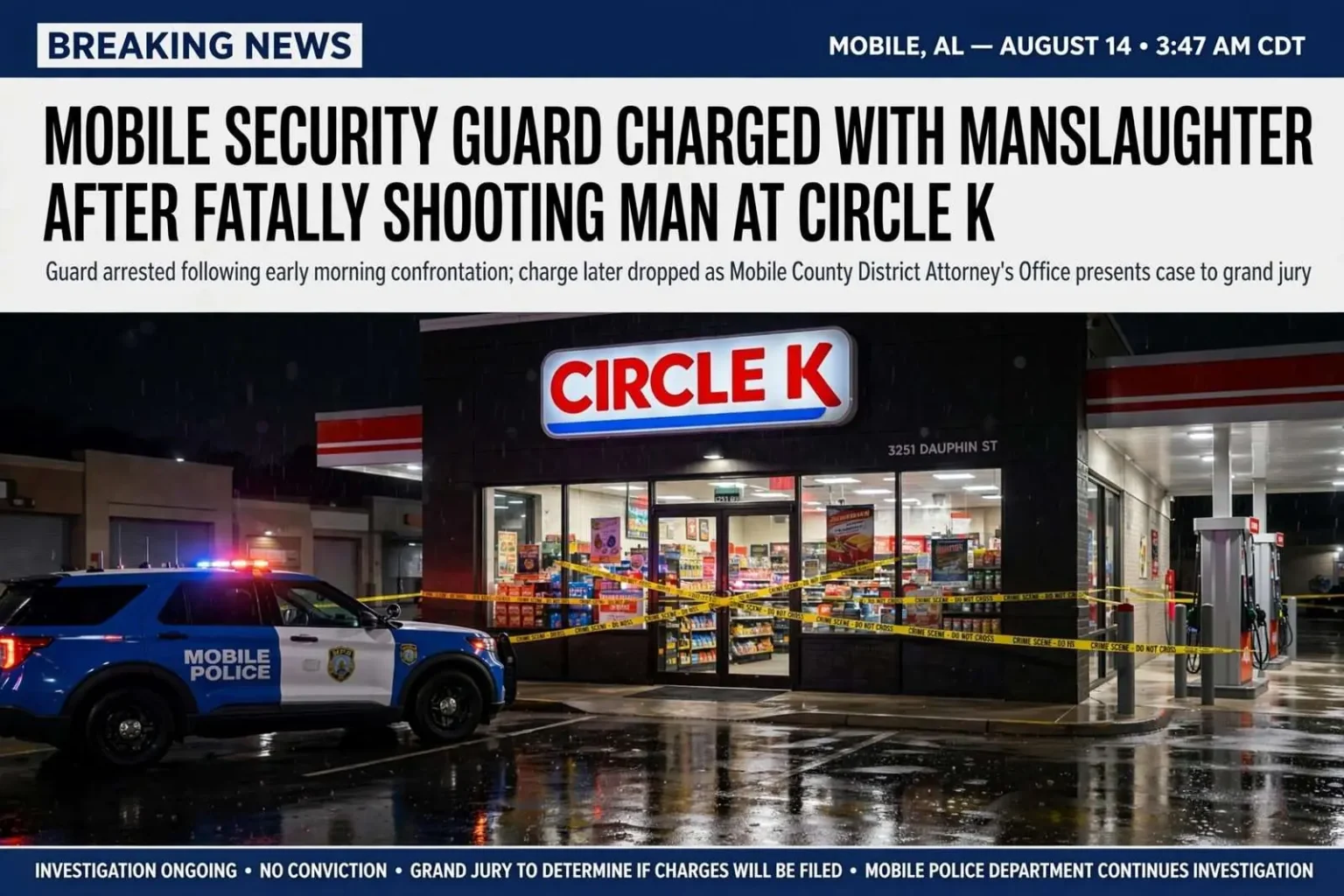
A security guard has been arrested and charged with manslaughter in connection with the death of a man he shot at a Mobile gas station early Friday morning, according to the Mobile Police Department. The shooting and the rapid arrest that followed opened a case that has since shifted direction more than once, illustrating how the earliest charges in a police shooting investigation can change as the evidence develops.
Police said a man entered the Circle K located at 3251 Dauphin Street at approximately 3:47 a.m. Friday, Aug. 14. Investigators believe the man assaulted the security guard, identified as 42-year-old William Weemes, and that Weemes then shot him.
The injured man was taken to a local hospital, where he later died from his injuries. The stretch of Dauphin Street where the shooting occurred sits in west Mobile, a corridor of commercial strips, restaurants and late-night businesses where security staff are a routine presence after dark. Convenience stores operating around the clock rely on guards and cameras as a frontline defense during the overnight hours, when robberies and confrontations are statistically most likely.
Weemes was initially arrested and charged with manslaughter in the shooting. Mobile police have not released additional details about the circumstances leading up to the confrontation, leaving open the central questions in the case: the nature of the assault, the moments before the shot was fired, and where the line falls between self-defense and criminal conduct under Alabama law.
The case had initially been reported by police as an active murder investigation with a suspect at large before Weemes’ arrest and the manslaughter charge were announced. That sequence — an at-large suspect alert followed within hours by an arrest — indicates how quickly investigators identified and located the guard once they pieced together the scene at the store.
Update: Victim Identified, Manslaughter Charge Dropped
Mobile Police have since released the identity of the man who was killed, identifying him as 48-year-old Reginald Whitehead. The manslaughter charge against Weemes has since been dropped, according to police.
The dropping of the charge does not end the case. Mobile County District Attorney Keith Blackwood said the case will instead be presented to a grand jury, which will determine whether any charges should be pursued.
Manslaughter under Alabama law covers killings that fall short of murder — deaths caused recklessly or under circumstances where the actor did not intend to kill but engaged in conduct that created a substantial risk. The charge’s selection by investigators, rather than murder, signaled that the early evidence suggested a confrontation that escalated rather than a premeditated act. The later decision to drop the charge and take the case to a grand jury means prosecutors and investigators have continued to weigh that evidence as more of it has come in.
How a Grand Jury Decision Works
The grand jury occupies a distinct place in Alabama’s criminal process. Unlike a trial jury, which decides guilt, a grand jury hears the evidence prosecutors assemble and decides whether there is probable cause to formally charge someone with a crime. Its proceedings are conducted in secret: the suspect and his attorney do not appear before it, witnesses testify behind closed doors, and the panel’s deliberations are not public.
That structure gives the grand jury a dual role in a case like this one. It shields a person who may have acted lawfully from the burden of a trial when the evidence does not support a charge, and it also shields prosecutors from the appearance of favoritism when a decision goes either way in a controversial shooting. When the panel returns a no-bill — a decision not to indict — the case is over unless new evidence emerges. If it returns an indictment, the case proceeds like any other criminal prosecution.
In shootings involving security guards, the legal analysis typically centers on Alabama’s self-defense statutes, including the provisions governing the use of deadly physical force in response to a threat of death or serious physical injury. Guards occupy a particular niche in that framework: they are private citizens with a security role, not police officers, and the law evaluates their use of force against the circumstances they reasonably perceived at the moment they acted.
The sequence of events investigators have outlined so far — an assault on the guard, followed by the shooting — sits at the center of that analysis. Evidence that will matter includes the store’s surveillance footage, physical evidence from the scene, the autopsy results, and witness accounts of the confrontation.
The Presumption of Innocence
No one has been convicted of a crime in connection with Whitehead’s death, and the grand jury process exists to determine whether formal charges are warranted.
That principle matters in a case that has already moved through two legal postures — a manslaughter arrest and then the dropping of that charge pending grand jury review. An arrest, prosecutors and defense attorneys alike stress, is the beginning of the process, not a finding of guilt. The dropping of a charge is likewise not a finding of innocence. The grand jury will have the final word on whether the criminal process continues.
Grand juries in Mobile County convene on a regular schedule and review a wide range of felony cases, from routine indictments to contested shootings. In officer- and guard-involved cases, District Attorney offices across Alabama have increasingly used the grand jury as the decision point precisely because the stakes and the public attention demand a process that stands apart from the charging decisions made in the immediate aftermath of an incident. The panel hears from investigators, reviews the physical evidence and autopsy findings, and can ask questions of the witnesses who appear before it.
About the Mobile Police Department
The Mobile Police Department (MPD) is the law enforcement agency responsible for policing Alabama’s third-largest city. MPD investigates crimes ranging from property offenses to violent felonies, and it routinely asks members of the public to share tips that may aid an investigation.
The department’s jurisdiction covers a city of roughly 185,000 residents spread across neighborhoods from downtown and the historic districts to the western corridors like Dauphin Street, where the shooting occurred. Homicide investigations in Mobile are handled by specialized detectives who work the scene, the autopsy and the canvass for witnesses, with the department’s public affairs office serving as the channel for information released to the media.
The department works alongside the Mobile County District Attorney’s Office, which prosecutes state criminal cases, and with state and federal agencies on matters that cross jurisdictional lines. Residents can report non-emergency information through the department’s tip line and through national crime-reporting programs.
Security Guards and Late-Night Retail
The case has drawn attention to the role armed security guards play at late-night businesses across Mobile. Convenience stores, clubs and restaurants that operate through the overnight hours contract with guard services to deter theft and protect staff, and confrontations between guards and aggressive customers or suspects are an occupational reality of that work.
Alabama requires security guards working in an armed capacity to meet training and licensing requirements, but the law does not grant guards the same authority or protections as sworn officers. Every use of force by a guard is judged against the same standard that applies to any private citizen, which is why cases like the Dauphin Street shooting go to a grand jury rather than being resolved at the arrest stage.
For the businesses along Dauphin Street and similar corridors, the outcome of the case will be watched as a marker for how these confrontations are legally evaluated. Store operators weigh the presence of armed guards against the risks of both crime and liability, and cases that test the boundaries of self-defense law feed directly into those calculations.
What Comes Next
The case now moves to the grand jury session where District Attorney Blackwood’s office will present the evidence. Neither the police department nor the District Attorney’s office has announced a timeline for that presentation, and grand jury outcomes in Mobile County are typically announced when the panel completes its review of a case.
Until then, the facts as publicly known remain limited: a confrontation at 3:47 a.m. at the Circle K at 3251 Dauphin Street, an assault on the guard, a gunshot, the death of Reginald Whitehead at a local hospital, an arrest that was later set aside, and a secret room of citizens who will now decide whether the criminal process continues. Anyone with information about the incident can contact the Mobile Police Department or submit an anonymous tip through established crime-reporting channels.
The Dauphin Street corridor itself tells the story of west Mobile’s commercial geography — a long artery of retail and dining stretching west from the downtown grid, dense with the kind of businesses that stay open late and depend on lighting, cameras and security personnel to get through the overnight shift safely. Incidents at any one location ripple through the corridor’s business community, where operators share concerns about crime, response times and the costs of protecting staff and property in the hours between midnight and dawn.


