Mobile Mayor Says Retreat of Alabama Mayors Could Forge a ‘Single Voice’
Mobile Mayor Sandy Stimpson said a two-day retreat of five of Alabama's largest cities, hosted at his family lodge near Jackson, could help mayors speak with a single voice to state leaders.
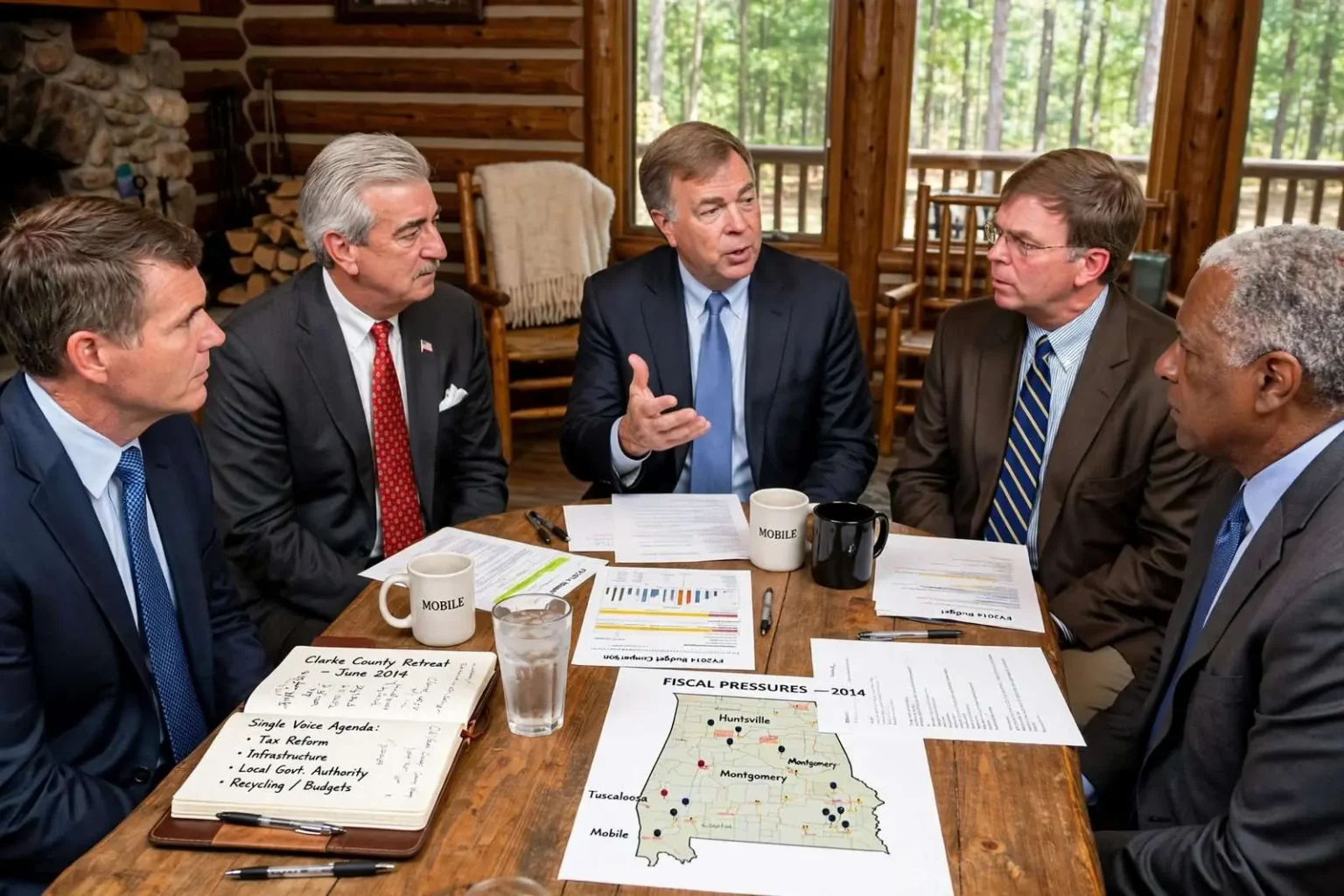
Mobile Mayor Sandy Stimpson told the Mobile City Council in June 2014 that a two-day retreat of mayors from five of Alabama’s largest cities could help forge what he called a “single voice” on municipal issues for the state. The gathering, which Stimpson hosted at his family lodge in Clarke County near Jackson, had concluded that Monday. Speaking during Tuesday’s council meeting, the mayor said the meeting could build relationships useful in addressing matters of municipal importance before the Alabama Legislature and the governor’s office.
The idea of Alabama’s big-city mayors moving as a bloc carries real weight in a state where municipal interests have historically competed with one another for legislative attention. Birmingham, Huntsville, Mobile, Montgomery and Tuscaloosa anchor the state’s four corners and its center, and their delegations in Montgomery are among the most influential in the Statehouse. A coordinated agenda from the five mayors — on tax reform, infrastructure or local governance authority — would give those delegations a common request rather than five separate ones.
Building a Coalition
“I think you’ll see us get together as a single voice to address our governor and legislature,” Stimpson said. “The potential outcome of this is a very healthy situation that is being created for Mobile and across the state.” The retreat drew the mayors of Birmingham, Huntsville, Mobile, Montgomery and Tuscaloosa. Participants included Stimpson, Mayor William Bell of Birmingham, Mayor Tommy Battle of Huntsville, Mayor Todd Strange of Montgomery and Mayor Walt Maddox of Tuscaloosa, along with the chiefs of staff and finance directors from each city. It opened at 3 p.m. Sunday and concluded at 11 a.m. Monday — a working session rather than a ceremonial summit, with the staff contingents handling the sort of detail work that makes follow-up meetings productive.
The guest list itself says something about the moment. Bell, Battle, Strange and Maddox were each seasoned executives of cities facing the same structural budget pressures, and each brought a finance director whose spreadsheets told a version of the same story. Stimpson, elected in 2013 in his first campaign for the office, was the newcomer of the group, and hosting the retreat on family ground in Clarke County gave the first-term mayor a chance to convene his more senior counterparts on neutral, informal territory.
Sharing Best Practices
The mayors framed the meeting as a chance to trade solutions to shared challenges. “From balancing budgets in the era of flat-line revenues to growing our local economies, mayors of Alabama’s major cities are implementing innovative solutions,” Maddox said in a statement. “It is essential to share these best practices as we improve the quality of life for our respective communities.” Battle struck a similar note. “Moving Alabama forward requires teamwork, and we need leaders who are willing to work together and focus on the big picture,” he said. “Mayors are on the front lines for their citizens.” The officials also exchanged policy ideas on administrative matters such as recycling.
The “flat-line revenues” Maddox described was the defining fiscal reality of Alabama cities in that period. General fund revenues built on sales and property taxes had recovered slowly from the recession while costs kept climbing, forcing cities to trim services, delay capital projects and hunt for efficiencies. Recycling was one practical, comparable arena where the five cities’ programs varied enough to make comparison useful — what worked in a city the size of Huntsville could inform what Birmingham, Mobile and Montgomery attempted with their own collection systems.
A Recurring Gathering
The Clarke County session followed an initial meeting of the same five mayors at the location in January, and a third retreat was tentatively planned for September in Montgomery. Among the staff members taking part were Chief of Staff Colby Cooper and Finance Director Paul Wesch from Mobile, along with counterparts from the other four cities. Officials emphasized that the mayors paid their own travel expenses and that the retreat was held consistent with Alabama’s ethics guidelines for municipal officials, according to the city of Mobile.
That attention to ethics guidelines reflects how closely such gatherings get scrutinized in a state where the ethics law places strict limits on things of value passing between officials and private interests. Paying their own way kept the retreat outside the gift rules entirely, and the decision to rotate future sessions — Montgomery’s turn in September — suggests the group intended to survive as a working body rather than a one-time photo opportunity. Two retreats in one year at the same lodge, with a third already scheduled, marks an unusually regular cadence for Alabama mayors whose calendars rarely align.
The choice of venue — a family lodge near Jackson in Clarke County, more than an hour’s drive north of Mobile — also set the tone. Removed from any of the five city halls, the setting put the mayors at the same table for an evening and a morning, with staff in the room. Retreats of that shape succeed or fail on whether the conversation produces a working agenda, and both Stimpson’s public account and his counterparts’ statements suggest the group found common ground in the budget arithmetic all five faced.
Stimpson’s First Year and the Big-City Agenda
For Stimpson, still in his first year leading Mobile, the retreat reflected an effort to raise the collective profile of Alabama’s largest cities in a state capital where their interests did not always align. By convening his counterparts on his home turf near Jackson, the mayor sought to turn shared frustrations over budgets and infrastructure into a coordinated push at the Statehouse.
The timing was pointed. Stimpson had taken office in late 2013 after defeating an incumbent mayor, inheriting a city government facing budget gaps and an infrastructure backlog, and his first year was devoted to reorganizing the administration and stabilizing the budget. A coalition of the five largest cities offered leverage no single city could generate: on proposals that would shift costs onto municipalities, on local governing authority, and on state support for infrastructure that every major city needed but none could fund alone.
The mayors’ collective weight is easy to underestimate until the numbers are laid out. The five cities represent the state’s major population and economic centers — the port, the auto industry, the aerospace cluster, the state government itself and the university. When their agendas align in Montgomery, committees notice. When they split, municipal interests tend to lose to rural and suburban priorities that are more consistently organized in the Legislature.
Whether the “single voice” Stimpson predicted actually materialized would depend on the sessions that followed — the September retreat in Montgomery first among them. But the Clarke County meeting established the structure: five mayors, their chiefs of staff and finance directors, a shared set of fiscal pressures, and an agreement to keep meeting. For Mobile, the meeting placed its new mayor at the center of that structure rather than on its edge, which for a first-term executive building relationships across the state may have been the retreat’s most valuable product.
The Fiscal Landscape Behind the Retreat
To understand what five mayors had to talk about, it helps to look at the budget books each of them carried into the lodge. Alabama’s constitutional structure limits local taxing flexibility — property tax rates in particular are among the lowest in the nation and require legislative or voter approval to change — which leaves cities leaning heavily on sales taxes and fees. When sales tax growth stalls, there is little else to pull. The result across the five cities was the same story with different numbers: pension and personnel costs rising faster than revenue, capital needs accumulating, and service levels defended one budget line at a time.
Those pressures gave the retreat’s best-practices discussion its practical edge. A shared conversation about contracting models, fleet management, health insurance pools or recycling collection was not abstract policy talk — each percentage point of efficiency translated into police officers, street resurfacing or park maintenance in all five budgets simultaneously. Finance directors comparing notes could identify which experiments in one city were worth copying and which had already failed at somebody else’s expense.
The coalition also had a defensive function. Proposals in the Legislature periodically surfaced that would shift costs to municipalities or preempt local ordinances, and big-city agendas could be defeated one by one when the mayors negotiated separately. A unified front, backed by the delegations that all five cities command, raised the cost of treating municipal interests as an afterthought in the state budget process.
Relationships as Infrastructure
Stimpson’s emphasis on relationships pointed to a working style that would define his approach in Montgomery for years: deals in Alabama’s capital are made between people who know and trust each other, and a first-term mayor needed a seat at those tables. Convening Bell, Battle, Strange and Maddox at the family lodge — cooking the meals, keeping the schedule loose, letting the staff compare spreadsheets in the afternoon — was the fastest available route to becoming a peer among the state’s most established mayors rather than the newcomer asking for support.
The retreat model borrowed something from the way Alabama’s business leadership has long worked its own agenda in Montgomery, where aligned interests present the Legislature with a single negotiated position. Whether mayors can replicate that discipline across five cities with five political calendars is the standing question, but the Clarke County session and the September follow-up planned for Montgomery gave the idea its first real test. For Mobile — the city whose interests Stimpson had promised to carry — the gathering meant that the state’s fifth-largest city’s new mayor had, at least for two days, made it the host city of Alabama’s municipal agenda.