Stimpson Puts the Pay-Raise Question in His Department Heads’ Hands as Mobile Shapes Its 2015 Budget
Mayor Sandy Stimpson said the size of Mobile employees' 2015 pay raise would depend on what department heads build into their budgets, while he prepared a citywide plan to attack blight.
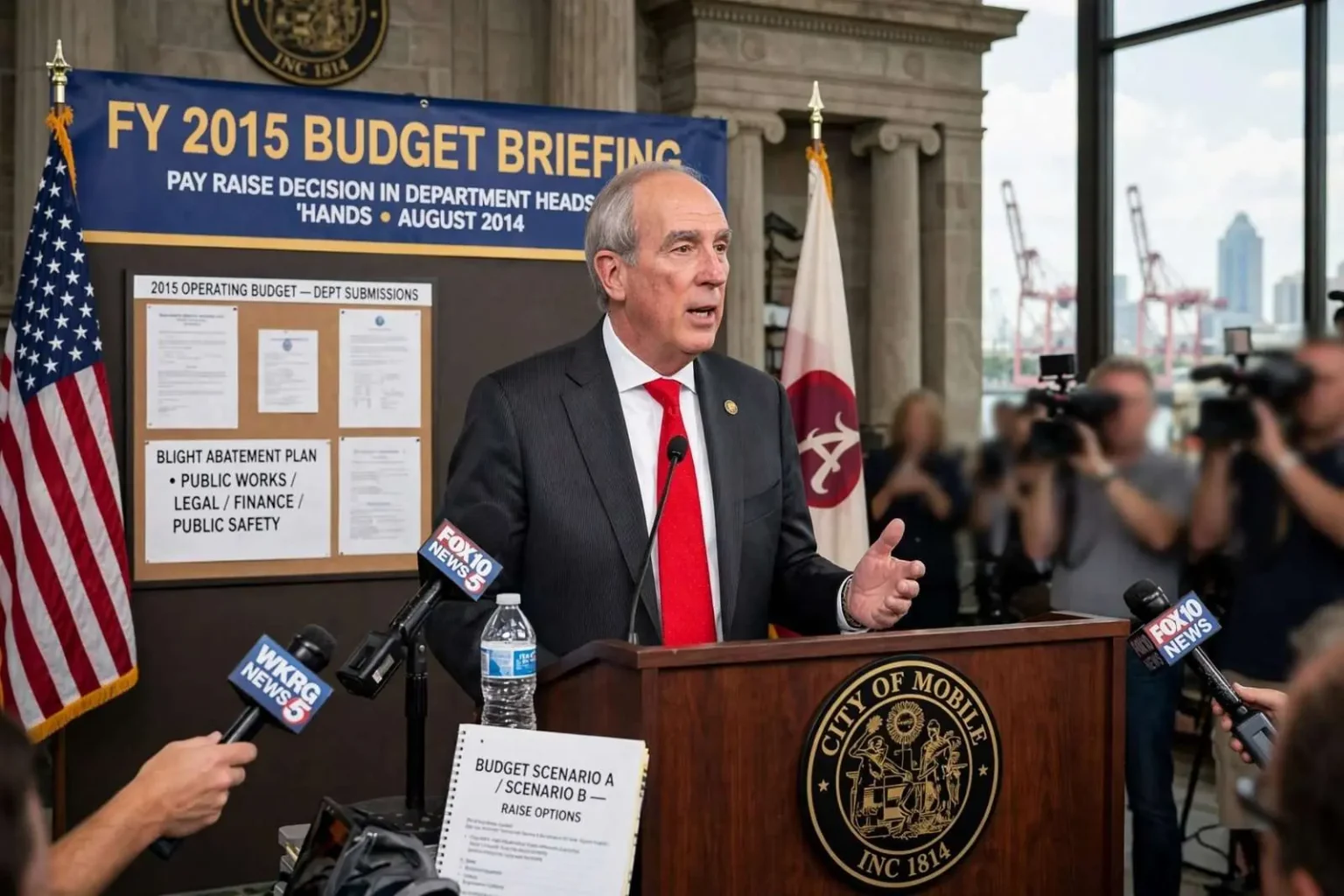
As Mobile’s department heads negotiated their fiscal year 2015 budgets with the administration, Mayor Sandy Stimpson made clear that the size of any pay raise for city employees would hinge largely on the choices those managers made.
On the surface, the approach looked like hardball. Speaking on consecutive days, Stimpson said it would be up to department heads to determine how much of a raise employees received in the budget year beginning Oct. 1. He affirmed that he intended to grant a raise; what remained unsettled was the amount.
The fiscal year 2015 budget was the second full spending plan of Stimpson’s term, and the mayor’s team had spent its first year cataloging what it described as years of structural imbalance — budgets that had been balanced with reserve draws and one-time revenues rather than recurring cuts. Against that backdrop, a raise for city employees, who had gone years without a general pay increase, was both a promise the administration was reluctant to break and a recurring expense it could not responsibly ignore. The device of making department heads bid for it by trimming their own requests was a way of testing which cuts were real.
Two possible raises
Stimpson described two scenarios, one a set figure and the other potentially twice as large. “It will be contingent upon what department heads turn their budgets in,” the mayor said, adding that even after submissions there would be room to keep negotiating. “When they turn them back in, there is nothing against us going back to them.”
The administration, he emphasized, wanted to offer the higher raise. “That’s the desire of the administration,” Stimpson said. “We can’t do it unless the money is there.” In effect, the mayor placed the ball in his managers’ court, tying the reward for employees to disciplined budgeting across departments.
The structure also shifted the politics. A department head who resisted cuts was no longer negotiating with the mayor alone; he was explaining to his own employees why the larger raise did not happen. City Hall veterans read the move as a management lesson as much as a budget one — Stimpson, a former corporate executive, had spent a career tying bonuses to unit performance, and the raise framework reproduced that logic inside a government.
For rank-and-file employees, the two scenarios meant a summer of uncertainty that would not resolve until the council adopted the budget in September. Public safety unions, which negotiate separately and had their own wage schedules, watched the general-fund exercise closely, since the administration’s read on available money would frame every negotiation that followed.
Turning to blight
With litter and tall grass already addressed, Stimpson said he wanted his administration to focus next on blighted properties, calling the issue a top priority. “Blight is the biggest cancer any community has,” he said.
The mayor said the administration had spent five to six months discussing how to tackle the problem, which he described as very difficult. He anticipated rolling out a comprehensive plan soon. “We are on the threshold of rolling out a blight plan,” Stimpson said, describing an effort that would span Finance, Public Works, Legal and Public Safety. He suggested the plan would require public education and might eventually call for new legislation.
The four-department scope reflected why blight had defeated previous administrations. A single derelict property can touch the city’s code enforcement officers, its legal department’s condemnation docket, Public Works’ mowing and demolition crews and, when the property becomes a crime scene, its police. Mobile’s housing stock — with thousands of structures built before World War II and a tax-delinquency pipeline that ran years behind — meant the problem was measured in thousands of properties, not dozens.
The mention of possible new legislation pointed toward Montgomery. Alabama’s municipal abatement and condemnation statutes had long been criticized by city officials as slow and lender-friendly, and any serious tightening — expedited hearings, clearer receivership authority, or a functioning land bank — would require the legislative delegation’s help.
A councilman’s doubts about the I-10 bike path
Meanwhile, Councilman John Williams voiced skepticism about the bicycle and pedestrian facilities planned for the Interstate 10 bridge project over the Mobile River. He was the only council member to vote against a resolution supporting the features.
Williams predicted sparse use. “I’m going out on a stretch here that one person a month will use it on average,” he said, doubting many would cross the span in winter. Bicycling advocates countered that hundreds of thousands could use the path, and some argued the feature could become a tourist draw.
The dispute put Mobile at the center of a national argument about infrastructure. Modern bridge replacements in other cities — Portland’s Tilikum Crossing, the paths added to New York’s bridges — had turned dedicated bike and pedestrian spans into commuter routes and attractions alike. Advocates argued that Mobile’s version, connecting downtown to the eastern shore communities at the top of Mobile Bay, could one day anchor the same kind of network, and that a bridge built without the facilities would lock the region out of that possibility for the structure’s entire life.
Williams said he supported bike paths generally and wanted to extend them toward Mississippi and Baldwin County. His concern was the location. He noted the bridge deck would sit higher than a 10-story building. “A casual guy is not going to get into a bike with a basket and a dog and go across it,” he said. Advocates maintained that riders of all skill levels would use the facilities.
The grade was the crux of the disagreement. A bridge deck high enough to clear the river’s shipping channel — the same traffic of container ships and bulk carriers that makes the port Mobile’s economic engine — requires long, steady climbs on both approaches. Casual riders, the kind the resolution’s critics imagined on a Sunday outing, do face real limits on grades like that. The advocates’ answer was that utility riders on e-assist bikes and tourists on rental fleets would fill the gap, a prediction that could not be tested until the span actually opened.
A conversation on race
Stimpson also planned to join a representative of Mobile United to announce an initiative for a community conversation on race relations. The announcement was set for the Mobile United courtyard on St. Joseph Street.
The effort followed a divisive spring dispute over whether former Mayor Sam Jones should be added to the board of the Mobile Area Water and Sewer System. Jones was ultimately appointed after Stimpson urged the council to back the nomination from Councilman Fred Richardson. The vote had split the council, and the debate spilled onto social media, underscoring why civic leaders felt a broader conversation was warranted.
The water board fight was, on its surface, about one seat — but the utility’s history gave it weight. MAWSS serves a customer base that is majority Black on both sides of the bay’s western tributaries, and its management had been a recurring flashpoint in Mobile’s politics for a generation. Jones, the city’s second Black mayor, brought both a resume and a symbolism that made his nomination a proxy fight for larger questions about who governs the utility and how.
Mobile United, the civic group that had convened similar dialogues across decades, offered the venue and the format: not a hearing with speakers and a gavel, but moderated tables where residents talk across the lines that usually separate them. Whether such conversations change policy is always the skeptics’ question. The city’s answer, in a spring when a water board seat had divided the council and filled its social media feeds, was that the alternative had been tried and had not gone well.
Together, the threads of the week captured a City Hall balancing fiscal restraint, neighborhood revitalization, infrastructure debates and the harder work of community trust.
The raise question carried a particular weight in 2015 because of who had left. The city had spent the previous several years watching experienced employees — police officers, engineering staff, inspectors — depart for neighboring governments and private firms that paid more, and department heads had flagged the attrition in nearly every budget submission. A raise, the administration acknowledged privately, was not generosity; it was retention, and every trained officer who left for a suburban department took the city’s recruiting investment with him. That arithmetic is what kept the larger of the two scenarios on the table even while the mayor preached discipline.
Department heads, meanwhile, faced their own test in the exercise. The mayor’s framework effectively asked each of them to find the raise inside their own budgets — to distinguish the programs that were obligations from the ones that were habits. Some managers arrived at the negotiations with cut lists already prepared; others defended their requests and accepted the smaller scenario as the price. Either way, the process gave the administration something the previous years’ budgets had lacked: a manager-by-manager map of what city government believed it could not live without.
The blight plan, when it arrived, would become the administration’s signature domestic policy, and the mayor’s “cancer” framing was deliberate. Derelict properties drag down the assessed value of every house on the block, depress the tax base the city depends on, and — the public safety argument — shelter the activity that fills the police blotter. Stimpson had concluded that no single department could fix it, which is why the plan reached across four of them at once, and why he was already telling audiences that the city could not litigate or mow its way out alone.