Erwin Rolls Out the Heavy Artillery: A Host List That Reads Like Mobile’s Political Rolodex
Mark Erwin's district attorney campaign assembled a fundraising host list spanning ex-congressmen, former mayors, sitting legislators and both parties, aiming to raise roughly $70,000 in two hours.
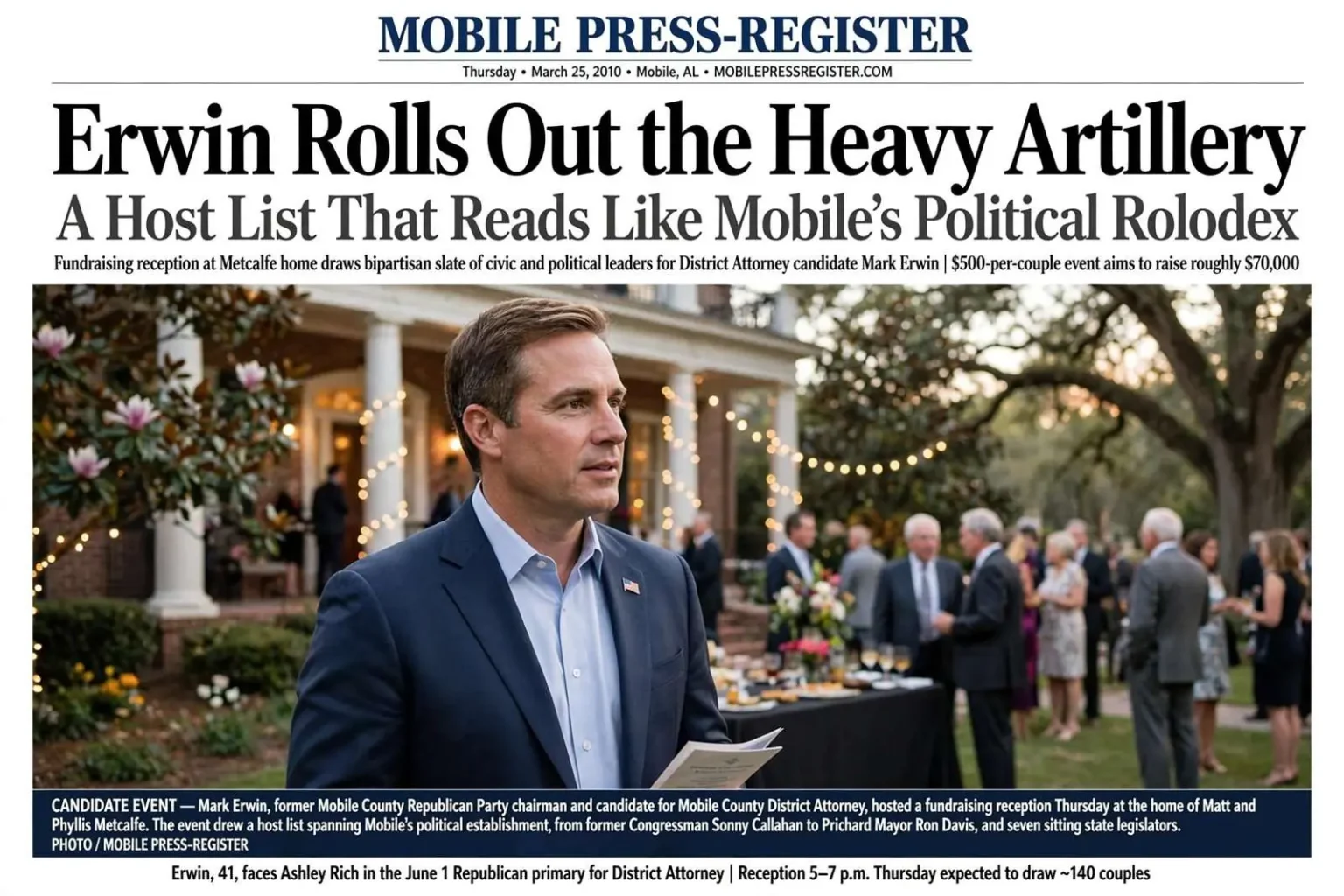
Mark Erwin will bring out the heavy artillery in his Republican campaign for Mobile County district attorney on Thursday, March 25, with a fundraising reception at the home of Matt and Phyllis Metcalfe. The reception runs from 5 to 7 p.m. At a requested contribution of $500 per couple, it should raise roughly $70,000.
Fundraisers are judged less by the money than by the names on the invitation, and Erwin’s host list stretched across the whole width of Mobile’s political landscape — and, notably, across party lines. It ranged from former congressman Sonny Callahan to Washington lobbyist Palmer Hamilton; from former Mobile Mayor Mike Dow to former City Councilwoman Bess Rich; from Mobile County License Commissioner Kim Hastie to Prichard Mayor Ron Davis, a retired Mobile County sheriff’s deputy.
Consider what that first tier of names represents. Sonny Callahan spent nearly two decades in Congress representing southwest Alabama and remains, years after leaving Washington, one of the most widely respected figures in the region’s politics; his name on a host list opens doors in every corner of the county. Mike Dow led the city of Mobile through its celebrated downtown renaissance and still commands the loyalty of the business community that reshaped Dauphin Street. Bess Rich has won more citywide votes than almost anyone in Mobile’s history. Kim Hastie holds a countywide office; Ron Davis runs Prichard, the county’s second-largest municipality. And Palmer Hamilton connects the whole apparatus to the state’s congressional delegation and Washington lobbying circles. Each of these names brings its own network, and networks are what a host list is actually for.
It included sitting legislators — among them Jim Barton, Spencer Collier, Chad Fincher, Victor Gaston, Rusty Glover, Jamie Ison and Randy Davis — along with County Commissioners Connie Hudson and Stephen Nodine, former Lt. Gov. Steve Windom, Gen. Gary Cooper, and a long roll of Mobile’s business and legal establishment: Maisel, Morrissette, Stimpson, Wesch, McDonald, Peebles, Mims, Bolt, Butler and dozens more.
The legislative names deserve their own accounting. Seven sitting state legislators from the Mobile County delegation — Republicans and conservative Democrats who together represent most of the county’s districts — lent their names to the event, which means the invitation reached every parish-pump political network from Citronelle to Grand Bay. Add two county commissioners, the former lieutenant governor and president of the Alabama Senate, a retired general whose family name is woven into the city’s history, and the attorneys and businessmen whose firms anchor downtown, and the list stops being a guest roster and becomes a directory of the county’s civic leadership. Spring 2010’s Mobilian of consequence — whatever party, whatever faction — is on this invitation.
Read as a document, the list is a map of who mattered in Mobile County in the spring of 2010, and of how thoroughly the county’s civic leadership had consolidated behind the Republican primary as the contest that would decide the office. With no Democrat in the field, the establishment’s logic was simple: the June 1 Republican primary is the election, and a serious candidate for district attorney needs to be measured against it — in money, in names, in visible momentum.
The arithmetic of the evening matches the ambition. Three hours at $500 a couple, producing roughly $70,000, implies on the order of a hundred and forty couples — several hundred of the county’s most engaged donors in one front yard. For a countywide race being decided in a single primary, that is not just a solid quarter’s fundraising; it is a demonstration. Contributors give early to candidates who appear to be winning, and nothing persuades a hesitant donor faster than a host list full of names they recognize. The reception was designed to be photographed, reported and talked about — and it was.
The candidates
Erwin, 41, is a Mobile attorney and former chairman of the Mobile County Republican Party. He is running against Ashley Rich, a longtime assistant district attorney and a member of the local GOP executive committee, in the June 1 primary. Rich had recently secured the endorsement of the Mobile County Law Enforcement Association, the organization representing rank-and-file Mobile police officers — a credential of a different kind entirely.
The race was shaping into a contrast between the courtroom and the county’s political and business establishment. Erwin’s campaign ran on breadth — the fundraisers, the host lists, the institutional signatures of a candidacy that the county’s leadership had adopted as its own. Rich’s ran on depth: fourteen years inside the district attorney’s office, a trial record in the county’s worst cases, and the endorsement of the officers who investigate them. The two logics appeal to different instincts in the same electorate. The establishment argument says a district attorney must manage a large office, a budget and the county’s political relationships. The courtroom argument says the office is, at bottom, about trying cases — and that the people who see a prosecutor’s work up close have voted with their endorsement.
They are competing to succeed District Attorney John M. Tyson Jr., who is retiring after 16 years. Tyson, appointed to the office in 1994 and twice elected afterward, had become one of the most recognizable law-enforcement figures in Alabama by the end of his tenure — most recently as head of Gov. Bob Riley’s task force on illegal gambling, a post that put him in the headlines and in courtrooms across the state, and made the office he was leaving the most watched county seat on the 2010 ballot.
An open seat after sixteen years concentrates a race like nothing else. Every ambition that had waited on Tyson’s tenure — inside the office and outside it — came due at once, and the Republican primary drew the county’s rival power centers into a single contest. Erwin’s candidacy carried the county’s political and fundraising establishment; Rich’s carried the courthouse and the badge. The Metcalfe reception put the first of those on display; the association’s endorsement had already put the second on record. Between them, the two candidates offered Mobile County Republicans a choice about what the office is for, dressed as a choice about who should hold it.
The Democrats’ problem
No Democrat had announced for the office. That was a remarkable state of affairs in a county where a Democrat had held the district attorney’s post continuously since 1978, when Gov. Fob James appointed Chris Galanos to fill the vacancy created by Charlie Graddick’s election as attorney general.
Galanos, now in private practice, tried to marshal support for a comeback but ultimately concluded that Erwin and Rich had locked down too much backing for his candidacy to be viable. The party continued to search for a credible candidate, according to interim chairman Reggie Copeland Jr. The presence on Erwin’s host list of prominent Democrats — including Prichard’s mayor and figures long identified with the other party — explains a good deal about why that search was going badly. When the money, the endorsements and the establishment have all migrated to one primary, the other primary ceases to be a contest and becomes a formality.
Galanos’s conclusion carries the weight of experience. He held the office through the 1980s and knows precisely what a countywide campaign demands; if a former district attorney with his name recognition judged the field closed, it is little wonder that lesser-known Democrats stayed out. Copeland’s continued search reflected the party’s obligation to fill its ballot rather than any expectation of success.
The migration of Democratic names onto Republican host lists is the detail that historians of local politics should linger on. Ron Davis, Prichard’s mayor, was among the most prominent Democrats in the county, and his signature on Erwin’s invitation — alongside other figures long identified with the other party — signaled that even the offices Democrats might have hoped to hold through their own coalition had accepted the primary’s verdict in advance. Party affiliation in the county’s courthouse politics had become, by 2010, less a label than a habit, with alliances that crossed the partisan line freely.
What remained for the county’s Democratic organization was a thinner field elsewhere on the ballot and the memory of a three-decade hold on the prosecutor’s office. The office Galanos won in the era of Fob James and Charlie Graddick would pass, in 2010, without a Democrat on the ballot at all. That transformation, from unbroken incumbency to contested vacancy in a single generation, is the quiet story beneath every name on Erwin’s invitation.
The outcome
Ashley Rich won the June primary and became Mobile County’s district attorney, a position she would hold for years afterward. Erwin’s $70,000 reception, and the impressive list of people who lent their names to it, proved insufficient against the endorsement of the officers who work the cases. That, too, is a lesson about Mobile politics, and one worth remembering: the Rolodex is not always the electorate.
The result rewards a closer look, because the size of the establishment’s investment makes the outcome more instructive, not less. Erwin did everything a candidate with institutional backing is supposed to do: assembled a host list that read like the county’s directory, outraised his opponent, and framed the race as a choice about management and leadership. Rich countered with the one asset no fundraiser can manufacture — the standing endorsement of the Mobile County Law Enforcement Association, whose hundred and twenty members vouched for her in exactly the places a prosecutor’s reputation lives. When the ballots were counted, the officers’ word of mouth outpolled the establishment’s signature list.
There is a structural reason the courtroom argument beat the establishment argument in this particular contest. A district attorney’s election is one of the few countywide races in which a substantial block of voters has direct, daily, practical knowledge of one candidate’s work product: the police themselves. Officers talk — to their families, their neighbors, their church groups — and their verdict on a prosecutor functions as expert testimony that no advertising campaign can answer. Every voter who knows a police officer, works with one or trusts one received the same message from the same credible source. A host list, however impressive, communicates something different and weaker: that important people support a candidate, which voters have learned to distinguish from the question of whether the candidate can do the job.
The race also settled, in practice, the question of succession that Tyson’s retirement had posed. His sixteen years had fused the office to one personality — culminating in the statewide visibility of the gambling task force — and both campaigns had defined themselves in relation to that legacy. Rich, the insider, inherited the office’s own constituency and its professional self-image; Erwin offered change from outside. The primary’s verdict amounted to a vote for the office as its practitioners understood it, rather than for the county’s political class as its donors imagined it.
The broader lesson has outlasted the campaign. Mobile County’s civic establishment remains capable of consolidating behind a candidate with remarkable speed, and its endorsement still matters in most races — county commissions, legislative seats, municipal offices where institutional support maps directly onto the electorate. But the district attorney’s office belongs to a different market. Its currency is trial records, professional reputation and the confidence of the working police, and in that market the Rolodex trades at a discount.
Every candidate who runs for prosecutor in Mobile County since has worked from the same playbook the 2010 race wrote: secure the law-enforcement endorsement first, build the courtroom narrative around it, and treat the establishment’s fundraising as necessary but never decisive. Erwin’s March reception — the Metcalfe house, the seven legislators, the two commissioners, the mayors past and present, the $70,000 — remains the standard against which establishment showings are measured. That it was not enough is the point. The names on an invitation can open doors and fill accounts, but the electorate, when it is finally consulted, asks a different question than the ones the host list was built to answer — and in 2010, it answered it with Rich.