Judicial Panel Begins Search for Successor After Herman Thomas Resigns
With Judge Herman Thomas gone from the bench, a selection committee chaired by Presiding Judge Charlie Graddick prepared to screen candidates for a Mobile County circuit judgeship, and the list was long.
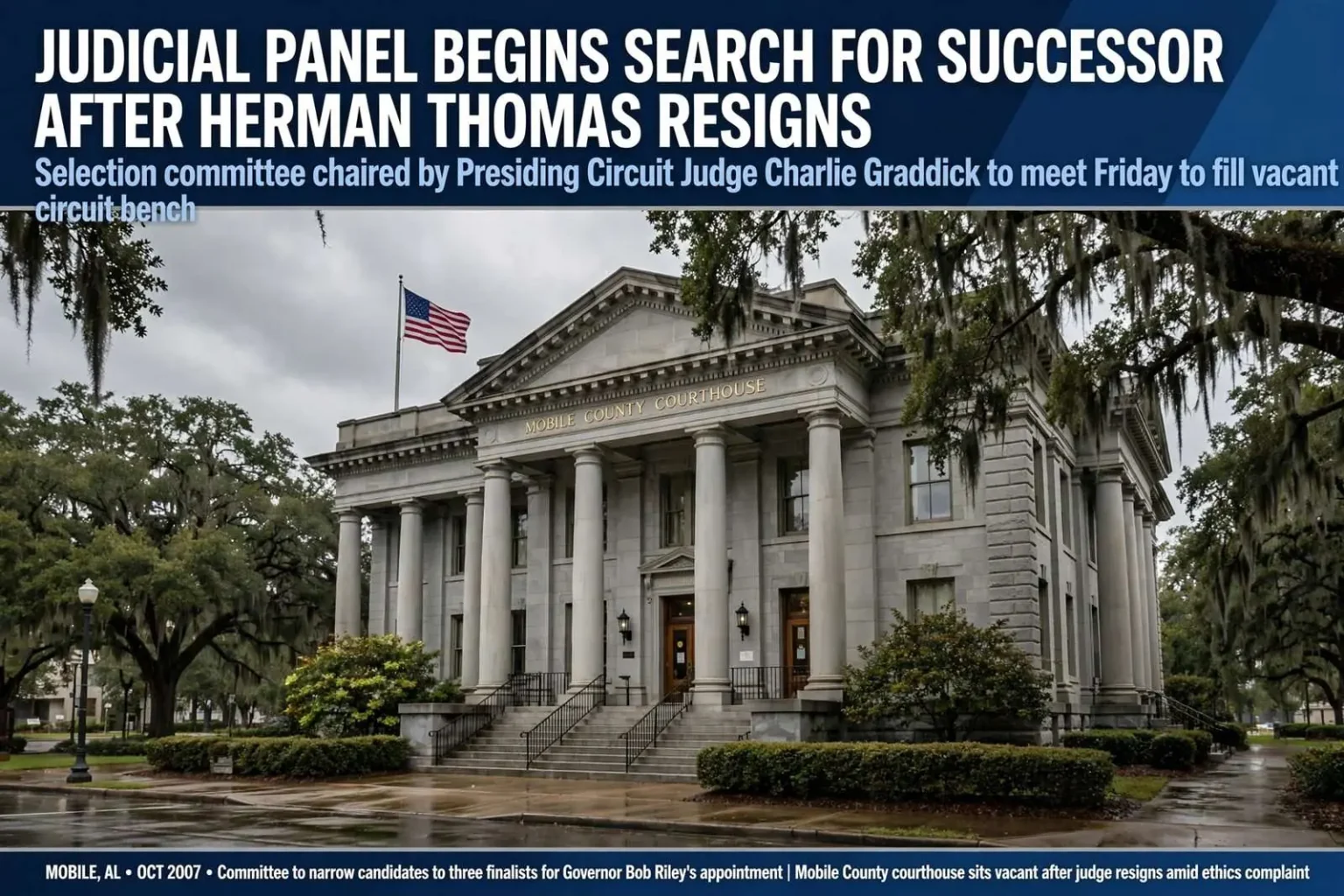
A judicial selection committee chaired by Mobile County Presiding Circuit Judge Charlie Graddick prepared to meet to begin the work of replacing Herman Thomas, who resigned from the circuit bench days earlier under the weight of a mounting ethics complaint and an active criminal investigation.
There was an irony in the assignment that nobody in the Mobile County courthouse missed: Thomas himself had chaired the judicial selection committee.
The departure of a sitting circuit judge under an ethics cloud is a rare event even in a legal community as large and politically active as Mobile’s, and the circumstances made Thomas’s exit one of the most closely watched judicial stories in the county’s modern history. A circuit judgeship in Alabama carries six-year terms, broad trial jurisdiction — felony criminal cases, major civil disputes, domestic relations and equity matters — and, in Mobile County, one of the state’s heaviest caseloads. Filling such a seat through appointment, rather than election, placed the decision in the hands of a small committee, a governor and, ultimately, the voters.
The ethics complaint and criminal investigation that shadowed Thomas’s final weeks in office were public knowledge in the courthouse, where rumor and court filings travel at the same speed. His resignation, offered before the machinery could force the question, spared the county a formal removal fight but left the seat vacant mid-term — and left the county’s bench, bar and voters facing the selection process that follows.
How the Seat Would Be Filled
The county’s judges met and tapped Graddick to head the panel. Its other members were attorneys Ken Nixon and Billy Bedsole, former Revenue Commissioner Freda Roberts and Sherry Moss.
“The committee will meet Friday to set deadlines for those interested in the appointment,” Graddick said.
The committee’s task was to narrow the field to three finalists. Gov. Bob Riley would then almost certainly appoint one of them. In the unlikely event the governor let more than 90 days pass without choosing, the appointment would fall to Chief Justice Sue Bell Cobb of the Alabama Supreme Court, a Democrat — a wrinkle that gave the Republican governor every incentive to move promptly.
Alabama’s judicial vacancy process gives the sitting judges of a county the first move in filling a mid-term circuit vacancy: they convene, elect a chair, and assemble a mixed panel of lawyers and lay citizens to screen applicants. The three-name shortlist that results goes to the governor, whose party — Republican in Riley’s case — held every courthouse seat it could. The 90-day rule is the statute’s pressure mechanism: dawdle, and the choice passes to a chief justice of the other party. For a Republican governor in a county as Republican as Mobile, the math was simple.
Whoever took the seat would have to stand for election in 2008 to serve the remaining four years of the six-year term Thomas won in 2006. That electoral reality shaped everything about the appointment. A governor’s pick would not merely take the bench; that person would immediately become an incumbent candidate, facing the county’s voters — and potentially a challenger — in the next cycle. The selection committee knew that its finalist list was, in effect, pre-endorsing a future campaign, and applicants knew the appointment was a fast track to a judicial career if they could win in 2008.
Graddick’s chairmanship carried its own weight. The presiding judge of Mobile County’s circuit court administers the county’s trial docket and speaks for its bench, and a panel under his gavel signaled that the process would be conducted with the county’s judicial establishment firmly in charge — a reassurance to applicants worried about politics, and a warning to anyone hoping the seat would be filled outside normal channels.
A Long List of Names
The names in circulation reflected how attractive a circuit judgeship is in a legal community the size of Mobile’s. Among those mentioned were Mobile County District Judge George Hardesty; Randy Crane, in private practice; Ashley Rich Hurt, a veteran assistant district attorney; Mark Erwin, an assistant Mobile County Commission attorney and chairman of the local Republican Party; municipal judge Shelbonnie Hall; part-time municipal judge Matt Green; James Brandyburg; longtime prosecutor Tom Harrison; John Williams, a recent Republican legislative candidate; juvenile district judge George Brown; Andrea Pennington, longtime referee at the Strickland Youth Center; and other names that continued to surface as the deadline approached.
The breadth of that list — trial judges, prosecutors, municipal judges, party officials, private practitioners and juvenile court veterans — shows what a circuit seat is worth in Mobile. A district judgeship handles misdemeanors and smaller civil matters; a municipal judgeship is part-time by design; but a circuit bench position offers full trial jurisdiction, a higher salary, and the prestige that comes with presiding over the county’s most serious cases. Attorneys who spent careers building toward such a seat rarely let one pass without weighing an application, and the panel expected applicants from every corner of the courthouse.
Each name on the list brought a distinct credential. Sitting district judges like Hardesty and Brown had already won countywide or district elections and knew the trial bench from the inside. Prosecutors such as Rich Hurt and Harrison carried trial experience that voters and lawyers alike prize in a circuit judge. Erwin’s dual role — county commission counsel and county GOP chairman — made him the establishment Republican candidate in a process run under a Republican governor. The municipal judges, Hall and Green, had judicial experience within the city’s courts, while Pennington’s years as referee at the Strickland Youth Center represented the juvenile side of the county’s justice system.
The committee’s screening process would test each applicant on the things judicial selection actually weighs: trial experience, temperament, ethical record, community standing and electability in 2008. In Mobile County, where judicial races are contested and expensive, the last criterion is never minor — an appointee who cannot win re-election is a short-term solution, and governors and committees alike prefer to appoint candidates who can hold the seat.
The Vacancy’s Context
Thomas’s resignation left more than an empty courtroom. A departing judge’s docket — pending criminal trials, civil cases, family court matters — must be redistributed among the sitting circuit judges, adding load to a bench already carrying one of Alabama’s busiest caseloads. Mobile County’s circuit court handles tens of thousands of filings a year across its divisions, and every vacancy ripples through scheduling, jail transport, jury pools and the attorneys with cases set before the departed judge.
The circumstances of the exit also weighed on the institution. A judge who leaves under an ethics complaint and a criminal investigation leaves questions — about cases he handled, about the court’s oversight, about what the investigations would find — that the county’s legal community discussed for months. The Alabama State Bar’s disciplinary machinery and any criminal process would run their courses independently of the selection committee, but the shadow they cast shaped how carefully every step of the replacement process was documented.
Judicial ethics in Alabama are governed by the canons adopted by the state’s Supreme Court and enforced through the Judicial Inquiry Commission and the Court of the Judiciary — bodies that can reprimand, suspend or remove a judge. An ethics complaint pending at the time of resignation placed Thomas’s conduct within that machinery, and the bar’s parallel disciplinary process could reach his law license. The separation of those proceedings from the appointment process was itself a discipline the county’s lawyers watched closely.
For the applicants, the episode cut both ways. A seat opened by scandal is a seat with a story, and the lawyer who wins it will spend years answering questions about the predecessor. But it is also a seat that confers the full authority of the circuit bench — and, with a 2008 election looming, the chance to convert an appointment into a durable judicial career. That combination explained the length and quality of the list the committee would soon have to cut to three.
Graddick’s own standing in Mobile’s legal history framed the process. The Graddick name has been part of Alabama law and politics for generations, and Charlie Graddick’s tenure as the county’s presiding circuit judge made him the natural choice to lead a panel whose work would be scrutinized by every lawyer in town. Committees of this kind succeed or fail on credibility — applicants must believe the screening is fair, the governor must trust the shortlist, and the public must see a process untainted by the scandal that created the vacancy.
The mixed composition of the panel — two practicing attorneys, a former state revenue commissioner and a citizen member — reflected Alabama’s tradition of blending professional and lay judgment in judicial selection. Lawyers can evaluate trial skill and legal knowledge; lay members contribute the perspective of the citizens who appear before the bench as jurors, litigants and families. Freda Roberts’ service as revenue commissioner brought state government experience to the table, and the attorneys’ practice backgrounds connected the panel to the bar it was screening.
The committee’s Friday meeting would set the machinery in motion: filing deadlines, application requirements and the interview calendar. Judicial selection at this pace — a vacancy declared, a committee seated, deadlines set within days — is typical of Alabama’s system, which treats mid-term judicial vacancies as matters to resolve quickly so the docket does not languish. The three finalists would emerge after interviews and deliberation, and the governor’s office would take it from there.
What happened after the appointment would belong to the voters. The 2008 election would give Mobile County’s electorate the chance to ratify or replace the governor’s choice, and the county’s judicial races — often among the most expensive and contested down-ballot contests in Alabama — would decide whether the seat stabilized or reopened. Between the committee’s Friday meeting and that election lay the whole life of the appointment: interviews, a shortlist, a governor’s signature, a swearing-in, and a new judge learning one of the heaviest trial dockets in the state.
For Mobile County’s courthouse, the episode was a test of institutional composure: a judge gone under a cloud, a selection process running in public, a governor watching, and a list of applicants longer than the committee could ever seat. The system built for exactly this moment — county judges convening, a mixed panel screening, three names forwarded — was now running in real time, under the gavel of the same presiding judge whose committee the departing judge had once chaired.