Mobile County Sheriff’s Booking Page Returns to Full Speed After a Data-Scraping Bot Bogged It Down
The Mobile County Sheriff's Office restored its 24-hour booking page after a third-party site's automated code repeatedly hammered the system, slowing access to public mugshot records.
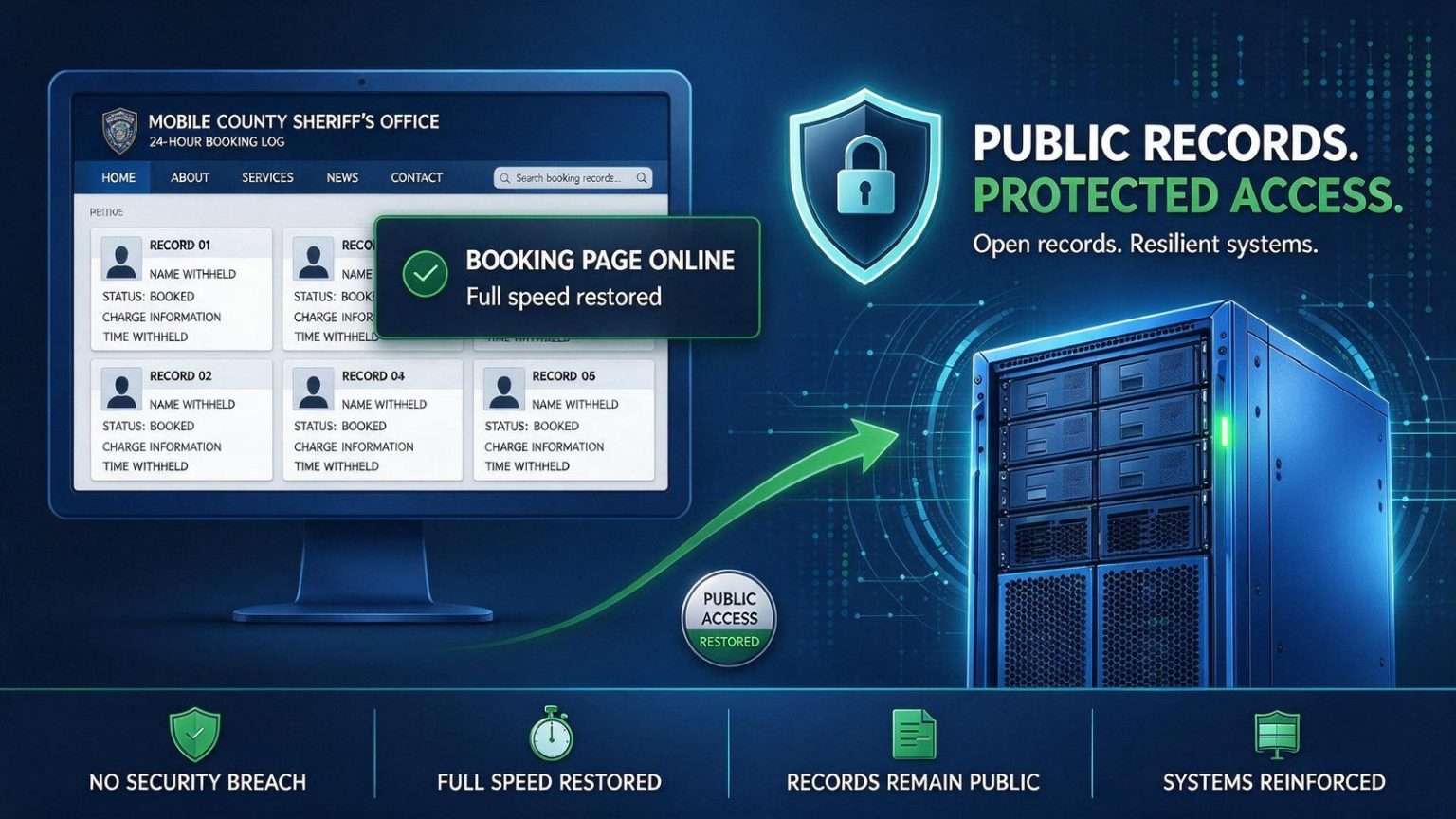
The Mobile County Sheriff’s Office said its website was working normally again after the agency temporarily took down its 24-hour booking section to examine a slowdown traced to an outside site’s automated data collection. The episode, resolved without any indication of a security breach, offered a behind-the-scenes look at what happens when the public’s right to see arrest records collides with software that wants those records at machine speed.
Sheriff’s spokeswoman Lori Myles said the booking page had to be evaluated after a third-party site’s code repeatedly struck the office’s system, degrading performance for everyone trying to reach it. The 24-hour booking section — the page where residents look up who has been arrested, on what charges, and when — is one of the most-visited parts of the sheriff’s website, which meant that whatever slowed it down slowed down a service a lot of people rely on every day.
What Slowed the System
According to Myles, the outside operator had written code designed to pull specific details off the office’s mugshot listings. The sheriff’s office maintains firewalls meant to protect that data, and when the code failed to retrieve what it wanted, it kept hitting the same page again and again in an attempt to break through. “It causes the system to slow down because there’s a continuous hit on that page,” Myles said.
She described the technique of trying to route data automatically into another website in a particular layout as a form of screen scraping. Screen scraping sits in a gray zone of the modern web: automated programs, sometimes called bots or crawlers, pull content from public pages and republish it elsewhere, usually in a new layout wrapped in the harvesting site’s own advertising. When the scraper meets a firewall or a page structure it can’t parse, it often retries in a loop — and a loop running every few seconds against a county server adds up to a denial-of-service problem the county never asked for.
Myles stressed that the mugshots themselves are public information and can be used from the sheriff’s website. The difference, she said, was that the outside site wanted the images in a specific format bundled together with names and charges, and its method of extracting them placed a heavy, repeated load on the county’s servers. In other words, the dispute was never about whether the public could see the records — it was about whether one operator could strip-mine them at a volume that broke the machinery of publication for everyone else.
How the Problem Surfaced
The issue came to the office’s attention, Myles said, after someone noticed that a person’s charges listed on the third-party site did not match the charges shown on the official sheriff’s page. That discrepancy prompted a closer look at how the outside operation was gathering its information. Mismatched data is more than an inconvenience in the booking-record business: a person shown with the wrong charges on a widely viewed mugshot site can suffer real reputational harm, which is one reason agencies care about the integrity of how their listings get republished.
When the booking page was first restored, it did not allow the mugshot images to be copied and pasted. Myles said that restriction was not intentional. After the site was checked and brought back online, she adjusted the settings so the images could again be copied. The correction matters for transparency — an arrest record the public can see but not copy is only half a public record — and the office moved quickly once it understood the setting had changed.
Public Records in a Digital Age
The episode highlighted a recurring tension for law enforcement agencies that post arrest information online. Booking photos and charges are public records, and the sheriff’s office made no move to withhold them. But the automated harvesting of those records, at high volume and in real time, can strain the very systems meant to make the information available to residents.
Agencies across the country have run into the same problem from different directions. Mugshot republishing became a minor industry in the internet era: sites scrape jail rosters, publish the photos, and monetize them through advertising — or, more controversially, through removal fees charged to people who want an embarrassing photo taken down. Several states have since passed laws restricting that removal-fee model, and some sheriffs’ offices have simply stopped posting mugshots altogether. Mobile County’s office, under the approach Myles described, chose a middle path: keep publishing, keep the records public, and manage the technical load.
The balance is a genuinely technical one. A county server has finite capacity, and every request an automated scraper makes is a request that competes with a resident trying to check the booking log. Rate limiting, caching and firewall rules can absorb much of the abuse, but tuning those controls without blocking legitimate public access takes the kind of trial and error the sheriff’s office just went through in public.
Where Things Stood
By the time the office had finished its review, the third-party site involved was no longer displaying mugshots, at least as of that Thursday morning. Whether that represented a permanent stop or a pause in the operator’s schedule was unclear, and the sheriff’s office made no prediction about whether the scraping would resume. The sheriff’s own booking section, meanwhile, was again loading at full speed, allowing the public to look up recent arrests without the delays that had prompted the shutdown.
For the Mobile County Sheriff’s Office, the incident amounted to a maintenance matter rather than a security breach, resolved once the source of the strain was identified and the page was reinforced. No arrests were affected, no records were lost, and no indication emerged that anything beyond website performance had been touched.
Myles said the goal throughout was to keep the booking information accessible to the public while protecting the office’s systems from being overwhelmed. That is likely to remain the standing policy: the 24-hour booking page will stay up, the mugshots will stay public, and the office will keep adjusting its defenses as long as outside code keeps knocking. For residents, the practical takeaway is simpler — the booking log is back, it is fast, and the images on it can be copied and used as the public record they are.
The Booking Log’s Role in the Community
It is worth pausing on why the booking page matters enough to protect. In Mobile County, the 24-hour booking log is a daily habit for a wide range of users: families checking on relatives who did not come home, defense attorneys tracking overnight arrests, journalists covering the courts, bail bondsmen, and neighbors who want to know what the police activity on their street last night actually was. Before agencies began publishing rosters online, that information required a phone call or a trip to the county jail — a barrier that kept public records out of public hands in practice if not in law.
Putting the roster online changed that overnight, and it changed the audience. A booking record once seen by whoever visited the jail now travels instantly, screenshotted and shared. The sheriff’s office has no control over that afterlife, and it did not seek one here; the principle at stake was narrower. The county publishes the record; the public may use it; but nobody is entitled to tax the county’s servers with automated machinery to republish it for profit at a volume that degrades the service.
That principle is being worked out agency by agency across the country, usually in exactly this fashion — a slowdown, an investigation, a firewall adjustment, and a policy clarified after the fact. Some jurisdictions have responded with formal rules limiting automated access, terms of service that prohibit scraping, or technical measures that throttle anyone pulling data at superhuman speed. Others, like Mobile County, handle the problem as it arrives, case by case.
What Residents Should Know
For the everyday user, the takeaway from the episode is reassuring in both directions. First, the county’s records remain as open as they were before: the booking page lists arrests as they happen, the mugshots can be viewed and copied, and the office has committed to keeping it that way. Second, the slowdown that interfered with the page was traced, explained and resolved — a working example of county government diagnosing a problem and reporting plainly on the cause, rather than letting the service quietly degrade.
Residents who spot errors in the booking log have a straightforward interest in reporting them, as the mismatched charges here illustrate. An arrest record that travels to third-party sites with wrong information attached can do damage that is hard to undo, and the official page is the source of truth that other sites should be measured against. When the official record and a scraper’s copy disagree, the discrepancy is worth flagging — it was exactly the kind of report that led to this investigation.
As for the third-party operation at the center of it all, its silence — at least as of Thursday morning — may or may not last. Scraper operators come and go, and a sheriff’s office that fends one off often finds another knocking before long. What has changed permanently is the county’s preparation: the page has been examined, the firewalls tuned and the copy-paste settings confirmed, so that the next round of automated knocking lands on a system already braced for it. The public record stays public; the server stays up; and the difference between a citizen reading the booking log and a bot strip-mining it is now, on Mobile County’s website, a line that has been tested and enforced.