Mobile County Constable Jailed on Murder Charge After Fatal Shooting Outside Spanish Fort Club
A 68-year-old Mobile County constable was booked into the Baldwin County jail on a murder charge after a fatal shooting in the parking lot of a club along the Causeway in Spanish Fort, police said.
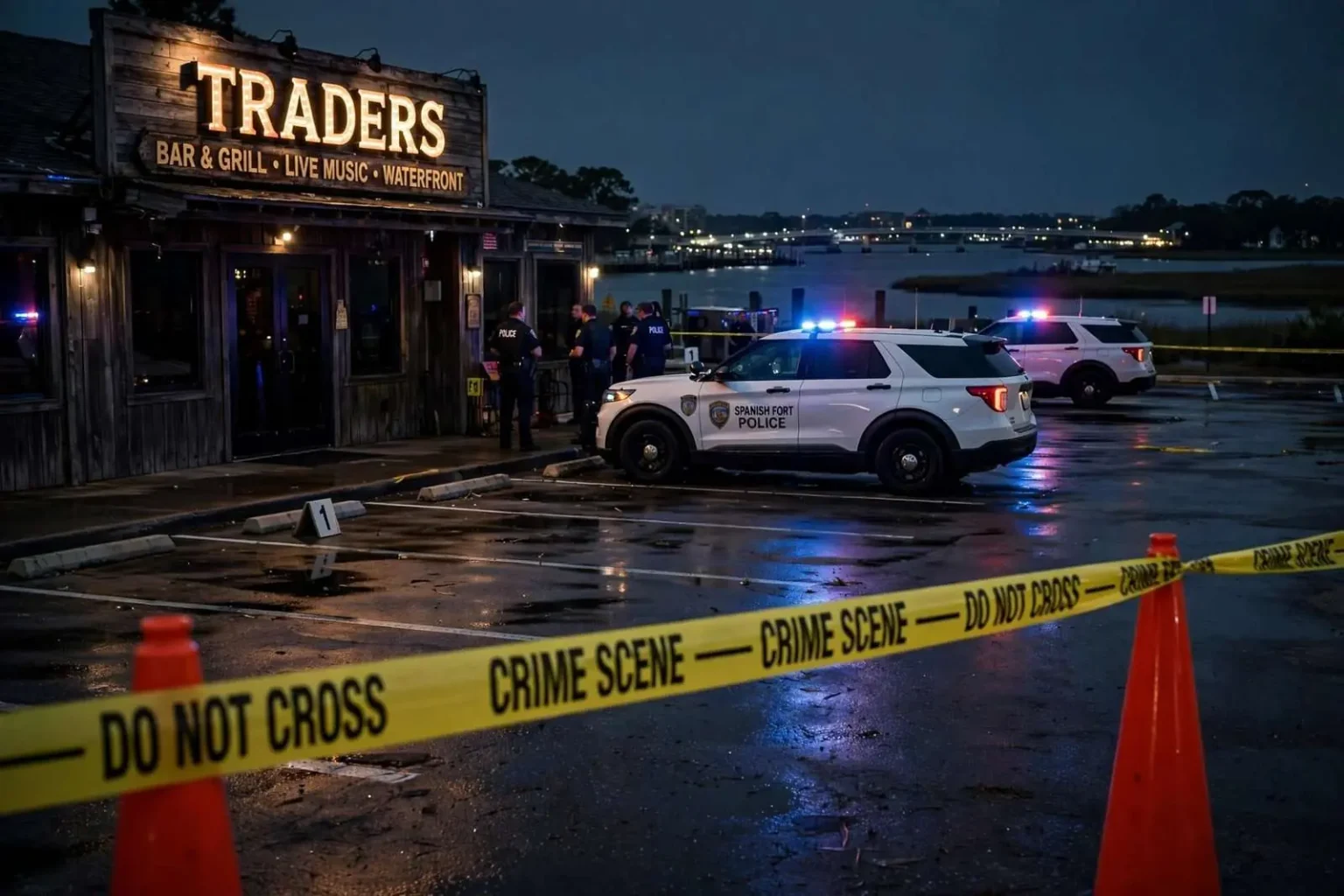
A Mobile County constable was arrested and charged with murder after a late-night shooting in the parking lot of a club along the Causeway in Spanish Fort, according to police.
Spanish Fort Police Chief David Edgar said officers were called shortly after midnight Sunday to a report that a person had been shot outside Traders, a club that sits on the Causeway. When officers arrived, they found 52-year-old Jeffrey Carter McMillan dead in the parking lot.
Suspect remained at the scene
Edgar said the man suspected of firing the fatal shot stayed at the scene and was identified by officers as 68-year-old Larry Lambert Sheffield of Semmes. According to the chief, Sheffield identified himself as a Mobile County constable. Records kept by the Mobile County Constables Association listed a constable of the same name as serving Precinct 24.
Investigators believe the confrontation began inside Traders, the chief said, though officers received conflicting accounts of whether it started as a verbal dispute or a physical one. Whatever its origins, the altercation spilled out of the building and into the parking lot, where it turned physical.
A single shot at close range
According to Edgar, Sheffield produced a semi-automatic handgun during the struggle and fired one round at close range, striking McMillan in the head. The chief said three or four bystanders were in the parking lot when the shot was fired, and roughly 20 people were inside the club at the time.
Sheffield was taken into custody at the scene and charged with murder, Edgar said. He was transported to the Baldwin County jail, where booking records showed he was processed in the early afternoon Sunday.
The quick arrest reflected the circumstances officers found when they arrived. There had been no search for a fleeing suspect: the man identified as the shooter had remained in the lot, witnesses were present on both sides of the club’s doors, and the physical evidence — the location of the struggle, the shell casing, the position of the victim — could be documented while the scene was fresh. Patrol officers secured the parking lot, detectives began reconciling the accounts given by the bystanders and the patrons inside, and the case moved from a midnight emergency call to a formal booking inside a day.
Questions about a prior record
Corrections records reviewed after the arrest indicated that a man by the same name had previously been booked into the Baldwin County jail in July 1999. Edgar confirmed the earlier booking but said the nature of those charges was not clear from the available records.
The finding underscored a familiar reality of record-keeping across county lines. An arrest history that stretches back years — and across the boundary between Baldwin and Mobile counties — can be slow to reconstruct, and officials declined to characterize charges that the available documentation did not clearly support. The earlier booking entered the case as a question for investigators, not as an established fact about the suspect’s history.
A jolt through a quiet city
The killing sent a jolt through Spanish Fort, a Baldwin County community better known for its shopping district and quiet neighborhoods than for violent crime. The Causeway, the low ribbon of roadway that carries traffic across the head of Mobile Bay, is dotted with restaurants and clubs that draw patrons from both sides of the bay, and the shooting drew immediate attention on both shores.
The Causeway’s nightlife geography explains the reach of the news. The corridor’s waterfront venues sit minutes from Spanish Fort and Daphne on the eastern shore and from the Blakeley River communities and Mobile on the western side, so a late-night shooting there is, in effect, a two-county story — patrolled by Baldwin County officers but drawing a crowd assembled from the entire bay area’s Sunday-night circuit.
What a constable is in Alabama
Constables in Alabama are elected peace officers who serve at the precinct level, a position rooted in the state’s older county government structure. Their duties have historically centered on serving court papers and assisting with civil process rather than routine patrol work, and the office carries limited law-enforcement authority.
The office is among the least visible in Alabama county government. Constables appear on county ballots in races many voters scroll past, and their day-to-day work — delivering subpoenas, executing civil papers, assisting courts with process — rarely generates headlines. That invisibility is part of why the case drew such attention: a citizen encountering a constable might never know the office’s actual scope, and the man charged in the shooting had identified himself by a title most residents could not place on the spectrum between full police powers and ceremonial office.
The precinct structure adds another layer of obscurity. Alabama counties are divided into numbered constable precincts, and the Mobile County Constables Association’s records — which listed a constable of the same name as serving Precinct 24 — are among the primary public means of connecting a name to a post. The title carries whatever authority state law grants it, but it does not place its holder on a police payroll, does not issue patrol cars and does not, in ordinary circumstances, put a constable at the scene of a bar dispute in a neighboring county.
The fact that the man charged in the case identified himself as a constable added an unusual dimension to what authorities otherwise described as a confrontation between two patrons.
Police were careful, in their public account, to keep that dimension in proportion. Nothing in the chief’s description of the night — a dispute inside a club, a struggle in a parking lot, a single shot — suggested the office held any role in what happened. The constable identification became a detail of the suspect’s background rather than a feature of the crime, a distinction investigators took care to preserve even as the unusual title guaranteed the case its headline.
The investigation ahead
Police did not release additional details about McMillan or about what may have prompted the dispute inside the club. Chief Edgar said the investigation was continuing and that officers were working to reconcile the differing accounts offered by witnesses in and around the building.
The reconciliation work would determine much of the case’s course. Investigators had a suspect in custody, a weapon and a clear account of the fatal shot, but the question that shapes a murder prosecution — how the confrontation escalated, and who did what first — rested on witness accounts that began as conflicting stories of a verbal versus physical start inside Traders. Detectives would spend the days that followed walking patrons and bystanders back through the sequence, comparing what each saw from inside the club and out in the lot.
As of the booking Sunday afternoon, Sheffield remained in the Baldwin County jail on the murder charge. Formal proceedings in the case were expected to follow in Baldwin County, where the shooting occurred.
The venue was never in doubt. The Causeway at Spanish Fort sits squarely in Baldwin County, placing the crime, the prosecution and the court proceedings in the county whose jail booked the suspect — a case that began with a midnight call to Spanish Fort police and moved, by Sunday afternoon, into the Baldwin County justice system entirely.
Sunday night on the Causeway
The Causeway occupies a peculiar place in the bay area’s social geography. The old highway — predating the interstate tunnels that now carry most through-traffic across Mobile Bay — runs low along the water at the head of the bay, its length lined with docks, seafood kitchens, dive bars and clubs that trade on sunset views and an unhurried, waterside atmosphere. On weekend nights the corridor draws a mixed crowd: boaters tying up at waterfront decks, regulars from both shores, and travelers cutting between Mobile and the Eastern Shore who treat the slow road as a destination rather than a route.
For Spanish Fort police, that geography defines a distinctive patrol problem. The Causeway venues sit inside the city limits but operate late into the night, at the far edge of town along a roadway that connects two counties, and incidents there routinely involve patrons from Mobile County rather than the city itself. A midnight call to one of the clubs brings officers to a crowded lot at the water’s edge, where the witness pool is as likely to include residents of Mobile as of Baldwin County.
How the case proceeds from booking
A murder charge initiates a defined sequence in Alabama’s court system. Following booking, the case moves through an initial appearance before a district judge, where the defendant is formally advised of the charge and bond is addressed; preliminary proceedings follow, in which the state must show sufficient cause to bind the case over to a grand jury. Each stage unfolds on the Baldwin County docket, in Bay Minette, far from the waterfront parking lot where the case began.
The prosecution’s file will be built from the elements police documented in the hours after the shooting: the physical evidence collected in the lot, the semi-automatic handgun recovered at the scene, the accounts of the three or four bystanders who witnessed the fatal shot and the roughly twenty patrons inside the club whose statements trace where the confrontation began. Investigators tasked with reconciling conflicting accounts of the dispute’s start will be reconstructing the timeline minute by minute — who entered the lot first, when the struggle began, how the handgun came to be drawn.
For the victim’s family, the proceedings will replay a night they already know in outline. McMillan, 52, was found dead in the parking lot of a club he had apparently been visiting like any other patron on a Saturday-night-turned-Sunday; what detectives released publicly about him was limited, and the fuller picture of his life was left to those who knew him rather than to the case file.
When a badge is a background detail
The case’s most lingering public question — what a constable was doing with a gun in a bar parking lot — has, on the facts released, a plain answer: the office was the suspect’s, not the crime’s. Alabama law authorizes constables to carry firearms under the same provisions that govern other citizens, and nothing in the chief’s account suggested the identification Sheffield gave officers was anything other than a statement of who he was. The unusual title guaranteed attention; it did not change the charge.
That distinction is worth holding onto as the case moves through the Baldwin County courts. The charge is murder — the deliberate taking of a life in a parking lot dispute, witnessed by strangers and documented by patrol officers who arrived to find the suspect still standing at the scene. The offices, precincts and titles that surround the story are context. The case itself will turn on what happened inside Traders, what happened in the lot, and what the witnesses to both saw when a Saturday night dispute became a killing.