Spanish Fort Settles Five-Year Bluff Erosion Lawsuit, Will Buy Threatened Homes
Spanish Fort resolved a long-running lawsuit over an eroding Mobile Bay bluff by agreeing to buy two threatened homes and fund repairs.
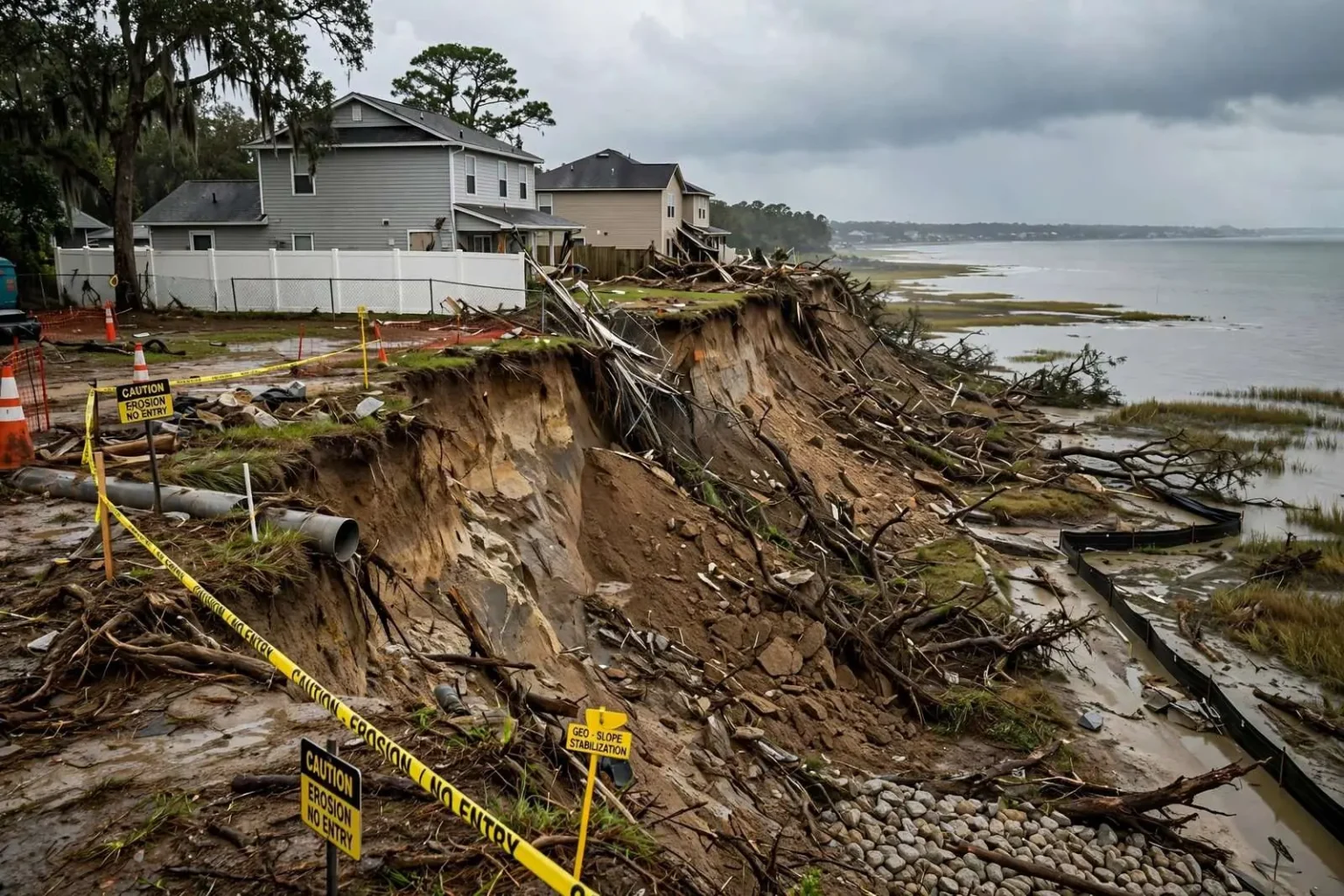
The city of Spanish Fort has brought an end to a five-year legal battle over a collapsing bluff along Mobile Bay, agreeing to purchase two homes on Patrician Drive whose backyards had been steadily swallowed by erosion. Combined with repair costs, legal fees, and other professional services, the total price tag for resolving the dispute is expected to top $2.5 million.
The dispute traced back to 2009, when homeowners in the Spanish Fort Estates neighborhood sued the city over a failing drainage system that ran between two properties on Patrician Drive. Over the following years, the broken drainage system caused more than 30 feet of bluff to collapse into the bay, edging dangerously close to the homes themselves.
A Baldwin County jury eventually sided with the homeowners, finding that the city had failed to properly maintain the drainage system responsible for the erosion. Jurors initially awarded more than $1.3 million for property loss and emotional distress, though a state municipal liability cap reduced that award to $500,000.
Following the verdict, a judge ordered the city to begin emergency repairs immediately, even as Spanish Fort pursued an appeal to the Alabama Supreme Court. Contractors were brought in under an emergency agreement worth more than $800,000 for construction work, with additional engineering services adding tens of thousands more to the bill.
The Storm That Turned Urgency Into Crisis
Before repairs could get fully underway, a record-setting rainstorm in late April dramatically worsened the situation, eroding the bluff to within just a few feet of one home’s foundation and chewing away more of the neighboring yard. The emergency prompted the city to bring on an additional geotechnical firm specializing in slope stabilization to help contain the crisis.
The storm reset the entire project. Plans drawn up for controlled, phased repairs assumed the bluff would hold its position while crews worked; instead, the slope retreated in a matter of hours, forcing engineers to reassess the site and the city to find specialists who could respond to an active failure rather than a slow-moving one.
Geotechnical firms that work on slope failures examine soil composition, groundwater movement and drainage patterns before recommending fixes, and the additional firm brought that expertise to bear on a bluff that had now absorbed both years of unchecked runoff and a record rainfall event. The layered response — an emergency construction agreement, follow-on engineering services and a slope-stabilization specialist — shows how a maintenance dispute escalated into one of the costliest engineering problems the small city has faced.
Rather than continue pouring money into repairs while litigation dragged on, city officials ultimately negotiated a settlement in which Spanish Fort will purchase both affected properties outright while also completing the necessary bluff stabilization work.
The mayor described the outcome as a practical resolution that allows the city to move forward, though he declined to disclose the specific purchase price for the homes ahead of a closing scheduled for the following week. The details of the transaction will become part of the city’s records after closing, but officials characterized the buyout as the capstone of a settlement that resolves the judgment, ends the appeal and secures the bluff in a single package.
For the Spanish Fort Estates neighborhood, the resolution closes a chapter that began when residents first noticed the drainage ditch between the two lots failing to carry stormwater the way it was designed to. What followed — a lawsuit, a jury trial, a capped judgment, an appeal, emergency contracts and finally a record storm — stretched across five years and reshaped how the city approaches the infrastructure that hugs its bayfront rim.
Why the Bluffs Fail
The bluff line along Spanish Fort and the rest of Mobile Bay’s Eastern Shore is inherently vulnerable. Sedimentary soils left over from ancient coastal deposits sit in steep slopes above the bay’s wetland fringe, and they hold together only as long as water is managed. When drainage fails — a blocked ditch, a cracked pipe, an outfall that discharges onto the slope face — water percolates into the soil, weight builds up, and the bluff face begins to slough away from the bottom up.
That process is slow and easy to underestimate. The more than 30 feet lost beneath the Patrician Drive homes accumulated over years of intermittent failures, each rain event taking a bite that seemed manageable until the cumulative retreat threatened structures. The late-April storm then compressed years of erosion into days, which is why the emergency response — and eventually the buyout — followed so quickly after it.
Age is the other half of the problem. Drainage systems installed decades ago, when the neighborhoods along the bluff were built, were sized for the rainfall patterns and development densities of their era. As Baldwin County added rooftops, driveways and roads across the uplands, more water arrived at the old systems faster, and components that were never replaced began to fail beneath the weight of modern runoff.
The episode highlights the ongoing challenges Baldwin County’s bayfront communities face as aging infrastructure meets increasingly severe weather events. Spanish Fort, like other municipalities along Mobile Bay’s eastern shore, has faced growing scrutiny over stormwater systems as erosion and heavy rainfall put waterfront properties at greater risk.
Communities across the Eastern Shore — Spanish Fort, Daphne, Fairhope and the unincorporated stretches between them — share the same basic geography: rim neighborhoods perched on bluffs, drainage networks of vintage infrastructure underneath, and a bay at the bottom that takes whatever the slopes give up. An engineering failure in one city is a case study for its neighbors, and the Patrician Drive dispute has already drawn attention from officials who see their own ditches and slopes in the story.
The financial anatomy of the case is instructive for those officials. The emergency construction agreement alone topped $800,000, engineering services added tens of thousands more, legal fees accrued across five years of litigation, and the purchase of the two homes pushed the total past $2.5 million. Set against the original dispute — a drainage line between two lots — the multiplier shows how maintenance problems compound once they enter the courtroom and the emergency-response cycle.
The settlement structure itself offers a template. By bundling the property purchase, the resolution of the capped $500,000 judgment and the withdrawal of the Supreme Court appeal into one agreement, the city avoided the alternative paths: years more litigation with uncertain outcome, or open-ended spending on stabilization around homes that could never safely be reoccupied.
Work on the bluff will continue under the city’s contracts, with the stabilization designed to hold the slope above the bayfront highway corridor for the long term. Once crews finish, the two lots join the small inventory of permanently protected land along the Eastern Shore rim — ground that development can never reclaim, purchased at the price of one city’s hardest-learned lesson in stormwater maintenance.
The emotional-distress element of the jury’s award also set the case apart from a routine property dispute. Living above an actively collapsing bluff — watching each storm move the edge closer to the back door — took a documented toll on the two families, and jurors accounted for it alongside the property loss. City officials who later explained the buyout decision often returned to that human dimension: no settlement structure was fair that left the families in homes they could not safely occupy, and no repair timeline could guarantee the slope would hold long enough to relocate them.
Behind the scenes, the litigation also consumed years of city administration. Councils changed, budget cycles passed and engineering reports accumulated, all while the drainage issue moved from a neighborhood complaint to a courtroom exhibit. The mayor’s characterization of the settlement as a way to “move forward” reflected that institutional fatigue as much as the arithmetic of repair costs.
The state municipal liability cap that reduced the $1.3 million award to $500,000 remains a recurring factor in cases like this one across Alabama. Cities argue the caps protect taxpayers from bankrupting judgments; property owners counter that the caps insulate municipalities from the full consequences of neglecting maintenance. In the Patrician Drive case, the cap ended up pushing both sides toward the buyout, because neither the capped judgment nor continued litigation delivered the homeowners a livable solution.
What happens to the Spanish Fort Estates drainage system itself will be watched as closely as the bluff. The concrete ditch between the two lots was the failure point identified at trial, and any long-term fix will involve rebuilding that line and verifying the outfalls that carry Eastern Shore runoff down the bluff face. Engineers involved in the stabilization work are expected to address the drainage as part of the permanent design rather than leaving the slope to fend off uncontrolled flow behind a new wall.
For now, the closing scheduled for the following week marks the practical finish line: two homes change hands, the judgment is retired, the appeal is withdrawn and the city’s contractors keep working on the slope. When the stabilization is complete, the bluff above the bayfront corridor will hold — and the green space that replaces the two houses will stand as a quiet monument to what deferred drainage maintenance can ultimately cost.