Baldwin County School Board Unveils $313 Million Spending Plan for 2015
Baldwin County's school board presented a $313 million budget for 2015 during a public hearing at Robertsdale High School.
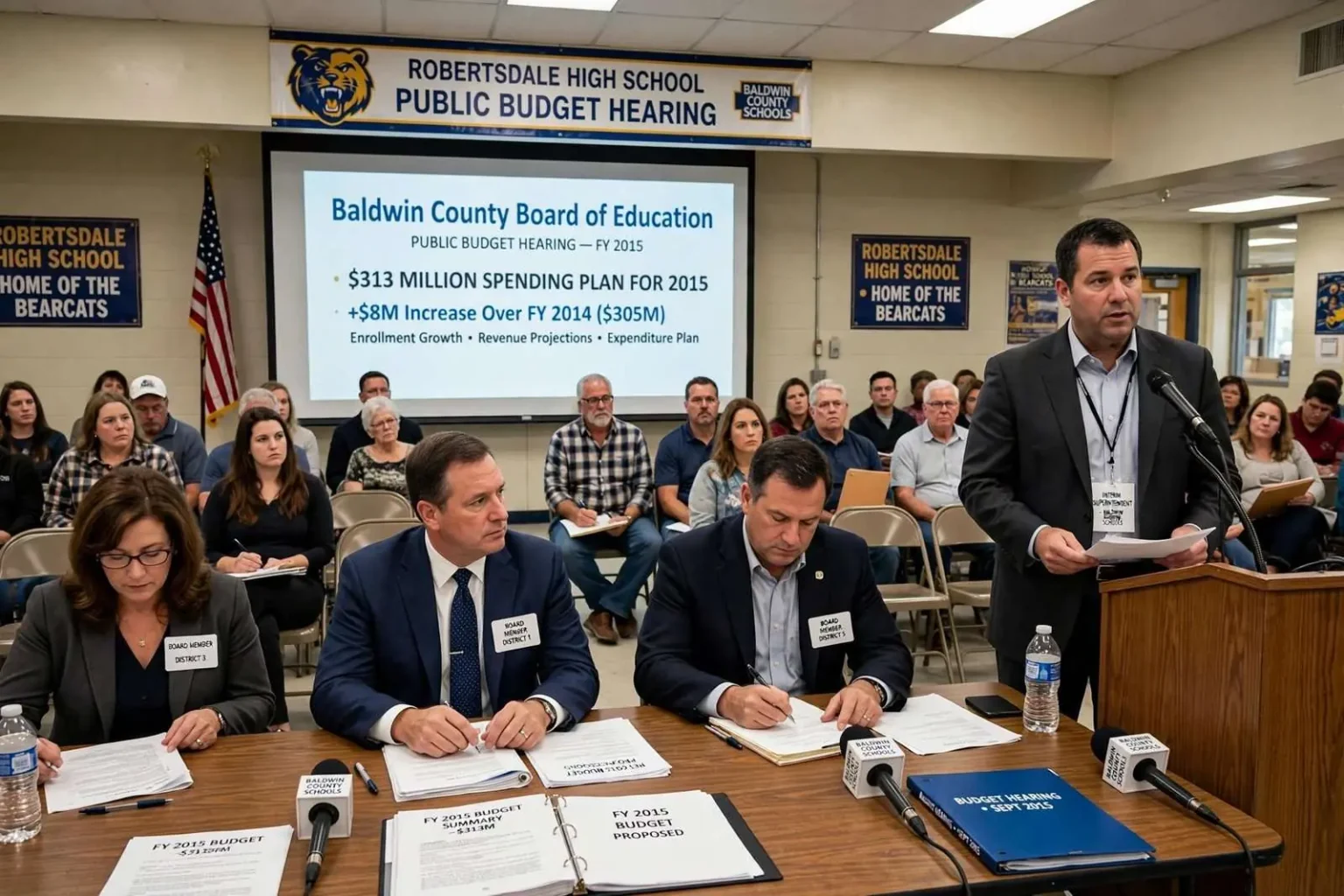
The Baldwin County Board of Education laid out a $313 million spending plan for the 2015 fiscal year during a public budget hearing held at Robertsdale High School. The proposal marks an increase of roughly $8 million over the current year’s $305 million budget, reflecting steady enrollment growth across one of Alabama’s fastest-expanding school systems.
The budget was presented by the district’s newly named interim superintendent, who took on the role earlier in the month and used the hearing as an early public test of the district’s financial priorities. Board members and district staff walked through revenue projections, expenditure categories, and the underlying enrollment trends driving the increased spending.
Holding the hearing at Robertsdale High School followed the board’s practice of rotating public budget sessions into the communities they affect. Central Baldwin has long been one of the district’s growth corridors, and a hearing held in a school building rather than a boardroom puts the budget discussion physically inside the product the budget pays for — a setting that district officials have said they value for the attendance it draws from parents and school staff.
Property Taxes Still Climbing Back
Property tax collections are expected to rise by roughly $3.2 million next year, climbing to about $45.4 million. Even with that increase, the district’s chief financial officer noted that property tax revenue remains well below where it stood before the recession, still down significantly compared to a peak collected around 2008.
The gap tells the story of Baldwin County’s last decade. The county rode the pre-2008 construction boom harder than almost any county in Alabama, and when the housing market collapsed, both property values and the tax base built on them fell away. Even as new subdivisions reappear across the county, assessments recover slowly, because rollback provisions and reassessment cycles mean collections trail market values by years. That gap has forced the district to lean more heavily on state funding and local sales tax revenue to keep pace with growth.
The reliance on sales tax carries its own volatility. Retail receipts move with the tourist economy and consumer confidence, and a single slow hurricane season or economic dip shows up in the collections the district depends on to fund positions. Budget planners have learned to treat sales tax projections conservatively, knowing that an optimistic forecast becomes a mid-year shortfall.
What the Money Would Buy
General fund expenditures are set at roughly $228 million, an increase of about 2.3 percent that district officials tied directly to projected enrollment gains. Baldwin County schools have averaged close to 2 percent enrollment growth annually for well over a decade, a trend that shows few signs of slowing given the county’s continued residential development.
A 2 percent annual growth rate sounds modest until it is compounded across one of Alabama’s largest school systems. Each year’s increase adds hundreds of students — the equivalent of adding an entire new school population every few years — and each new student arrives with the same fixed costs as every other: a teacher’s salary share, a bus seat, a desk and a share of the utilities and maintenance that keep the district’s campuses running.
Salaries and benefits account for roughly two-thirds of the total budget, covering a workforce of more than 3,600 employees across the district’s schools and support offices. That proportion is typical for school systems, where people — not buildings or buses — are the service. It also means that personnel decisions drive the budget more than any other factor: a hiring freeze, a step increase or a change in insurance contributions moves the total more than almost any operational choice available to the board.
State funding is projected to increase modestly next year, while federal revenue is expected to dip slightly compared to the current year. The state’s education budget, financed largely through income tax and sales tax collections, has recovered unevenly from the recession years, and modest increases rarely match the pace at which a growing district adds students. Federal dollars, concentrated in programs for special education, child nutrition and schools serving lower-income populations, arrive with restrictions attached and represent a smaller share of the total.
A local one-cent sales tax dedicated to education is projected to generate nearly $28 million in 2015, money the district uses specifically to fund several hundred teaching and staff positions that would otherwise be difficult to support through property tax and state allocations alone.
That dedicated tax has become the quiet foundation of Baldwin County’s school staffing. By earmarking the penny directly for personnel, the county insulated those jobs from the annual volatility of the state budget — but it also linked them to retail sales, making the positions’ funding a function of consumer spending. District leaders in recent years have pointed to the tax as the difference between the staffing levels families expect and what state and property tax revenue alone would support.
The Growth Equation
The arithmetic of growth dominates the budget discussion in Baldwin County. New rooftops arrive with children attached, and Alabama’s school funding formula follows the students — but with a lag, and without covering the construction, buses and startup costs that precede any per-student funding. A district can grow its way into a shortfall when the cost of absorbing new students arrives faster than the revenue they generate.
Residential development pressures are most intense along the Interstate 10 corridor and the Eastern Shore, where subdivisions keep expanding, but growth has spread to nearly every feeder pattern in the county. The central and southern parts of the county, including the Robertsdale area that hosted the hearing, have seen steady increases of their own, keeping classrooms full and portables in demand well beyond the fast-growing shore communities.
Public Review Comes Next
District officials emphasized that the budget remains a proposal subject to further board review and public input before final adoption. Residents were encouraged to review the full budget document posted on the school system’s website and to attend upcoming board meetings where the spending plan will be discussed further ahead of a final vote.
Alabama law sets the rhythm for that process. School boards must hold public hearings on their proposed budgets before adoption, and the state’s financial reporting calendar pushes districts to finalize their spending plans in the weeks before the fiscal year begins on Oct. 1. The public hearing at Robertsdale is the formal opening of that window, when the numbers on display are still numbers — before final votes make them commitments.
For the interim superintendent, the hearing served as an early demonstration of priorities. Interim leaders inherit budgets drafted by their predecessors and staffed by career finance officers, but the public presentation of a $313 million plan is still the moment a new leader’s understanding of the district becomes visible. Board members watched how the proposal balanced growth spending against revenue caution, and residents watched whether the numbers reflected what they see at their own children’s schools.
The Balancing Act Ahead
The hearing reflected the ongoing balancing act facing Baldwin County schools as they work to keep pace with one of the region’s fastest-growing student populations while managing a tax base still recovering from the previous decade’s economic downturn.
Every year’s version of this budget contains the same structural tension. Enrollment growth demands spending now, in classrooms that exist and students who are already enrolled. Property tax recovery arrives slowly, on a schedule set by assessments and reappraisals. Sales tax arrives quickly but swings with the economy. State funding follows enrollment but always one step behind it. A budget that works means aligning those four clocks — spending, property tax, sales tax and state aid — without letting any of them slip far enough to force mid-year cuts.
District officials will carry that equation into the board meetings ahead of the final vote, where board members typically probe the assumptions behind the revenue projections and press staff on what happens if the numbers disappoint. The published budget document gives residents the same opportunity, line by line, and the board’s public comment periods remain the formal channel for questions about specific schools, positions or programs.
The Interim Transition’s Question Mark
The interim nature of the appointment adds another layer to the process. Budgets adopted under an interim leader bind the district just as firmly as those adopted by a permanent superintendent, which means the board must weigh not only the numbers but the transition itself — whether to lock in multiyear commitments now or leave flexibility for whoever takes the post permanently. How the board handles those choices will say as much about the district’s direction as any line item in the proposal.
What the $313 million proposal makes plain is that growth, for all its benefits, is expensive. Every new subdivision that fills a classroom also generates a claim on the budget, and Baldwin County’s challenge — shared by fast-growing districts across the Southeast — is building the financial capacity to say yes to its own success.